-

How to safely overwinter shiitake mushrooms through summer? These management points must be mastered
The quality of summer management for shiitake mushrooms directly affects yield and profitability. Doing a good job of summer management is a key step in shiitake mushroom production, and two methods can be used: indoor and outdoor. I. Indoor spawn running for summer survival (1) Minimize the number of shiitake bags indoors and the number of bag layers. Stack two bags in a cross pattern, with no more than 5 layers at most, and keep the spacing between stacks at more than 20 cm to facilitate ventilation and heat dissipation. (2) Build a shade canopy outside the window so that sunlight does not shine directly onto the window or indoors. (3) In hot weather, close doors and windows at 7 a.m. to prevent outside hot air from entering indoors, and in the evening
-
Feeding and management methods for autumn lambs to safely overwinter
Sheep estrus and mating occur mainly in spring and autumn, and the gestation period averages around 150 days, so spring and autumn are also the seasons when lambing is more concentrated. According to surveys, the overwintering survival rate of autumn lambs born in various places is significantly lower than that of spring lambs. The main reasons: 1. Environment. When autumn lambs overwinter, they are in the suckling period or weaning period. In winter, green fodder is scarce, forage quality is poor, ewes' milk is insufficient, and lambs are malnourished, weak in constitution, and poor in disease resistance. Moreover, the long dry and cold winter climate very easily causes respiratory infections in lambs, and many lambs die from pneumonia infection. Due to the cold climate
-
Detailed Explanation of Technical Measures for Safely Overwintering Shiitake Mushroom Logs Through Summer
Key Management Points for Safely Overwintering Mushroom Logs Through Summer. Outdoor summering. Outdoor shade shelters have good ventilation and cool down quickly, therefore, using outdoor shade shelters for mycelium running can effectively reduce the occurrence of "mushroom burning." Specific measures taken for summering and mycelium running using outdoor shade shelters: First, build trellises around the shade shelter and plant vine crops such as pumpkins and luffa to improve the shading effect; Second, install automatic rotating tap water sprinklers or spray pipes on the shelter roof, and spray water to cool down from 10 AM to 4 PM every day; Third, dig interconnected trenches 20 cm wide and 30 cm deep around the inside of the shelter and on both sides of the walkways, and run flowing water through the trenches to cool down.
-
Eight preventive measures for bagged shiitake mushrooms to safely overwinter the summer, explained in detail
Based on our investigation and analysis of the summer-survival problems in large-scale bagged shiitake mushroom cultivation in Xixia over more than ten years, we have summarized a set of preventive measures for bagged shiitake mushrooms to safely get through the summer. They are presented below for reference. 1. Prevent contaminated spawn. There are many factors that can cause contamination in spawn, for example: incomplete sterilization of the substrate, lax disinfection during inoculation, introduction of pathogens during inoculation operations, air forced in through the cotton plug, respiration or damage during spawn transport, inoculation with contaminated spawn, and other such reasons. If contaminated spawn is used for production, it can harbor incalculable losses. 1.1
-
How to care for northern azaleas in summer? Detailed explanation of methods for safely getting through summer
Azaleas prefer a cool, humid, well-ventilated environment. Due to the influence of temperature, light, humidity and other conditions in northern regions, azaleas must endure some challenges in the northern summer. If not handled well, multiple diseases can accumulate at once, the leaves can drop completely and the plant can die. So how can it get through the hot summer smoothly? Roughly, the following points should be grasped: Ventilation. Northern azaleas all overwinter in greenhouses. As spring arrives, temperatures keep rising. In early April, the indoor temperature at noon can reach around 28°C, and at this point ventilation should begin
-
How to Safely Transport Live Fish? A Full Breakdown of Practical Methods
1. Sealed transport: Sealed transport places the fish and water in a sealed, oxygen-filled container for transport. Its characteristics are small volume and easy portability; for general adult fish transport, within 8 hours there is no need to change the water midway, the seal is tight, and the survival rate is high. A single oxygen fill can keep fry alive in the container for more than 20 hours, and it is even more convenient for long-distance transport of large quantities of fry and fingerlings. Methods such as oxygen-filled sealed transport in plastic bags and oxygen-filled sealed transport in plastic buckets can be used. 1. Oxygen-filled sealed transport in plastic bags: Fill the plastic bag with clean clear water, with the water volume accounting for 1/3 of the bag's total capacity
-
Management Measures for Pregnant Rabbits to Safely Get Through Summer
In the hot summer, measures should be taken to ensure pregnant rabbits get through the summer safely. 1. Pay attention to heatstroke prevention and cooling. The suitable temperature for pregnant rabbits is 14-16°C. In summer, heatstroke prevention and cooling work should be done carefully to prevent heat stress, which can cause premature birth, miscarriage, or stillbirth in pregnant rabbits. Keep the rabbit hutch cool with air circulation, and build a shade awning over the rabbit hutch. 2. Adjust feed promptly. Hot weather often causes pregnant rabbits to reduce their feed intake. Adjust the feed promptly, increase the proportion of protein and energy feed in the feed, feed more green and succulent feed, and when feed intake is reduced,
-
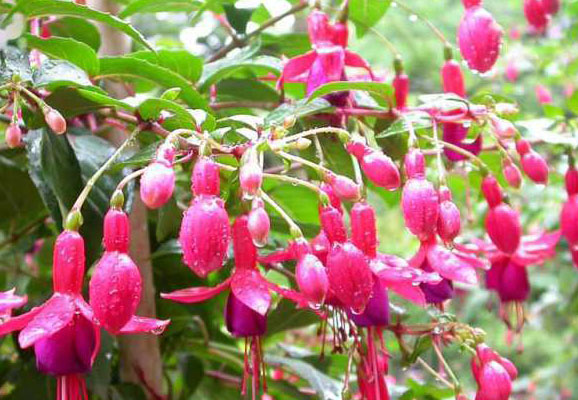
How to care for fuchsia to get through summer safely
Fuchsia prefers a cool, airy, semi-shaded environment, with an optimum growing temperature of 15-25°C. When the temperature exceeds 30°C it enters a semi-dormant state, at which point leaf drop and root rot very easily occur; if effective measures are not taken in time, the whole plant can die.
-

Detailed measures for cold protection and overwintering of papaya to ensure the plants survive the winter safely
Cold protection and overwintering measures for papaya
-

Key points for summer care of Phalaenopsis orchids: do these well and they will get through summer safely
Phalaenopsis orchids like to live in a warm, humid, well-ventilated semi-shaded environment. The most suitable growing temperature is 22-28°C; temperatures too high or too low will both adversely affect their growth. In summer, the weather is hot and dry, the air temperature often exceeds 32°C, air circulation is poor, and direct sunlight is strong
条件筛选