-
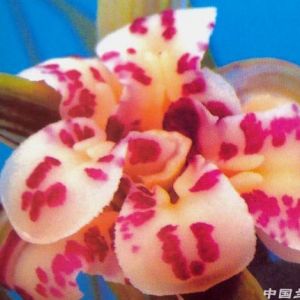
Introduction to and Appreciation of the RuYiDie Cymbidium Variety
RuYiDie, Latin name: Cymbidiumgoeringii 'RuYiDie', named by Wang Yong. It is a multi-lipped exotic flower; its four labella are highly transformed into butterfly-like form, appearing as large tongue-shaped structures, white in color, with a vivid "U"-shaped stripe pattern in the center, delightful to the eye and quite rare.
-
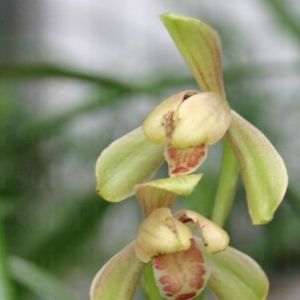
What kind of orchid variety is Ruyi Mei Jianlan
Origin: Selected and bred in Guangdong. Content: I heard there are two lines of Ruyi Mei (please correct me if I am wrong, seniors). The one I am introducing is said to be the Guangdong Ruyi Mei. Recently another group said theirs was selected and bred in Sichuan. I heard from orchid friends that its flowers bloom extraordinarily well, so a Shenzhen orchid friend asked me in return how my bloom could be Ruyi Mei. My flower is indeed Ruyi Mei, the old variety of Ruyi Mei passed down in Chaoshan. I introduced it from Old Qiu at Zhongjiao Net in 2004. This flower blooms quite well, the tongue is a bit long, and the center holds up only so-so, but the outer petals have good narrowed bases and flared tips. The flower blooms large, stands above the leaves, and is fragrant. Strangely, this flower rarely appears, and it indeed sprouts slowly. It was not valued much before, so I estimate there are not many left in existence.
-
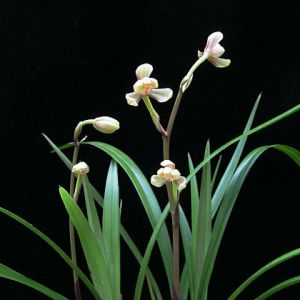
Jianlan Dasheng Mei, also known as Ruyi Mei, orchid variety introduction
Proper name in Sichuan: Ruyi Mei (the name used in Luzhou), also known as Xiaoling Mei (legend has it that it was first discovered by a girl named Xiaoling); renamed again in Chenghai: Dasheng Mei (meaning the flower is larger than Chenghai's Sheng Mei, with a similar flower form)
-
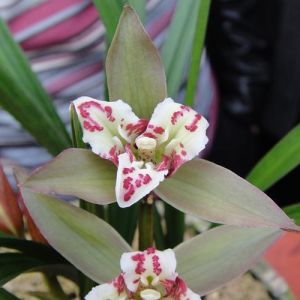
Introduction to the Ruyi Sanbao Chun Jian Orchid Variety
A new three-star Chun Jian variety, Ruyi Sanbao. It occasionally produces leaf variegation in the form of butterfly markings, but not often. When the plant is young it shows crystal tissue, but once it matures this can no longer be seen.
-
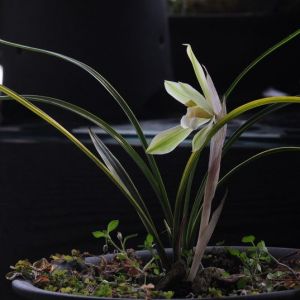
What kind of orchid is the Yuruyi Cymbidium goeringii?
The multi-art Cymbidium goeringii Yuruyi originates from the Dabie Mountains in western Anhui, was collected in the spring of 2003, first shows a compound-ring variegation and later a striped variegation, has swallowtail-shaped leaves, and its petals present a deer-antler pattern with a mottled-shell compound-ring plain color. It rebloomed in the spring of 2005 and won the gold award at the first Jiangsu Provincial Cymbidium goeringii Exhibition. It is kept by the owner of Caolu on Yushan, Changshu.
-
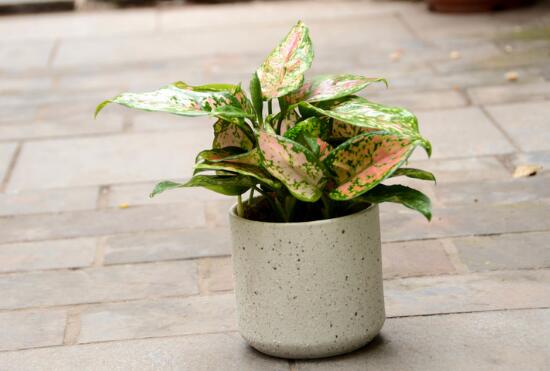
What to do when the Ruyi Queen's leaves turn yellow? Supplement light, reasonable water and fertilizer, change soil and replant
Keeping a pot of evergreen at home is absolutely a good choice, and as a premium variety among them, Ruyi evergreen, also called Ruyi Queen, can be said to be much loved by flower enthusiasts. However, during cultivation, the brilliantly colored Ruyi Queen often shows yellowing symptoms, so what should be done when the Ruyi Queen's leaves turn yellow?
-
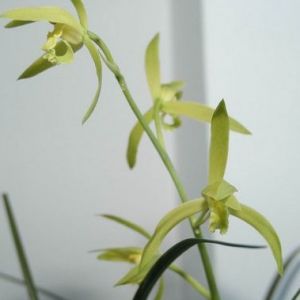
Cymbidium faberi 'Ruyi Su': Variety Characteristics and Care Tips
The three outer petals are narrow and long, shaped like bamboo leaves, with tightly rolled edges. The lip petals are pointed and long, with a green moss-green tongue; the flower has level shoulders, and the leaves stand at a slant.
-
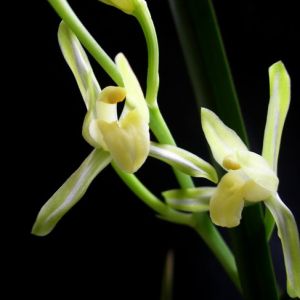
Introduction to the Qianxi Ruyi Jianlan Variety and Key Care Points
A variegated-leaf and floral evolution variety of Tiegusu Xinlan (Iron-Bone Plain-Heart Orchid). Because it was first discovered in the Meishan area of Chiayi, it is commonly known as "Meishan Su." When the spring buds of this variety first sprout, the young shoots display a highly variegated appearance; the inner variegation gradually fades as the plant grows, while the claw variegation becomes progressively more pronounced, with a slight tendency to reverse (summer or autumn buds may partially show delayed-expression claw variegation), ...
-
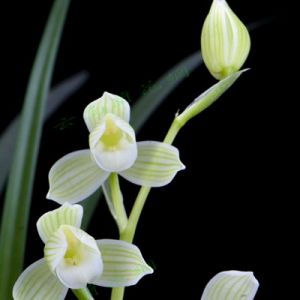
Detailed Introduction to the Ruyi Suhe Variety of Cymbidium tortisepalum
Ruyi Suhe: Cymbidium tortisepalum, lotus-petal type, pure-colored (su xin), a famous variety. History: Ruyi Suhe originated in the Baoshan region in the early 1980s. Characteristics: tall leaf type, 60-80cm long, leaf width 0.8-1.2cm, obliquely upright leaves, small or medium-sized flowers, very difficult to grow to a larger bloom (requires a very high level of skill); when the flower first opens the lip is round, hence it is also called Ruyi...
-
条件筛选