-

Can Pothos Roots That Are Too Long Be Cut Off? Causes of Root Rot and Solutions
Pothos is the preferred plant for many beginners at growing flowers and plants, because pothos's advantage of being easy to manage is widely known. Although the method of growing pothos is very simple, people still have many, many questions about it. For example, after growing it for a while, you will find that the pothos
-
How to Deal with Root Rot in Clivia? Teach You the Correct Way to Grow Healthy Roots
As everyone knows, the orchid is one of the precious and delicate flowering plants, and Clivia is also a type of orchid. It has an upright and elegant posture, and its flowers are beautiful and generous; it is both ornamental and able to purify the air. But many friends who grow Clivia have encountered root rot.
-
Key Technical Points and Operation Methods of Vegetable Grafting Explained
Abstract Top-insertion grafting method: Pull the bamboo skewer inserted in the rootstock out, then insert the trimmed scion into the hole, with the scion cotyledons and rootstock cotyledons forming a "cross" shape. Approach grafting method: Insert the scion cut into the rootstock stem cut, the two cuts need to fit tightly together, then use a grafting clip ⟦4 <p class="cintro"><span>Abstract</span>Top-insertion grafting method: Pull the bamboo skewer inserted in the rootstock out, then insert the trimmed scion into the hole, with the scion cotyledons and rootstock cotyledons forming a "cross" shape. Approach grafting method: Insert the scion cut into the rootstock stem cut, the two cuts need to fit tightly together, then use a grafting clip to secure the joint. Cleft grafting method: Insert the trimmed scion into the cleft, keeping the rootstock and scion surfaces level, then use a grafting clip for securing.</p> <p></p> <p><strong>I. Vegetable Grafting Techniques</strong></p><p>1. Top-insertion grafting method</p><p>(1) Removing the rootstock growing point: A blade or bamboo skewer can be used to cut off the true leaves and growing point of the rootstock.</p><p>(2) Cutting the rootstock: A bamboo skewer with the same thickness as the scion hypocotyl and a wedge-shaped tip can be used, then insert it at a downward slant from the main vein of one cotyledon of the rootstock toward the other cotyledon to a depth of 1cm; generally, it is best if the outer epidermis is not pierced and the bamboo skewer is faintly visible.</p><p>(3) Cutting the scion: At 1-1.5cm below the cotyledon node, use a blade to cut it into a wedge-shaped face with a bevel length of 1cm.</p><p>(4) Grafting: Pull the bamboo skewer inserted in the rootstock out, then insert the trimmed scion into the hole, with the scion cotyledons and rootstock cotyledons forming a “cross” shape.</p><p></p><p>2. Approach grafting method</p><p>(1) Removing the rootstock growing point: A blade or bamboo skewer can be used to cut off the true leaves and growing point of the rootstock.</p><p>(2) Cutting the rootstock: At 0.5-1cm below the cotyledons, use a blade to make a downward slanting cut, with the depth needing to reach 1/2 of the stem thickness.</p><p>(3) Cutting the scion: Make an upward slanting cut at the corresponding part of the scion, generally with the depth reaching 1/2 of the stem thickness, and the cut length the same as the rootstock cut.</p><p>(4) Grafting: Insert the scion cut into the rootstock stem cut, the two cuts need to fit tightly together, then use a grafting clip to secure the joint.</p><p>(5) Root cutting: After grafting, plant the rootstock and scion together into a nutrient pot, about 1cm apart, with the joint about 3cm from the soil surface; wait 7 days for the joint to heal, then cut off the scion root; generally after 10-15 days, the grafting clip can be removed.</p><p></p><p>3. Cleft grafting method</p><p>(1) Removing the rootstock growing point: A blade or bamboo skewer can be used to cut off the true leaves and growing point of the rootstock.</p><p>(2) Cutting the rootstock: From between the 2 cotyledons, split the young stem downward, with a length of 1-1.5cm.</p><p>(3) Cutting the scion: Cut the scion young stem into a wedge shape, with a cut surface length of 1-1.5cm.</p><p>(4) Grafting: Insert the trimmed scion into the cleft, keeping the rootstock and scion surfaces level, then use a grafting clip for securing.</p><p></p><p><strong>II. Suitable Grafting Time for Vegetables</strong></p><p>1. Cucurbits: When the cotyledons are fully expanded and when the true leaves appear, this is the suitable grafting period.</p><p>2. Eggplant: When the rootstock has grown 3-4 true leaves and the scion has grown 2-3 true leaves, grafting requires retaining 1 true leaf.</p><p>3. Tomato: When the rootstock has grown 4-5 true leaves and the scion has grown 2-3 true leaves, grafting requires retaining 1 true leaf.</p>
-
Symptoms and Control Methods of Crown Gall Disease in Fruit Trees
Crown gall disease in fruit trees is a very common disease. If it is not controlled in time, it may reduce yields and even cause the death of fruit trees. Therefore, fruit growers must do a good job of prevention and control. So what are the symptoms of crown gall disease in fruit trees? How should it be controlled? I. Main symptoms of crown gall disease
-
Practical marketing tips for grassroots agricultural supply stores to help you boost your agricultural supply sales
As a grassroots dealer's business activity, with competitors increasing day by day, whether the business is profitable depends on the store's competitiveness. Some agricultural supply stores, with flexible minds and keen market control ability, have achieved considerable economic benefits, making
-
Rural demolition and relocation must fully respect farmers' wishes
Zhu Yaoyin, deputy director of the Department of Grassroots Political Power and Community Construction of the Ministry of Civil Affairs, said in Beijing on the 2nd that the No. 1 Central Document has repeatedly stressed that the demolition of rural residential areas and the merging and withdrawal of villages must respect farmers' wishes and obtain villagers' consent, and that farmers must not be forced to relocate and move into apartment buildings, so as to avoid
-
The Agricultural Technology Promotion Law stipulates that promotion funds shall increase year by year
Professional and technical positions at the grassroots level shall be no less than 80%. Beijing, April 24 (Report): The draft amendment to the Agricultural Technology Promotion Law stipulates that professional and technical positions at county- and township-level agricultural technology promotion institutions shall be no less than 80% of total positions. The draft regulates staffing and structural proportions,
-
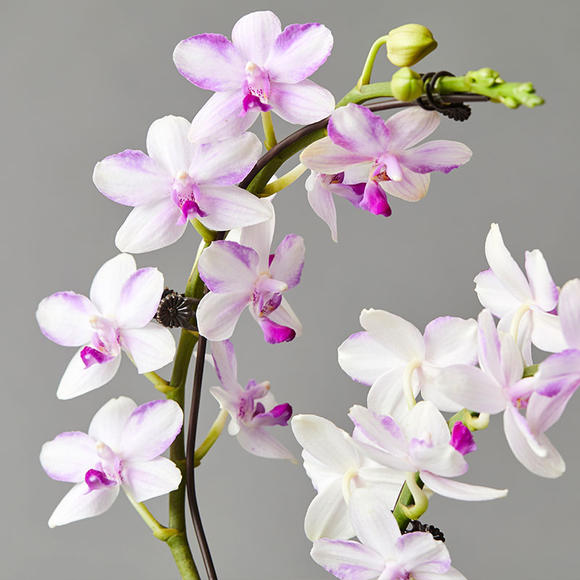
How to deal with the blackened roots of the Crystal Phalaenopsis?
Among the numerous colorful and charming flowers, the Crystal Phalaenopsis has become the focus of attention due to its unique charm. Next, let's delve deeper
-
Ficus microcarpa Growing Environment, Potted Cultivation Precautions, and the Medicinal Benefits of Its Aerial Roots
Ficus microcarpa, also known as small-leaved fig, evergreen tree, etc., reaches 15-25 m in height, with a flowering period from May to June. Here we take a look at where Ficus microcarpa grows, what precautions are needed for potted cultivation, and what medicinal benefits its aerial roots have. 1. Where does Ficus microcarpa grow? Ficus microcarpa's
-
How to grow succulents indoors so they thrive
Succulent plants refer to plants whose leaves, among the three vegetative organs of roots, stems and leaves, are thick and juicy and have the function of storing large amounts of water; they are also called "succulents". So how do you grow succulents indoors? 1. Temperature The indoor temperature for succulents is best kept at
条件筛选