-

Key points and precautions for building a rooftop rice field eel pond
What should be noted when building a rooftop rice field eel pond? Considering the load-bearing capacity of the rooftop, it is recommended that all rooftop ponds be built with bricks laid upright (wall thickness 6 cm); except for breeding ponds, all should use soil-free culture. From the perspective of cooling, the wall that is often exposed to the sun should be built higher than the height of the culture pond, and then the pond should be started about 10 cm back from it, to prevent prolonged sunlight on that pond wall from causing the water temperature in that pond to rise abnormally compared with other ponds, resulting in an undetected high water temperature that causes the death of rice field eels.
-
How to sow licorice? 5 steps to easily get planting done
Sowing licorice is a relatively simple method for this type of herb, but its key points should also be noted when cultivating it. The key points are as follows: 1. Sowing method. Site selection and land preparation. Licorice has wide adaptability and does not have strict requirements for the cultivation environment. It can be cultivated in semi-arid and arid areas with an average temperature of 4°C to 12°C and more than 2600 hours of sunshine, and it can also be planted on poor farmland returned from cultivation. However, it should also be noted that waterlogged low-lying areas, areas with a high groundwater table, and areas with heavy clay and acidic soil are not suitable for planting licorice.
-
Detailed Explanation of Key Points on Licorice Harvesting and Processing Technology
Harvesting and Processing Licorice is generally harvested after 1-4 years of cultivation. In Hebei and Beijing, it is harvested after 1-2 years of cultivation; in Inner Mongolia; Northeast China, and **, it is harvested after 3-4 years of cultivation. There are currently 2 cultivation methods: one is direct seeding, and the other is raising seedlings in the first year and transplanting in the second year. When transplanting, plant them flat and lay them horizontally in the field to facilitate harvesting. The first method is simpler and requires less labor; the second method is suitable for small-area household planting with intensive cultivation. For large-area planting, harvesting is a problem, and manual digging is very difficult. After many years of testing, a 55-type Iron Ox rubber-tired tractor can be used, with a plowing depth of about 45 cm, plowing one row at a time, and then manually using a four-tooth rake to pick out the licorice roots plowed out, then plowing the second row. One tractor paired with 10 workers can generally harvest about 10 mu per day, and the root damage rate is also somewhat lower than manual digging. The residual roots lost in the field are about below 10%, meeting the requirements, opening a new path for large-area licorice planting. After the harvested licorice roots are dried in the sun for a few days, use manual shears or a guillotine to cut off the rhizome heads and tails, and cut out licorice strips for cutting into oblique slices for export. The rhizome heads, fibrous roots, and tails are tied into bundles and used as hairy licorice for extracting licorice paste. For licorice grown for two years, the general dry weight of licorice strips is about 250-300 kg per mu, and hairy licorice is about 300 kg per mu. The output value per mu can reach about 4000 yuan.
-
Home-style recipe for celery and yellow fish shreds, tender and refreshing, perfect with rice
Ingredients: one fresh live carp, celery, chili pepper, egg white. Method: 1. Slaughter the live carp, remove scales, gills and internal organs, wash clean, wipe dry, split open and remove the bones, then cut the pure fish flesh into shreds about 7 cm long. Mix egg white and dry bean starch evenly, add cooking wine and salt and mix well, then blend with the fish shreds. 2. Cut the celery into sections about 7 cm long, remove the seeds from the pickled red chilies and cut into shreds. Mince the ginger and garlic into fine pieces. Mix soy sauce, white sugar, vinegar, monosodium glutamate, sesame oil and water bean starch with good stock to make a thickened sauce. 3. Place the wok over high
-
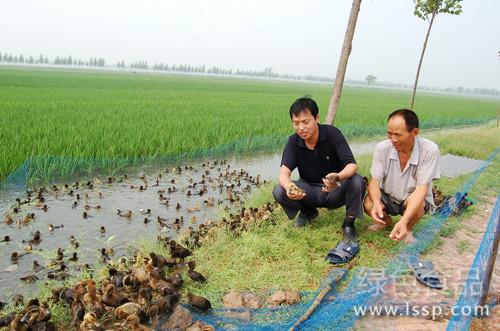
Rice Harvest and Fat Ducks: Key Technical Points of the Rice-Duck Symbiosis Model
Rice Harvest and Fat Ducks: Key Technical Points of the Rice-Duck Symbiosis Model
-

What are the pest and disease control methods for licorice?
Pest and disease control methods for licorice
-
What kind of rice is Donglan black rice? Introduction to its origin and characteristics
Basic information: Black rice is called "Hou Mo" in the Zhuang language. It gets its name because the husk and the grains are purple-black both inside and out. This rice is produced in Donglan County, Guangxi, so it is also called "Donglan black rice". Donglan black rice is a rare rice variety developed through long-term selection by farming families from wild black rice in the high-cold mountainous areas of Donglan County. It has a cultivation history of more than 400 years and is a treasure among grains. It contains as many as 18 amino acids, 8 of which are essential to the human body, with the highest levels of threonine and lysine. Its crude protein, crude fat, sulfur
-
Cultivation Techniques for the Space Red Rice Variety Weihong Jingjing Rice
The only Weihong Jingjing rice in China that has passed space breeding and been approved (approved name: Ganwanxian 33) is a high-quality red rice new variety developed by rice breeding expert researcher Li Yuanxiang together with the Institute of Genetics of the Chinese Academy of Sciences by sending 1000 seeds of the dual-purpose mid-late indica genetic engineering rice "GER-3" aboard a recoverable satellite, selecting mutants after mutagenesis, and then carrying out 3 years of directional breeding. It is also the only red rice variety among China's space rice varieties. After introduction and planting at our base, the plants perform well, show no photoperiod sensitivity or thermosensitivity reactions,
-
Disease Outbreaks and Emergency Treatment After Introducing Inferior Quality Rice Field Eels into Eel Ponds or Net Cages
(1) Disease outbreak situation: After inferior quality rice field eels are introduced into eel cages or eel ponds, they generally develop disease within 2 to 7 days, and mass mortality occurs around 12 days. When disease breaks out, a method combining Chinese herbal medicine and chemical fishery drugs should be used for treatment to control the infection. (2) Emergency handling: ① Search for and remove floating-head eels, exposed-body eels, and dead eels 2 to 3 times during the daytime each day; ② Change the water once every morning and thoroughly inspect for and remove dead eels; ③ At night each day, use electric light for illumination and search for and remove diseased eels from aquatic plants 1 to 2 times.
-
How do you make fish head in fermented rice wine sauce? A home-style recipe for fish head rich with the aroma of fermented rice wine
Appearance, aroma and taste: The fish head is fresh and fragrant, the broth is rich. Main ingredients: 1 bighead carp fish head (about 1500 g), 12 small cabbages, 5 g sliced ham, 15 g sliced fresh mushrooms. Secondary ingredients: appropriate amounts of fermented rice wine brine, monosodium glutamate, salt, raw oil, water caltrop starch and stock. Method: 1) Remove the gills from the bighead carp fish head and wash it clean, then steam it in a steamer until cooked and remove the bones (do not break it apart), and set aside; 2) Pour the stock into the pot, add the fermented rice wine brine, salt, monosodium glutamate and other seasonings, then add the fish head, sliced ham, sliced fresh mushrooms and small cabbages, bring to a boil, thicken with water caltrop starch, and drizzle with
条件筛选