-

What to Do When Silkworms Are Poisoned? Detailed Explanation of Six Rescue Methods
1. Bleaching powder detoxifying solution. For mulberry leaves contaminated by bacterial pesticides, use 0.15-0.25 kg of bleaching powder, add 50 kg of clean water to make a bleaching powder solution. Take the clarified liquid and spray it on the surface and underside of mulberry leaves, and feed the silkworms only after the leaves have no medicinal odor. 2. Atropine aqueous solution. When mulberry leaves contaminated by organophosphorus pesticides and arsenic-containing pesticides cause silkworm poisoning, use 0.3 g atropine tablets or 0.5 g atropine liquid in 1 vial, add 0.5 kg of cooled boiled water, rinse the poisoned silkworms or spray it on mulberry leaves as an additional feed, until the silkworms
-
Control Methods and Rescue Measures for the Three Major Types of Pesticide Damage in Cotton
1. Strict operation and effective prevention. When using the various types of pesticides mentioned above on cotton, the operating procedures must be strictly followed and the pesticides used rationally (including the type, concentration, method and timing of application, etc.), so as to give full play to the pesticide's efficacy while reducing costs and preventing pesticide damage. 2. Timely "rescue" to eliminate the "danger". After pesticide damage occurs, a large amount of water can be sprayed on the leaves to wash it off; in the soil, irrigation, drainage to wash out the pesticide, or neutralization and detoxification with safeners can be used. If Bordeaux mixture is mistakenly used, since copper ions cause the pesticide damage, 0.5%-1% lime milk can be sprayed; spray equipment that has been used for
-
What to Do If a Pig Is Poisoned? Rescue Methods Every Pig Farmer Must Know
① Emetic: generally used for poisoning by organic phosphorus and similar drugs. Subcutaneous injection of the emetic veratrine 0.01-0.03 g, or oral administration of the emetic ipecac powder 1-3 g; if no emetic is available, a wooden stick or rubber tube may be used to lightly wipe the throat mucosa to stimulate vomiting. ② Gastric lavage: when the poison has been in the pig's body for 4-6 hours, gastric lavage should be performed. For hydrocyanic acid poisoning, a 1% potassium permanganate solution or 3% hydrogen peroxide may be used; for organic phosphorus pesticide poisoning, a 1%-5% sodium bicarbonate solution may be used; for zinc phosphide poisoning, a 1% copper sulfate solution may be used. Gastric lavage is not suitable for corrosive drug poisoning
-
Rescue Methods and Emergency Treatment Measures After Pig Poisoning
The causes of pig poisoning fall into two categories: feed poisoning and drug poisoning. There are five commonly used rescue methods: Emesis is generally used for poisoning by drugs such as organophosphates. For subcutaneous injection of emetics, there is veratrine 0.01-0.03 grams, or oral emetic ipecac powder 1-3 grams (or antimony potassium tartrate 1-2 grams); if no emetic is available, a wooden stick or rubber tube can also be used to lightly wipe the throat mucosa to induce vomiting. Gastric lavage: when the poison has entered the pig's body for 4-6 hours, gastric lavage should be performed. For hydrocyanic acid poisoning, 1
-
What to Do When a Phalaenopsis (Moth Orchid) Has Root Rot? A Detailed Guide to Home Rescue Methods
When growing Phalaenopsis orchids at home, improper watering or poor potting medium can sometimes lead to root rot. Below are measures to prevent root rot and ways to rescue an orchid that already has it. First, choose the potting medium: use a loose, airy, well-draining substrate. For example, peat mixed with perlite, or peat mixed with pine needles, moss, and the like, all work well. Use organic fertilizer as a base fertilizer. Second, keep the potting medium moist, but never waterlogged; waterlogging is the main cause of root rot. Pay close attention: if water does not drain through for a long time after watering, it means the potting medium has been used too long and has become too dense, so you should change the soil promptly.
-
How to control the citrus black scale in orange orchards? The pure yellow aphelinid wasp comes to the rescue
[Morphological characteristics] Female wasp body length 0.92-1.18 mm, yellow, without color spots. The posterior margin of the scutellum has dark brown stripes. The base of the forewing has short black stripes; the ventral side of the antennal scape is dark brown, and the remaining segments are deep fuscous. Legs yellow. Compound eyes with fine hairs. Thoracic hairs thick and black; the scutellum bears 4 hairs; the forewing is 2.25 times as long as wide; the ovipositor is 1.9-2.01 times the length of the middle tibia. Male wasp body length 0.71-0.92 mm; the forewing is wider than that of the female, 2.2-2.33 times as long as wide. Important differences from Aphytis chrysomphali: the pure yellow aphelinid wasp of the citrus black scale is a bisexual species, and the propodeum is shorter, 0.75-0.8 times the length of the scutellum. The fan-shaped projections are large and elongated. Strongly overlapping; the thorax and venter of the mature pupa are dark brown, with only the abdominal tip lighter in color. Aphytis chrysomphali is a unisexual species, with males rarely seen in nature; the propodeum is longer, equal to or slightly longer than the scutellum. The posterior margin is broadly arched; the fan-shaped projections are small, rounded, and not overlapping. The mature pupa is yellow, with only a single black longitudinal line on the mesothoracic ventrite.
-
How to rescue fish from toxic water? Three methods for treating fish
Excess dissolved oxygen toxic water syndrome: Excessive dissolved oxygen in the water body can cause eutrophication of the water, leading to gas bubble disease and various other conditions in fish. Many small bubbles adhere to the fish gills, causing the fish to float up or lose balance when swimming. There are white bubbles in the fish intestines, or relatively many bubbles are attached to the fish body surface, fin rays, and gill filaments, and the fish body floats on the water surface; in severe cases, it can cause fish to die in batches. When bubbles appear in the fish pond, first, clean water should be injected quickly while discharging part of the pond water; fish with mild symptoms can expel the bubbles in clean water; second, use 400-60 per mu of water surface
-
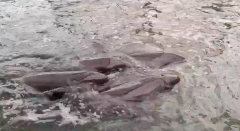
6 small killer whales stranded at Qijin; after rescue, 5 are already swimming leisurely in the holding pool
On the evening of the 25th, a report came in of 6 small killer whales stranded together on the shore of Qijin in Kaohsiung. By the early morning of the 26th, the 5 surviving individuals had been transported to the Sicao holding pool of the National Cheng Kung University Marine Biology and Cetacean Research Center; at 8 a.m., the 5 small killer whales were already able to float and swim as a group in the holding pool! Ocean Conservation Administration
-

How to Rescue an Overwatered Phalaenopsis with Root Rot? Practical Tips to Share
Friends who grow Phalaenopsis, nine out of ten fail at "watering" - watering a little every few days, and then one day you look and the leaves are limp and droopy, the pot even smells bad, and when you pull it out the roots are all rotted! Actually, root rot isn't a terminal illness; as long as you deal with it in time, there's a good chance you can save it. The thing about Phalaenopsis root rot is, it's like a person who ate too much and gets bloated
-
Why Are the Leaves of the Money Tree Turning White? A Few Rescue Methods to Teach You
The money tree (Pachira aquatica) is a perennial evergreen tree, upright and straight, with palmate compound leaves spreading out like an umbrella and a rounded canopy of green branches and leaves, making it very suitable as a landscaping tree species. As an ornamental bonsai, its novel shape suits the mindset of modern people looking to beautify their home environment in homes, guesthouses, shopping malls, hotels and office buildings, and it is deeply loved by consumers.
条件筛选