-
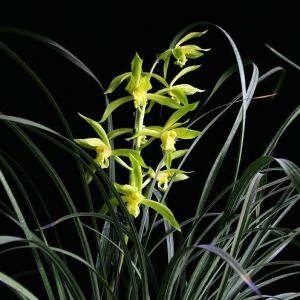
What kind of orchid is Jiangshan Su? Introduction to the pure-green variety of Cymbidium faberi
Petal type: green-sheath pure petals. History: In the early years of the Republic of China, a Shaoxing orchid grower dug it up in Jiangshan. Name: Jiangshan Su. Because it is a lotus-form bamboo-leaf narcissus petal, it is also called: Jiangshan Narcissus Su. Characteristics: The three outer petals are pale yellow-green, bamboo-leaf petals, large rolled tongue with green moss, leaves semi-drooping, leaf surface flat, leaf texture thick and hard, leaf length 50-60 cm, width about 1-1.2 cm...
-
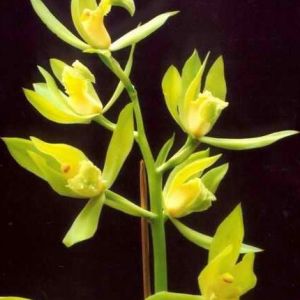
Introduction to the Wang Mingyang Su cultivar of Cymbidium faberi, a pure-green (Suxin) variety
Its leaf shape resembles that of 'Wenzhou Su'; leaves are 40-50CM long and 1-1.2CM wide, bright green and glossy, with a semi-pendant posture and elegant form. The flower scape is tall and upright, rising above the leaves with a majestic presence, bearing 8-10 flowers. The three outer sepals are relatively short and broad when first open, with tightly rolled edges and thick substance. The two lateral sepals spread horizontally, reaching 7-8CM across. The petals clasp the column, appearing pointed and elongated.
-
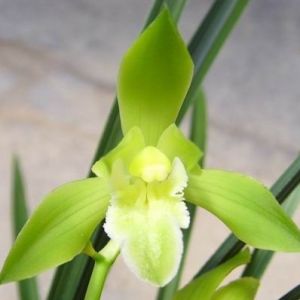
Introduction to the Variety Characteristics of Wenzhou Su Huilan
Petal type: willow-leaf narcissus-style plain lotus petal. History: selected in the early Republic of China period by orchid growers in Wenzhou. Characteristics: the three outer petals have long stems and resemble willow leaves, the scissors-shaped column (opening into a skylight form when in full bloom), the flower color is pale yellow-green with a white curled lip. The leaves are broad, drooping and soft, long and large; most of the outer leaves of the leaf cluster are semi-drooping. The flower scape is tall, generally able to reach over 40 cm, and sturdy. It propagates quickly and flowers vigorously.
-
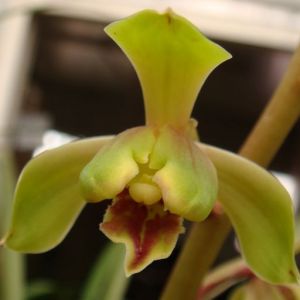
Introduction to the variety characteristics of Nanyang Mei Hui Orchid
Petal type: Red-sheath type green-flowered plum petal. History: Selected by Gu Tongsun of Yixing, Jiangsu during the Republic of China period, and spread to Japan before the War of Resistance. Characteristics: The three outer petals have long stems and round tips, the inner petals are half-hard and folded against the back, the lip has flared corners and a fringe-like shape, with bright red patches. The shoulders are level, and the flower color is entirely green.
-
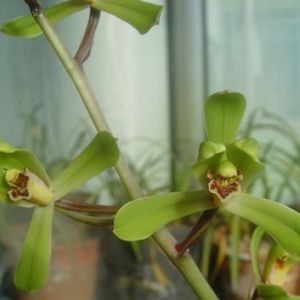
Introduction to the Characteristics and Appreciation Methods of the Zhenpin Huilan Variety
Also known as "Zhenpin Mei," it was selected in 1930 by He Gengquan of Wujin, Jiangsu, and named Gengquan Mei at the time; in 1941, after Mr. Xie Ruishan of Suzhou cultivated it and it bloomed again, because its flower shape and bearing were of a rare variety, it was given the new name "Zhenpin"; afterward the orchid world also called it "Dicui" (it shares the same name as but is a different plant from the "Dicui" that was lost by the end of the Qing dynasty...
-
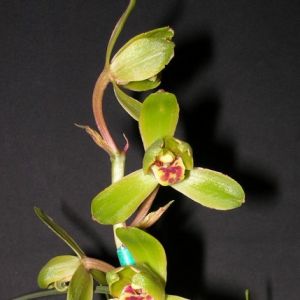
What kind of orchid is Dongshan Mei? Introduction to the characteristics of the Cymbidium faberi variety
Petal type: red-to-green plum petal. History: Before the War of Resistance, it was selected by orchid growers in Dongting Dongshan, Suzhou, and later came into the possession of Yao Junyu of Suzhou. Characteristics: the five petals are set in separate compartments, the petals are thick in texture, with round tips, tightly rolled edges, and narrowed bases; soft silkworm-moth stigma, and a Liu Hai tongue; the flowers are showy with a rich, creamy color and an elegant form, making it a rare treasure among modern Cymbidium faberi, and it has been very rarely circulated.
-
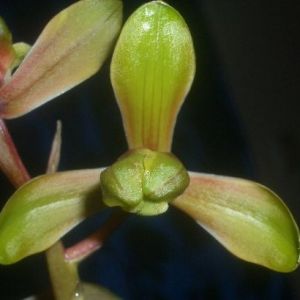
Introduction to Shiroundong: Get to know this Cymbidium faberi variety
Petal type: Red-shell plum petal. History: Breeding history unknown. Also called "Diyuan". Characteristics: Leaves 35-45 cm long, about 1 cm wide, thick in texture, semi-arching in posture, emerald green in color. The three outer petals are short and round, and round to just the right degree, hence the name "Shiroundong" (appropriately round). The petal tips have a pointed apex, thick fleshy texture, tightly rolled edges, and flat shoulders. The flower shape resembles that of "Guanding"...
-
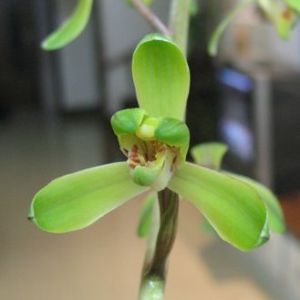
Introduction to the Variety Characteristics of Yushan Mei Cymbidium faberi
Leaves 30 cm long, 1 cm wide, old leaves semi-arching, without gloss, leaf tips pointed, veins deep, leaf texture thick; the three sepals have rounded heads and slender bases, silkworm-moth Classp, ruyi tongue. The three sepals have large heads and slender bases, tightly rolled edges, thick flesh, divided into pockets with silkworm-moth hooded Classp, ruyi tongue, green color, level shoulders, stem slender and long.
-
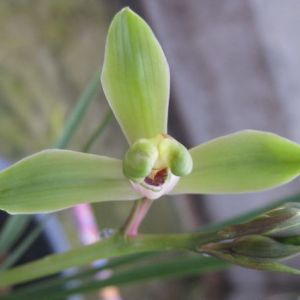
Tianxi Mei Cymbidium faberi Variety Introduction and Care Key Points
Petal type: Red-sheath plum petal. History: Unknown. Characteristics: The three outer petals are round-headed, tightly edged, and narrowed at the base; the shoulders are level; the holds are half-hard cupped; the lip is a small ruyi tongue; the inflorescence on the scape bears only four or five flowers.
-
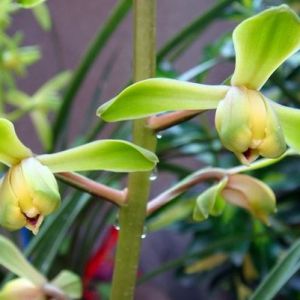
What variety of Cymbidium faberi is Jiepei Mei? A brief introduction to its characteristics
The flowering period of Jiepei Mei is generally in March and April. Each scape bears six to ten flowers. The flower stalk is purplish red, with the outer ring being the sepals and the inner ring being the petals. The petals are white jade held at the heart, praised as "red hairpin and green jade." The form in which the sepals on both sides extend to the sides is called the "shoulder"; sepals that are left-right symmetrical with a flat "shoulder" are considered authentic; if they slant upward to both sides like bird wings, it is called a flying "shoulder" and is considered divine grade; if they slant downward to both sides, it is called a dropping "shoulder" and is considered inferior grade. The lip below the inner ring of petals is commonly known as the tongue; the tongue is round, short and large, not elongated or curled back, and the ru yi tongue is considered the best.
条件筛选