-

-

Can't name the common plants you see? Today we'll help you identify them all
Life is always full of all kinds of flowers and plants. Some plants you see all the time, yet you simply cannot name them. Today, let's get to know them! 1. Sicklepod Sicklepod, also known as wild senna, flowers and fruits from August to November. Sicklepod is mainly propagated by seed. The seeds of sicklepod are called cassia seeds, and have the effects of clearing the liver and improving eyesight, promoting urination and relieving constipation. The young leaves and tender pods are edible.
-
-
How can you tell real orchids from fake ones? These few methods help you identify them easily
In recent years, some unscrupulous flower vendors have stopped at nothing, making and selling fakes to pocket ill-gotten gains, with ever-changing tricks that leave people unable to guard against them. The author now summarizes here personal experiences and the lessons learned by surrounding orchid friends who fell victim in transactions, hoping orchid friends can take warning. Tiger-stripe seedlings 'tiger-stripe variegation' is what many orchid friends pursue...
-
Detailed explanation of the morphological characteristics of orchids, helping you quickly get to know orchids
The Orchidaceae family comprises 750 genera and more than 35,000 species, while the genus Cymbidium has more than 70 species. Common cultivated species in China include: the famous flower of the four seasons, Cymbidium goeringii (C. goeringii): also called grass orchid, mountain orchid, and duoduo xiang. One stem bears 1 to 2 flowers, fragrant. Flowering period is February to March. Mainly distributed in the Yangtze River basin and the southwestern region. Traditional precious varieties...
-
How do you grow orchids? These eight tips will help you grow orchids well
First trick, keep calm and have an ordinary mind. For growing orchids, you should treat them with an ordinary mind, grow orchids with a calm heart, and believe in orchid fate. If you are destined to have them, even if you long for a good flower, you can have it; if not destined, even with countless wealth, you still cannot get it. Even if you rack your brains, or use despicable means to obtain it, it will still leave you with both people and money lost. At the same time, no matter how the orchid market is, calm down and grow...
-
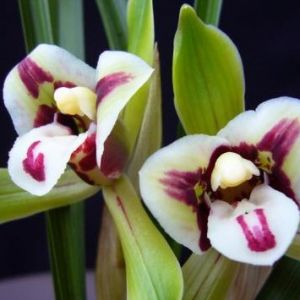
Orchid Vernalization Tips: How to Help Orchids Vernalize Better
Cymbidium goeringii, stamen-petaled butterfly type, rare flower, famous cultivar. The leaves grow to about 40 cm, forming a U shape, semi-arching, uniform in type, neat and consistent. The center of the flower is round and full, and the butterfly-transformed petals are broad and round in shape, pioneering the round and well-proportioned center in the stamen-petaled butterfly category of Cymbidium goeringii! The three outer petals open with balanced poise, with the petal tips narrowing at the base and forming corners, and the center and outer petals match perfectly...
-
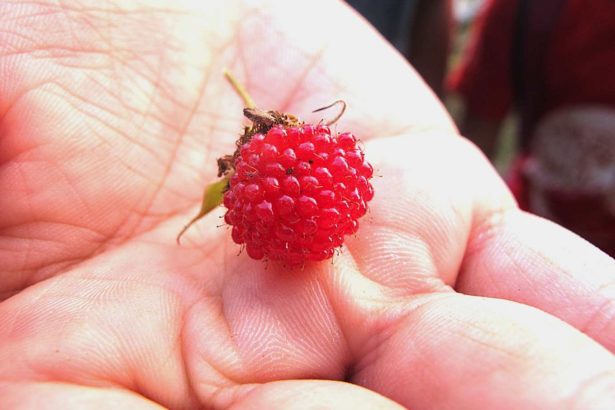
During the Qingming paper-hanging season, Qiu Jinghui asks the bamboo partridge to help gather wild berries
Qiu Jinghui / During the paper-hanging season, asking the bamboo partridge to help gather wild berries
-
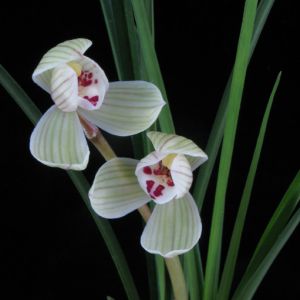
A complete analysis of the pros and cons of Jianlan (Cymbidium ensifolium) varieties to help you choose the right one
Yunxi He is honored as "China's Western Orchid City." Baoshan, because it is rich in lotus-petal-type flowers, holds a special place in the orchid world. Here have appeared many fine lotus-petal varieties such as "Yunxi He," "Zixi He," "He Zhi Guan," "Yipin He" and many others, and thus it was jointly named by orchid world masters Mr. Chen Xinqi, Liu Qingyong and Pan Guanghua...
-
How to help cymbidium orchids (Cymbidium faberi) settle into a new pot? A detailed guide to practical care tips
"Settling in" refers to the period a plant needs to adapt to its new pot environment after repotting. Cymbidium orchids settle in earlier than Chinese orchids (Cymbidium spp.), which means the cost of settling in is higher for cymbidiums than for Chinese orchids. As a result, cymbidiums are more prone to decline than Chinese orchids. Chinese orchids can be repotted often, but if you want to repot a cymbidium, you need to think twice before acting. Cymbidiums sometimes take years to settle in; generally speaking, a cymbidium that has been repotted for over a year...
条件筛选