-

Detailed explanation of potato crispy candy slice processing technology, master all steps and methods
1. Selecting potatoes and slicing: Choose fresh potatoes weighing 50-100g with no pests or diseases, wash the soil off the skin, then place them in a 20% alkaline solution and stir constantly with a wooden stick to peel them. After all the skin has come off, scoop them out, rinse once, and drain for later use. For slicing, cut into diamond-shaped or triangular thin slices 1-2mm thick as needed; after cutting, immediately soak them in clean water to prevent the starch on the surface from discoloring. 2. Boiling and drying: Scoop out the cut slices soaked in water and put them into boiling water to cook. When they are 80% cooked, immediately turn off the heat and dry them. In this step, you must master
-
Detailed Explanation of Potato Soft Candy Processing Technology
A high-grade soft candy made with potatoes as the main raw material has excellent taste and color, is moderately soft, sweet and delicious, and is very popular among consumers. It also features simple equipment, easy production, and high profit. 5 kg potato paste, 3 kg white sugar, 1.3 kg edible gelatin, 2.5 kg water, 10 g sodium benzoate, an appropriate amount of flavoring, 2.4 g sodium sulfite, an appropriate amount of edible coloring, and citric acid with the amount adjusted according to pH. 1. Material selection: select potatoes that are not moldy, deteriorated, frost-damaged, or blackened for processing.
-
How to Make Sweet Potato Soft Candy and Key Technical Points
Soft candy is a type of candy that is soft and slightly elastic, available in transparent and semi-transparent forms. Soft candy has a relatively high moisture content, generally 10%-20%. The vast majority of soft candies are made in fruit flavors, while some are made in milk flavors and refreshing flavors. Their shapes are divided into rectangular or irregular forms depending on the molding process. 1. Process flow: preparing starch milk -- scalding the slurry -- boiling the sugar -- cooling -- molding -- packaging 2. Ingredients: 12 kg starch, 40 kg starch syrup, 50 kg white sugar, citric
-
Carambola Candy
This product is a dry candied fruit, purely sweet in taste, and requires the salt contained in the raw material to be removed. Whether sweet or sour carambola, both carry varying degrees of acidity, and ensuring the removal of the acidity is no easy task. The processing technique is as follows: 1. Raw material handling: Peel off the ridges of fresh carambola, cut lengthwise into 2-3 pieces, and soak in 3% limewater to neutralize the acidity. Add 1.5 kg of quicklime to 50 kg of clean water, stir, let stand for a moment, then take the supernatant liquid to treat the fresh carambola, generally soaking for 5-6 hours
-
A Detailed Explanation of the Techniques and Methods for Making Ginger Candy
The small town of Fenghuang in western Hunan was once praised by the New Zealand poet Rewi Alley as "the most beautiful small town in China," and it is also the hometown of Shen Congwen, Huang Yongyu and Xiong Xiling. Ginger candy is its most famous snack specialty. There are many small shops making ginger candy, most of them family workshops, and the scale of the storefronts and the production techniques are roughly the same, yet the prices differ greatly. Generally, ginger candy sells for only 8 yuan per jin, but "Zhang's Ginger Candy" can sell for 1.5 yuan per small bag, with only 10 pieces per bag, nearly 3 times the price of the former, and its sales are excellent. Why do people
-
Detailed Explanation of the Processing Technology and Production Method of Ginger Juice Soft Candy
This product sells well on the market because the soft candy carries the flavor of ginger. The processing technology is as follows: 1. Raw material processing: select fresh young ginger, remove rotten ginger, and peel it by manual scraping or rubbing; chop it and put it into a pulping machine to make a slurry. The amount of water added depends on whether the ginger is old or young; older ginger can have a little more water added, while young ginger should have a little less water added. 2. Juice extraction by filtration: use pressing or a cloth bag to remove the residue and obtain ginger juice. The ginger residue can be comprehensively utilized after drying. The ginger juice is heated for sterilization and set aside. 3. Gelling agent treatment: the soft candy uses
-
Processing Methods and Technical Key Points of Ginger Juice Hard Candy
Hard candy is the densest type of all candies. The specific gravity of general hard candy is between 1.5 and 1.6. Hard candy currently sells poorly in the candy market, but if improvements are made in variety and flavor, it has great prospects. Ginger juice hard candy is rarely seen on the market, and its processing technology is as follows: 1. Raw material processing: Use tender ginger or a small portion of old ginger, wash clean, peel and crush, then put into a pulping machine to make pulp, press and filter to obtain ginger juice for later use. 2. Production process using atmospheric pressure boiling to make hard candy: (1) Sugar boiling: Hard candy contains 9
-
How is ginger candy made? A detailed explanation of ginger candy processing techniques
The ginger candy referred to here is a dry-state candied fruit, and it still holds a certain position in today's food market. The processing techniques are as follows: 1. Raw materials: Select fresh ginger with thick, plump flesh that is tender and crisp, and remove rotten ginger as well as parts affected by pests and diseases. 2. Washing: Wash clean and remove rotten parts. 3. Peeling: For small-scale production, peel by hand scraping. Slicing: Slices should be uniform in thickness, generally 2-3 mm thick is suitable. Color protection: Soak the sliced ginger in a 0.1% sodium sulfite solution for 4-5 hours. 6. Sugar boiling: Scoop out the ginger
-
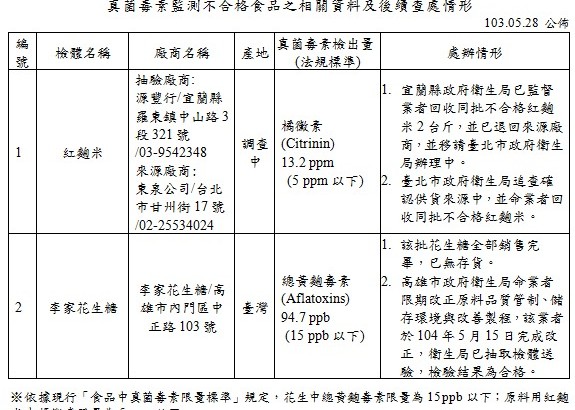
Peanut candy found with aflatoxin levels 6 times over the limit, FDA inspection reveals
FDA inspection finds peanut candy with aflatoxin 6 times over the limit
-

How to grow candytuft? A detailed guide to the cultivation and care of Iberis amara
Iberis amara is also called candytuft. Its flowers are white, and it has a long blooming period and high ornamental value. It is commonly grown in pots or in parks, and some people also use it as a cut flower. It can be grown from seed or transplanted, but note that transplanting requires keeping plenty of soil around the roots, otherwise the roots will be damaged and the survival rate will drop.
条件筛选