Peanut candy found with aflatoxin levels 6 times over the limit, FDA inspection reveals
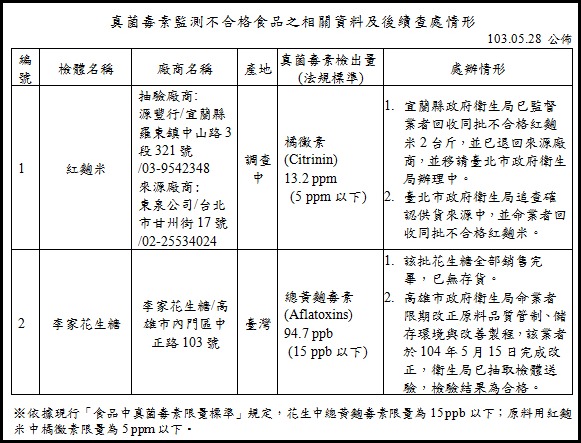
The Food and Drug Administration announced today the April "Market Food Mycotoxin Content Monitoring Plan," with 2 out of 56 products failing. Yilan Yuanfeng Firm's "red yeast rice" had citrinin 1 time over the limit, and Kaohsiung Neimen's "Li Family Peanut Candy" had total aflatoxin as high as 94.7 ppb, exceeding the standard value of 15 ppb by more than five times. The entire batch of the product had already been sold, but Hsu Chin-feng, deputy director of the FDA's Northern Region Management Center, said the operator improved its process, and upon retesting on the 15th of this month, the product had all passed.
The Ministry of Health and Welfare's Food and Drug Administration and county and city health bureaus carried out the "Market Food Mycotoxin Content Monitoring Plan." In April, a total of 11 peanut products were sampled and tested for aflatoxin; 7 rice and wheat products were tested for aflatoxin and ochratoxin A; 10 coffee products were tested for ochratoxin A; and 28 products made from red yeast rice as a raw material, red yeast capsules and tablets, and red yeast were tested for citrinin, with a pass rate of 96.4%.
One of the failing products came from Kaohsiung City's Neimen District "Li Family Peanut Candy," exceeding the standard value set by the Ministry of Health and Welfare by five times. Hsu Chin-feng said Li Family Peanut Candy is a family-style factory. When the Kaohsiung City Health Bureau notified the operator, the operator said the entire batch had already been sold out. Under Article 17 of the Act Governing Food Safety and Sanitation, the operator must make improvements within a deadline. After the health bureau asked the operator to correct the storage environment, manufacturing process, and raw material quality control, samples were taken for retesting on the 15th of this month, and the product had all passed.
The other product was Yilan Yuanfeng Firm's "red yeast rice," with citrinin at 13.2 ppm, exceeding the standard value of 5 ppm by two times. The Yilan County Government has already recalled 2 jin of the same batch of red yeast rice, but the supplier came from Taipei City's Dongquan Company, and the Taipei City Government is investigating the source of supply.
Jiang Chih-kang, a nephrologist at National Taiwan University Hospital, said aflatoxin has been internationally confirmed to cause cancer, inducing and promoting tumors, and patients with hepatitis B and liver cancer must be especially careful. Because aflatoxin is cumulative in the human body, unless too much is consumed at once, the public will not have obvious symptoms, possibly only elevated liver enzyme levels, so the government's gatekeeping at the source is very important.
Jiang Chih-kang said aflatoxin is secreted by Aspergillus flavus, and Taiwan's humid and warm climate makes it hard to avoid. He suggested that when the public selects cereal products prone to aflatoxin, such as peanuts and corn, they should follow the principle of "every grain clearly visible," buy packaging that allows the product to be clearly seen, avoid eating it if it is moldy or blackened, store it in a dry, low-temperature place, and consume it as soon as possible.