-
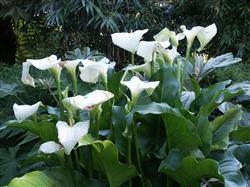
Detailed Guide to Common Pest and Disease Control Methods for Calla Lily
I. Diseases 1. Calla lily soft rot: Soft rot and detachment occur on the plant near the soil surface, causing leaves to wilt upward and the fleshy tuber to develop a soft rot downward, with roots also rotting, and the whole plant suddenly wilting and dying. When leaf edges are affected, they become soft and wet-rotted. When flower stalks are affected, the flowers turn brown, and the stalks become soft-rotted and drop off...
-
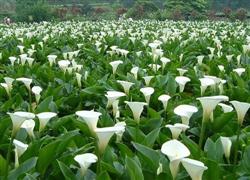
Occurrence and Control of Calla Lily Mosaic Disease
Common calla lily diseases include: ① Soft rot. During the growing period, soft rot and detachment occur on the plant near the soil surface, and extending upward it causes the leaf edges to become soft, wet rot and withering, the flower color to turn brown, and the flower stalk to become soft, rot and drop off, while extending downward it causes the tuber to become slimy and soft-rotted and the roots to rot, and the plant may even wilt and die. Control measures: a....
-
What are the control methods for leaf spot disease in calla lilies?
I. Symptoms: Infected leaves develop lesions ranging from light brown to yellowish-brown, mostly round, oval, or irregular in shape. A few lesions have indistinct concentric rings. In the later stages of the disease, many small black dot-like moldy growths appear in the center of the lesions, namely the conidiophores and conidia of the pathogen. II. Pathogen and disease occurrence...
-
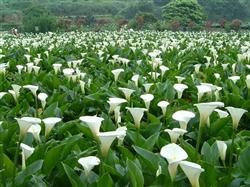
Detailed Guide to Common Disease and Pest Control Methods for Calla Lily
The main pests harming calla lily are: the two-spotted spider mite, namely the cotton spider mite and the cotton red spider. The female two-spotted spider mite has an oval dorsal surface, while the male has a diamond-shaped dorsal surface. In spring and summer, their color is yellow and yellow-green, with a black patch on each side. By late summer, individuals turn orange in body color, and the number of females...
-

What are the cultivation methods and planting management key points for calla lily?
In calla lily cultivation methods, two approaches are commonly used: pot culture and trough culture. For pot culture, the compact white-stem type, red calla lily and silver calla lily are generally chosen; if large plants are the goal, the tall green-stem type or yellow calla lily can be selected. For calla lily grown to harvest spathes as cut flowers
-
How does calla lily reproduce? Introduction to several common propagation methods
The propagation of calla lily is mainly through corm division. After the plant enters dormancy, peel off the small corms around the tuber and plant them separately. It can also be propagated by seed. Once the seeds mature, sow them in pots. The optimal germination temperature is around 20°C. Let's take a look at the propagation methods of calla lily below.
-
Colored Calla Lily Propagation Methods and Cultivation Notes (with pictures)
Colored calla lily is the general term for species and hybrid varieties in the genus Zantedeschia (calla lily) of the Araceae family other than the white calla lily. It is native to central and southern Africa and is often used to make bouquets, flower baskets, wreaths and vase arrangements. Dwarf and small-flowered varieties are grown in pots and placed on steps, windowsills, balconies and in front of mirrors, planted in gardens, or grouped beside pools or rock piles.
-
Detailed Guide to Potted Cultivation Techniques for Colored Calla Lilies
Colored calla lily (Zantedeschia spp.) is a perennial herbaceous bulbous flower of the genus Zantedeschia in the Araceae family. Its flower shape is elegant and its colors are varied, making it a new favorite in the flower market, suitable for cultivation as cut flowers and pot flowers. Botanical characteristics of potted calla lily: the leaves of colored calla lily are basal, entire, and emerald green, with some cultivars having white spots on the leaves.
-

-

条件筛选