-

Give your money tree and Chinese rose a snip, and new shoots will sprout like crazy, filling the pot with leaves
Spring is exactly when the plants at home put out new shoots, and the more new shoots that come out, the more branches will grow. So how exactly can you get your plants to grow more new shoots? Come and take a look!
-

How Are Chinese Orchids Classified? A Guide to the Variety Types of Chinese Orchids
Orchids of the genus Cymbidium in the family Orchidaceae are what we commonly call Chinese orchids, and they can be roughly divided into Chunlan (spring orchid), Huilan (Huilan orchid), Jianlan (Jianlan orchid), Molan (Molan orchid), Hanlan (Hanlan orchid), Chunjian (Chunjian orchid), and Lianban (Lianban orchid). Chunlan Cymbidium goeringii (Rchb. f.) Rchb. f. 1. Blooming period: February to March. 2. Inflorescence: 1-2, solitary or paired....
-
A Practical Guide to the Appreciation and Exploration of Chinese Cold Orchids
In the large family of Chinese orchids, the cold orchid (Cymbidium kanran) is the strain that was systematically developed latest as an ornamental variety. To explore the appreciation theory of Chinese cold orchids, one must understand when China began to enjoy cold orchids as ornamental plants. Although Professor Liu Qingyong also cites "Chen Mengliang" in the Jinzhang Lanpu (Golden Zhang Orchid Manual) as a suspected cold orchid, from the text...
-
A Detailed Guide to the Classification Methods and Variety Characteristics of Chinese Cymbidiums
Terrestrial Orchids Terrestrial orchids are suited to growing in the loose soil layer on the ground surface. The terrestrial orchids native to our country are also called "Chinese cymbidiums," and they have high ornamental value and economic value. This article focuses on Chinese cymbidiums. Terrestrial orchids have poor seed propagation ability, and tissue culture is difficult; there are currently no successful reports. Therefore, although there are many types of terrestrial orchids...
-
When did Chinese orchid culture originate? Exploring the historical origins of orchid culture
The orchid is one of the traditional famous flowers most loved by the people of our country. Its leaves are graceful and varied in form, its foliage stays evergreen all year round, and its flowers are noble and delicately fragrant. For thousands of years, it has been known as the "ancestor of fragrance," the "king's fragrance," and "the finest fragrance under heaven." The Chinese orchid culture, created by the working people of ancient China in long-term social practice with the orchid as its main content...
-
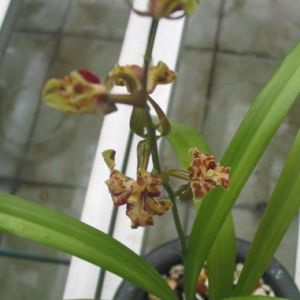
Introduction to the Chinese Fireworks Cymbidium sinense variety and its care essentials
The leaves are semi-arching and soft in texture, green with a yellowish tinge, 40-55cm long; the flower stems are reddish and upright. It is a multi-lip unusual flower, with the lip coating yellow at the base and dotted with red, and deep lip grooves that give it a rich texture; at its most floriferous it bears seven lips. The column is short and small, yellow in color. Overall it is crystal-clear and gorgeous, grand and imposing, like brilliant fireworks, which is how it got the name "Chinese Fireworks".
-
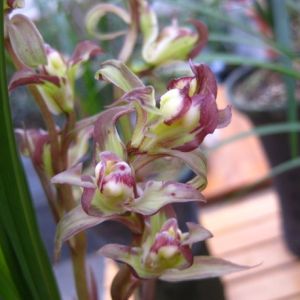
Why is the Chun Jian orchid hailed as a Chinese treasure?
"Chinese Treasure" has rich, magnificent colors, with twin flowers atop the stem, a rarity in the world and an excellent variety among Chun Jian orchids.
-
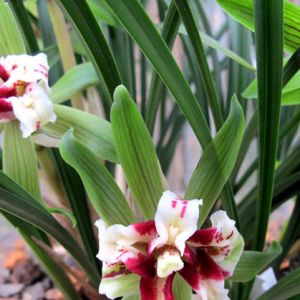
Sixi Die is a famous butterfly-type cultivar among Chinese cymbidiums.
The new shoots are purplish-red; the leaves are long and narrow, 33-34 cm long and about 0.7-1 cm wide, semi-arching, with a slightly deep leaf groove forming a shallow "V" shape; the leaf texture is thick, the leaf margins have coarse serrations, and the color is dark green and glossy; the leaf posture is soft and graceful. The bracts are light reddish-purple with dark purple vein patterns. The flower form is unstable: sometimes there are five or six petals and 4-6 tongues, ...
-
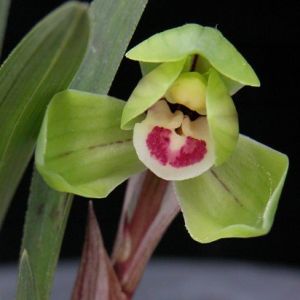
Gaiyuan He is a cultivar of Cymbidium goeringii (Chinese spring orchid).
Originating from the Siming Mountain area of Shangyu, Zhejiang. Discovered and cultivated in 1988 by Zhao Yinquan of Sanshe Village, Lizhu Town, Shaoxing County. Its leaf texture closely resembles the old cultivar "Huanqiu Heding", and its leaf shape also resembles "Da Fugui". The leaves are 17 cm long and 1.2 cm wide. The three outer petals are short, broad and round, with narrowed bases and broadened tips; the mussel-shell-shaped pollinia are tightly rounded; the large round lip does not curl back; the central column is round and upright; the color is tender green. Delicate fragrance...
-
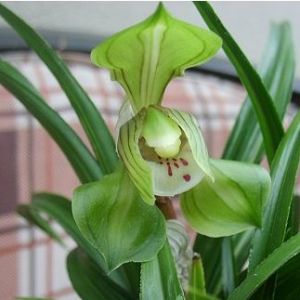
The flowers of the Chinese orchid Cymbidium goeringii are crystal clear and translucent, and it is known as the Crystal Flower.
Crystal Flower, a Cymbidium goeringii discovered in Zhoushan, China, of the Linsheng type, selected and bred in 2002 by Putuo orchid enthusiast Li Bo. Its leaves have the Linsheng body, forming a dwarf variety; the flower stem rises above the leaves, and the flower shape is unusual. It won the gold award at the 11th (Fuyang) Orchid Exposition of Zhejiang Province.
条件筛选