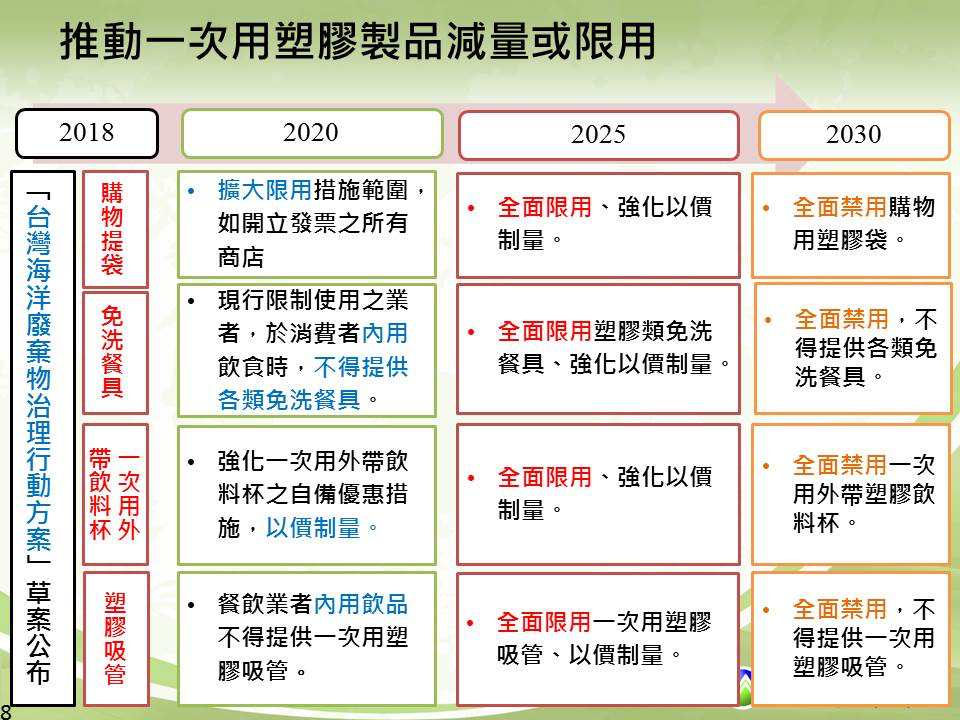
Reducing marine waste at the source: four single-use plastic products to be banned by 2030, including shopping bags, disposable tableware, takeaway drink cups, and straws
Marine debris pollution is severe. "The United Nations World Ocean Conference pointed out that nearly one ton of garbage is dumped into the ocean every minute. If humans do not take action, by 2050 there will be more plastic bags in the ocean than fish." Environmental Protection Administration Director-General Lee Ying-yuan stated that control will start at the source so that garbage does not enter rivers, coastal waters, and the ocean. Therefore, four single-use plastic products, including shopping bags, disposable tableware, single-use takeaway drink cups, and plastic straws, will be fully banned by 2030. Starting next year, chain restaurant operators will first be required not to provide single-use plastic straws for dine-in drinks.
The Environmental Protection Administration and environmental groups established the Marine Debris Governance Platform in July last year, and today (the 13th) jointly released the "Taiwan Marine Debris Governance Action Plan," setting out four major directions: source reduction, prevention and removal, research and investigation, and expanded cooperation and participation, with the hope of moving from plastic restrictions and plastic reduction all the way to a plastic-free ocean.

Next year, chain operators will first be barred from providing plastic straws for dine-in drinks
"The photo of a straw passing through a sea turtle's nose is too shocking, and everyone feels distressed, but that distress must be turned into making ourselves less convenience-oriented," Lee Ying-yuan emphasized. Next year will start with plastic straws: chain operators may not provide single-use plastic straws for dine-in drinks, and can switch to steel or edible materials, or even skip straws and drink directly. "Banning plastic straws for dine-in will not cause inconvenience to the public but to businesses, yet businesses can overcome it, which is why dine-in was targeted first."
In addition, regarding beach cleanups, Yeh Chun-hung stated that key coastal areas will be designated for strengthened efforts, a single window will be established for adoptable and cleanable coasts and for handling beach cleanup activities, so that society can invest more human resources in key coastal areas. At the same time, the status of coastline cleanup and maintenance and information on key coastal areas awaiting cleanup will be published regularly. Also, by 2022, it is hoped that the environmental protection fleet will increase from 1,200 vessels to 5,000, using an incentive system to encourage fishermen to join and bring back garbage salvaged along the way to shore for disposal.
In addition to marine debris management, garbage transported by rivers is also one of the sources of marine litter. Yeh Chun-hung explained that in the future a network platform will also be established for garbage cleanup, reporting, and record-keeping for rivers, major drainage channels, and irrigation ditches managed by the central government and county and city governments.
Chen Li-hsin stated that the Marine Debris Governance Platform will continue to operate in order to implement the policy guidelines, with rolling reviews every two years, and appropriate supplements and revisions based on implementation status, investigation results, and feedback from all sectors. "Marine debris involves a wide scope and is not limited to the jurisdiction of the Environmental Protection Administration. We look forward to incorporating cross-departmental dialogue in the future, bringing in fisheries, coast guard, the Ministry of Foreign Affairs, the Ministry of Economic Affairs, and others, all of which have roles and responsibilities they should fulfill." It is hoped that participation can be expanded and horizontal integration achieved, and friends from all sectors are urged to respond to this policy guideline, play their part as responsible global citizens, and one day return to the Earth a clean, plastic-free planet and save life in the ocean.