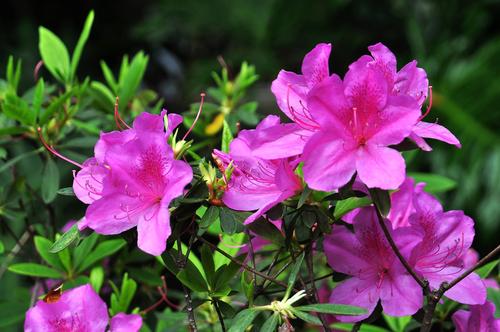
Introduction to Rhododendron cultivation techniques and propagation methods, and how to control Rhododendron pests and diseases
The Rhododendron is a fairly common plant. Do you know the Rhododendron growing methods? Let's take a look!
Cultivation and management methods
(1) Cultivation environment
1. Temperature and light: The new Rhododendron varieties Taoyuan No. 1 and No. 2 have an optimum growth temperature of 22°C to 32°C. In summer, appropriate shading is advisable to avoid leaf damage and slowed plant growth caused by full sun and high temperatures. In winter, full-sun cultivation is possible; excessive shading will reduce the number of flower buds and flower size, and make flower color paler.
2. Soil environment: It prefers well-drained acidic soil with a pH of 4.5 to 5.5. When the soil is neutral to alkaline, new leaves are prone to interveinal yellowing due to iron deficiency. This iron deficiency can be improved by watering the soil with chelated iron (Fe-EDTA), spraying the leaves with a ferrous sulfate (FeSO4) solution, or lowering the pH of the soil and growing medium.
(2) Cultivation methods
1. Fertilization: After flowering, appropriate fertilizer should be given, and a second fertilization should be carried out during the rapid growth periods in spring and autumn. Slow-release fertilizer is a good way to supply nutrients. When necessary, a 30N-4.4P-8.3K formula fertilizer diluted 1,000 times can be applied as a supplement. Take special note that Rhododendron has a fibrous root system and relatively shallow roots, so over-fertilization easily causes fertilizer burn.
2. Pruning and plant height control: Pruning can control the height of Rhododendron and promote branching. For potted-flower Rhododendron, after completing the final pruning by the end of June, spray the growth inhibitors chlormequat chloride (CCC) at 3,000 to 4,000 ppm or paclobutrazol (PP333) at 50 to 100 ppm to control height uniformity and promote compactness and uniform flowering of the potted flowers.
3. Propagation: For cutting propagation, it is advisable to use tip cuttings about 4 cm long. The cutting environment should be about 70% shaded, and appropriate misting should be provided to increase air humidity. Under suitable conditions, cuttings can root and be planted out in about 30 to 60 days. Rooting will be delayed when the temperature is below 16°C.
4. Pests and diseases: During the seasons when new shoots are growing and flower buds are forming, attention must be paid to damage by shoot borers. In summer high temperatures, attention must be paid to damage by spider mites. In humid and warm environments, brown spot disease easily occurs, producing irregular dark brown necrotic spots on the leaf surface, so attention must be paid and regular chemical treatment carried out. Other common pests and diseases include lace bugs and lepidopteran pests, etc.
Promotion and prospects
The genus name Rhododendron means "rose tree." Its flower shapes and colors are richly varied, and it has wide applications and is also one of the most common landscape flowers. Its beautiful traces can be seen from parks and traffic islands to mountains and fields. In China, New Taipei City is the main seedling cultivation area, with an annual output of about 3 million plants.