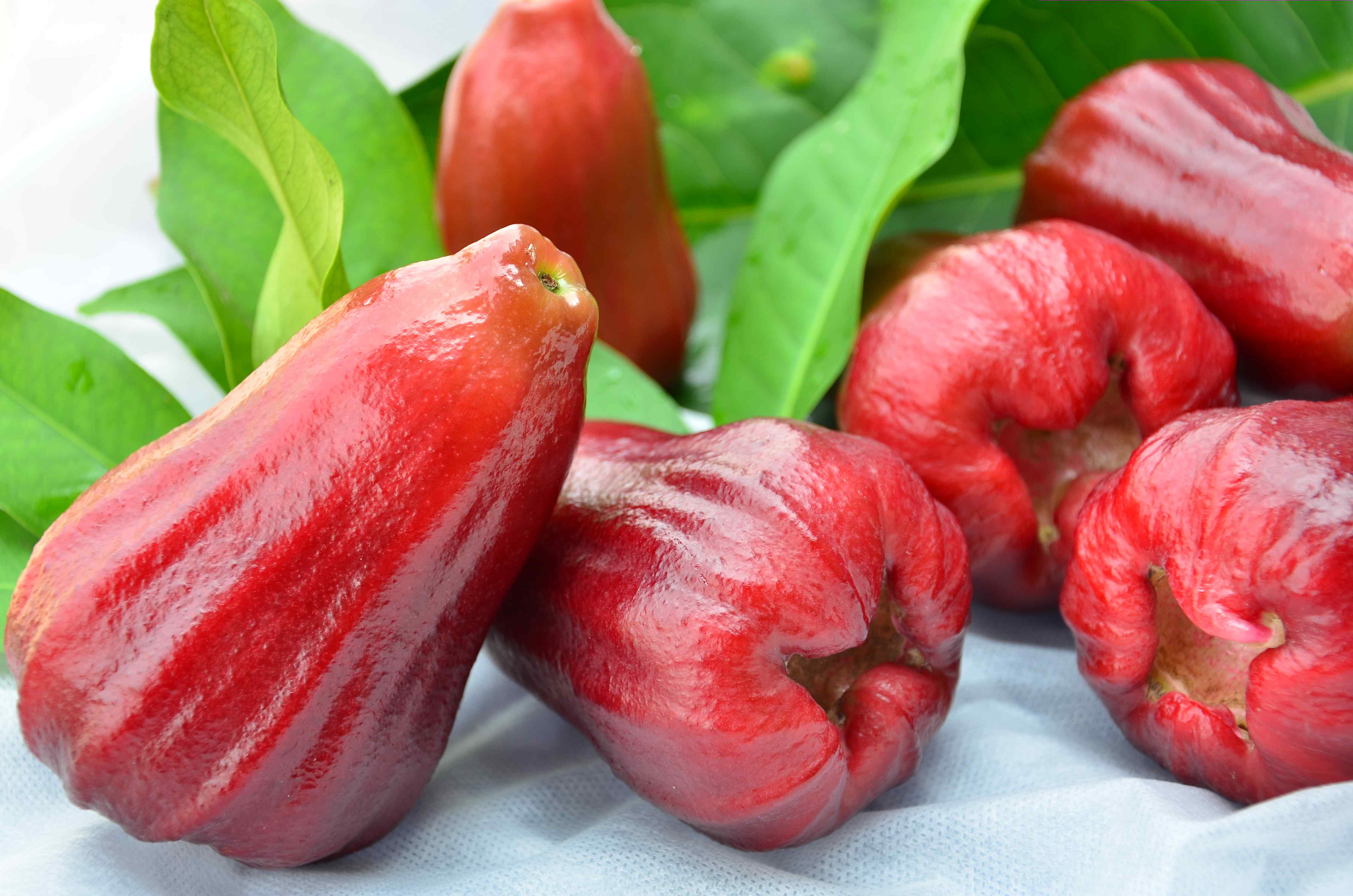
How do the wax apple varieties Summer Love and Spring Peach taste in terms of quality?
In Taiwan, China, wax apple cultivation techniques and production areas are concentrated mainly in Pingtung and Kaohsiung regions. In Pingtung, they are mainly in Fangliao, Yanpu, Neipu, Jiadong, etc., while in Kaohsiung they are mainly in Liugui, followed by Luzhu. In recent years, Xinyi in Nantou and Tianzhong in Changhua have also become new
In Taiwan, China, wax apple cultivation techniques and production areas are concentrated mainly in Pingtung and Kaohsiung regions. In Pingtung, they are mainly in Fangliao, Yanpu, Neipu, Jiadong, etc., while in Kaohsiung they are mainly in Liugui, followed by Luzhu. In recent years, Xinyi in Nantou and Tianzhong in Changhua have also become emerging production areas for autumn wax apples and missile wax apples. Taiwan's wax apples have stable quality and have been deeply loved by consumers for many years. Through the research and development techniques of agricultural departments, research institutions, and farmers, this delightful red fruit held in the palm of one's hand has transformed into a premium fruit with local characteristics.
Breeding varieties takes great effort, from wild types to the release of multiple commercial varieties
I wonder if everyone has ever tasted a wild wax apple - crystal clear, small and cute, but take a small bite and it is extremely sour and astringent. With such a wild flavor, the variety is probably still the one with the longest cultivation history, commonly known as the "local variety wax apple." But in recent years, cultivated wax apple varieties have increased to four types, including large-fruit varieties, Thai Ruby, and Indonesian large-fruit (palm-sized or perfume) wax apples, etc. The Fengshan Branch of the Taiwan Agricultural Research Institute has also bred three varieties: Tai Nong No. 1 "Purple Crystal," Tai Nong No. 2 "Large Red Fruit," and Tai Nong No. 3 "Brown Sugar Barbie." The Kaohsiung District Agricultural Research and Extension Station has also successfully bred Kaohsiung No. 1 "Summer Love" and Kaohsiung No. 2 "Spring Peach."
How to breed high-quality wax apple fruits that also meet cultivation costs according to Taiwan's own terrain and climate conditions is the most important task for domestic agricultural research institutions.
Chen Siru, Assistant Researcher at the Kaohsiung District Agricultural Research and Extension Station, shared the station's past breeding history. She said that in the early days, the lines were mainly large-fruit varieties, and farmers would retain seeds from branch mutations that grew especially well, but their genetic expression was unstable and this was not the best cultivation method. In response to increasing demand for fruit tree varieties suitable for cultivation in the country, the station began collecting germplasm for breeding work after the year 92 of the Republic of China.
Summer Love does not crack easily and is suitable for export; Spring Peach has fine flesh and is suitable for domestic sales
Along the way, from 92 to 95, the focus was on investigating the diversity of germplasm in the germplasm nursery. In 98, crossbreeding was carried out on germplasm with deep fruit color, stable coloring, large fruit shape and size, and low fruit-cracking rate. After repeated research and evaluation, in 101 it finally successfully propagated "Kaohsiung No. 1 - Summer Love," which has stable coloring, relatively hard fruit that does not crack easily, and a firm, somewhat hard texture with collision-resistant characteristics, produced with the export market as the priority consideration, and it obtained variety rights in 106.
At the same time, it also cultivated "Kaohsiung No. 2 - Spring Peach," which mainly targets the domestic market and was successfully bred in 102. Its production season is from January to March. Its characteristics are fine flesh, thin skin, and abundant juice, and it is easily favored by the older market. Because its appearance is large and its color is like a peach, farmers also call it "honey peach wax apple."
At present, there are already many wax apple varieties for farmers to choose from, but ultimately it still depends on orchard management and choosing suitable locations and conditions for planting. Only by "matching the right crop to the right place" can high-quality wax apple fruits be produced at low cost.
A hot commodity in domestic and international markets
⟦NL>
Speaking of planting different varieties in response to domestic and export markets, starting from the wax apple production season in mid-September, the collection center of the Liugui District Farmers' Association enters its busy stage. Wax apple is one of Taiwan's important economic fruit trees. Its fruit has a dense, bright red texture and is crisp, sweet, and juicy. It is exported to Canada, Hong Kong, China, Singapore, Malaysia, Xiamen, China, and other places, and is highly praised by consumers.
In recent years, the "Purple Honey Wax Apple" produced in the Liugui area has been a favorite in the export market. Liugui is located in the protected watershed of the Laonong River. The soil is mostly schist and gravel alluvial soil. The temperature difference between day and night in the mountainous area is large, the flesh is crisp and juicy, and the wax apple quality is excellent. It has always been a hot commodity in the export market. Through production period regulation, it can be harvested until May and June.
The Liugui District Farmers' Association uses "Black Diamond Wax Apple" as the representative brand for its local wax apples. The main cultivated varieties include the large-fruited "palm-sized wax apple," the "Brown Sugar Barbie" with dark red color, hard crisp juicy flesh and ample aroma, and the "Purple Honey Wax Apple (Honey Wind Chime)" with round, dark red fruit and a firm texture. Each distinctive wax apple variety has its own loyal supporters. When the production season arrives each year, orders arrive as well. Liugui wax apples with outstanding quality performance are only shipped north for domestic sales to the Taipei fruit and vegetable auction market. Not only are auction prices stable, but they are also treasures that wholesalers compete to buy.