Breeding Process and Cultivation Characteristics of New Azalea Cultivars Taoyuan No. 1 and Taoyuan No. 2
The main azalea cultivars currently available on the market fall into 5 major groups: Hirado azalea, Western azalea, Kurume azalea, Satsuki azalea, and Taiwan native azalea. Due to differences in the regional environments where each group was bred and in their parentage, each azalea group has different characteristics.
The Western azalea, which has gorgeous flower forms and is often used as a potted flowering plant, grows relatively weakly in Taiwan, China because of the high summer temperatures and heat, making it harder to cultivate. The Hirado azalea commonly seen along roadsides for landscaping and greening has less color variation, mainly in 3 colors: purple, pink, and white. To improve the vigor of potted-flower cultivars and to increase the color and flower-form variation of landscape cultivars, the Taoyuan District Agricultural Improvement Station spent 9 years selecting and breeding 'Taoyuan No. 1——Red Rose', suitable for potted cultivation, and 'Taoyuan No. 2——Torch', suitable for landscape use.
Breeding Process
The azalea cultivars 'Taoyuan No. 1' and 'Taoyuan No. 2' were bred by crossbreeding. 'Taoyuan No. 1' used Western azalea and Tai-jiao azalea as parents; 'Taoyuan No. 2' used Rhododendron oldhamii and Hirado azalea as parents.
'Taoyuan No. 1' and 'Taoyuan No. 2' each went through breeding procedures including crossing, selection of superior individual plants, and 2 rounds of line comparison trials. Among them, azalea line TYR0408051 was selected; its plants have good branching, strong growth, magenta single hose-in-hose flowers, numerous flowers, uniform flowering, and good ornamental quality, and it was named 'Taoyuan No. 1——Red Rose'. Azalea line TYR0401009 was selected; it has moderate branching, numerous flowers, and good ornamental quality, and it was named 'Taoyuan No. 2——Torch'. Both cultivars obtained our country's plant variety rights in ROC year 102, and the period for exercising the variety rights extends to September 11, year 127.
Cultivar Characteristics
(1) Azalea 'Taoyuan No. 1——Red Rose'
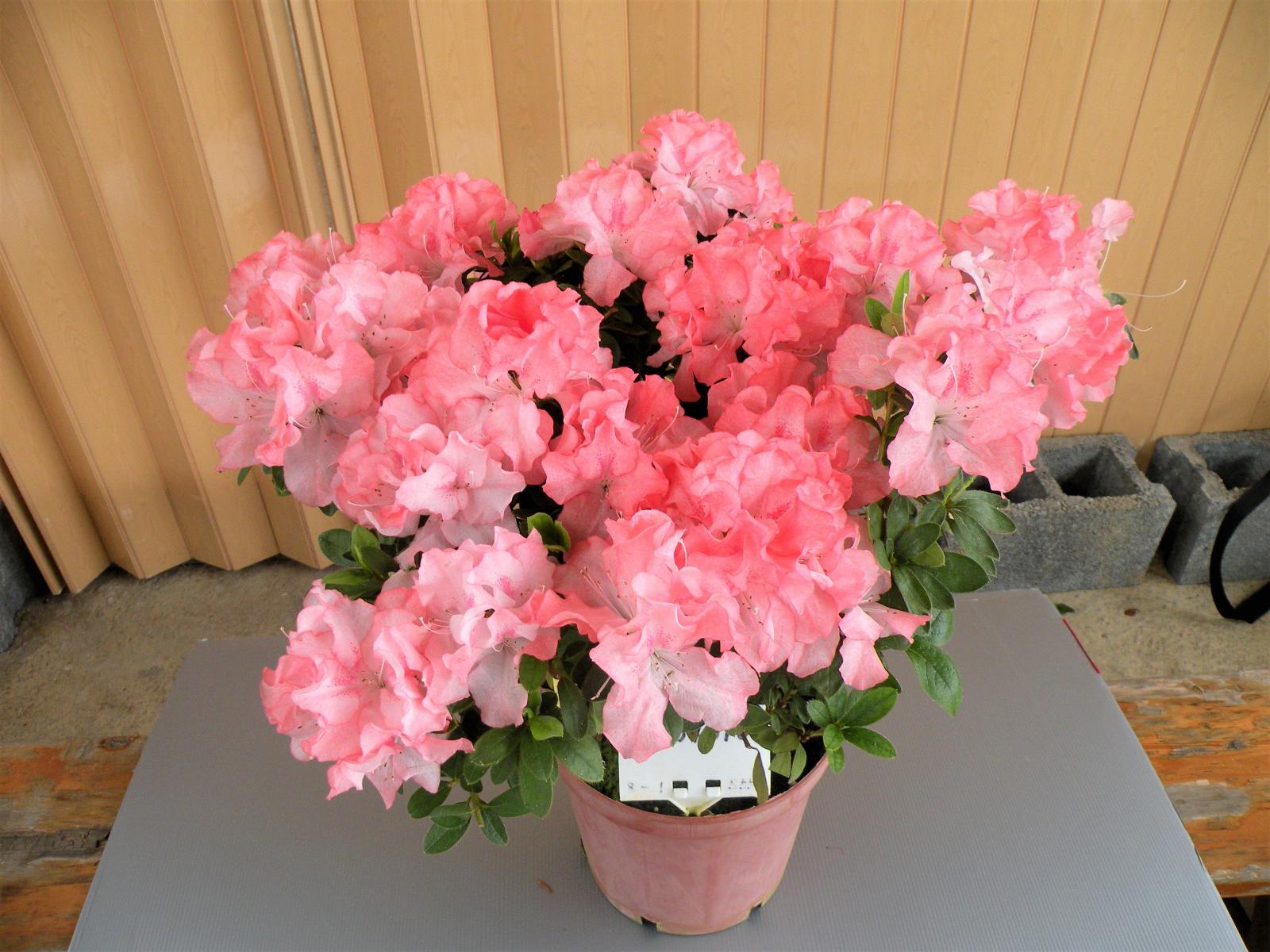
1. Plant characteristics: Evergreen small shrub, moderate branching, leaves oblanceolate, leaf apex acute, both leaf surfaces green, papery, non-glossy. The corolla is broadly funnel-shaped, the flowers are hose-in-hose (the calyx petalized into a second whorl of petals), some stamens are petalized, flower diameter is large (10.4 cm), the main flower color is purplish red (RHSN57A), and the main flower color has no variation in shade. The number of flowers is large and flowering is uniform, with good flowering quality.
2. Cultivation characteristics: It can be managed according to general azalea cultivation methods. In summer, appropriate shading should be provided to avoid leaf damage caused by strong light. It can adapt to outdoor ground planting, but care should be taken to choose a location with good drainage and protection from strong winds. The natural flowering period is about the end of February.
(2) Azalea 'Taoyuan No. 2——Torch'
1. Plant characteristics: Evergreen medium shrub, moderate branching, leaves elliptical, leaf apex obtuse, base shape acuminate, both leaf surfaces green, medium in length and width, papery in texture, with relatively long fine hairs. The corolla is rotate-funnel-shaped, the flowers are single, flower diameter large, the main flower color is in the red range (RHS38A), the secondary flower color is white (RHSN155B), the flower color has variation in shade, with very slight spots or stripes.
2. Cultivation characteristics: It can be managed according to general azalea cultivation methods. In summer, appropriate shading should be provided to avoid leaf damage caused by strong light. It can adapt to outdoor ground planting and grows well. In summer and autumn the branches tend to elongate, so appropriate pruning is needed to increase branching. In high-temperature and high-humidity environments, attention must be paid to the occurrence of leaf spot (Septoria azalleae Voglino). The natural flowering period is about March.