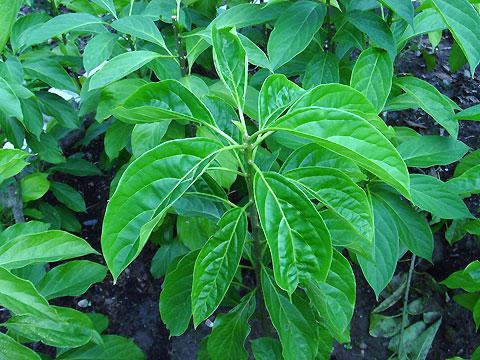
Introduction to the Effects and Fruit Toxicity of Nothapodytes nimmoniana, a Plant Endemic to Taiwan, China
Plants endemic to Taiwan, China are very likely a treasure bestowed by nature; it is just that we do not know it. On Lanyu, there is an endemic plant called "Nothapodytes nimmoniana" that has long been contracted by Japan, given to farmers for contract cultivation, then shipped back to Japan to be developed into anticancer drugs, earning Japanese companies billions of New Taiwan dollars every year. Taiwan itself, limited by patented technology, is unable to benefit instead. Its cultivation method is somewhat similar to how to grow potted lemons.
This inconspicuous little sapling becomes a money tree in the hands of foreigners. It is a plant endemic to Lanyu, Nothapodytes nimmoniana, and its special compound "camptothecin" can treat terminal colon and rectal cancer.
He Zhengkun, head of the Silviculture Division at the Taiwan Forestry Research Institute: "After camptothecin is extracted and then subjected to artificial semi-synthesis, it can treat colon cancer and rectal cancer, and its therapeutic effect is quite good."
Contract farming method: Japanese companies earn billions of New Taiwan dollars every year. Lanyu Nothapodytes nimmoniana's anticancer properties are all contracted by Japan
The endemic organisms of Taiwan, China are very likely a treasure bestowed on us by nature; it is just that we do not know it! Xu Yuantai, director of the Graduate Institute of Horticulture at National Taiwan University, said yesterday that a Japanese trading company has "contracted" the Lanyu endemic plant "Nothapodytes nimmoniana" in Taiwan, China, developed it into anticancer drugs, and earned a great deal of money, while Taiwan itself is unable to benefit instead.
He called on the government to grasp Taiwan, China's biodiversity, actively seek out and develop endemic species that have not yet been discovered, and use modern technology to turn them into wealth for all.
Xu Yuantai said that there are still two or three cases in Taiwan, China similar to that of "Nothapodytes nimmoniana," and because they involve commercial secrets, it is not convenient for him to disclose which endemic species they are. In the eyes of the people of this country, these species are just a plant, but in the hands of foreigners they become treasures.
The National Science Council held another pre-exhibition series press conference yesterday for the "2006 Science Season - Diverse Taiwan," raising the issue of our country's diverse organisms facing international competition.
Xu Yuantai pointed out that of the 150 prescription drugs most commonly prescribed in the United States, 120 come from natural compounds. For example, aspirin was first extracted from willow bark, penicillin was obtained from fungi, and the most popular recent one is shikimic acid extracted from star anise to develop drugs against avian influenza.
Lin Fulai, director of the Department of Science Education at the National Science Council, said that in recent years the international community has attached importance to how intellectual property rights should be distributed for new drugs developed from species in nature, but this has also triggered many controversies.
The Japanese company Yakult's "contracting" of the Lanyu endemic "Nothapodytes nimmoniana" is the most famous case in Taiwan, China. Xu Yuantai pointed out that three or four years ago, Yakult discovered that the Lanyu endemic Nothapodytes nimmoniana contains the special compound camptothecin, which can treat terminal colorectal cancer, so it used contract farming to commission farmers in Taitung to cultivate Nothapodytes nimmoniana in large quantities, extract camptothecin, and develop new drugs, earning the company billions of New Taiwan dollars every year.
Farmers in our country later discovered that Nothapodytes nimmoniana was such a good thing, but because Japan holds the technology patents, even though Nothapodytes nimmoniana is an endemic organism of Lanyu, farmers in our country only earned the meager processing fee for cultivating it for Yakult.
This matter caused controversy in the country. Xu Yuantai pointed out that to avoid expanding the controversy, Yakult gradually moved its Nothapodytes nimmoniana cultivation base to Ryukyu, and now there are not many farmers in Taitung still cultivating it, so even the money for processing cannot be earned.
Xu Yuantai believes that, strictly speaking, in the "Nothapodytes nimmoniana" incident, Yakult did nothing wrong; Japan invested a large amount of research and development funding before discovering that Nothapodytes nimmoniana was originally a treasure. On the contrary, our country did not even know that it had a treasure in its own home. "As for how to distribute the benefits, I do not have an answer right now either."
Going to Taitung / Is the hometown of Taiwan, China's medicinal herbs in Taitung? Leshan was originally named Yaoshan
When you see "Leshan" in Taimali, please read it as "Yaoshan." This name carries a forgotten past. The local people have not forgotten to call it "Yaoshan," because only in this way will they always remember that Taitung is the hometown of Taiwan, China's medicinal herbs.
Leshan, this name sounds very unfamiliar, but once you know its location, it makes people feel very familiar: it is right next to the well-known hot spring area Zhiben Hot Springs. Going all the way along Longquan Road, passing the large and small hot spring hotels lining the roadside, and walking to the end of Longquan Road, you will connect to Leshan Industrial Road.
I have been to Zhiben Hot Springs many times, but from my first visit more than 10 years ago to now, I never knew that Taitung's important medicinal herb cultivation area was right beside it.
During the Japanese occupation period, 6 mountainous areas between Zhiben and Taimali were selected as cultivation sites for medicinal herbs, while areas in Taitung City such as the stadium, parks, National Taitung University, and the Taitung District Agricultural Research and Extension Station were research and seedling centers for medicinal herbs.
The main purpose of large-scale cultivation of medicinal herbs was to prevent the occurrence of infectious diseases; during the Japanese occupation period, the most terrifying were naturally malaria and tuberculosis, so the cinchona tree, from which quinine can be extracted, and Stephania japonica, which has therapeutic effects on tuberculosis, were naturally the main crops.
The reason it could be selected as a medicinal herb cultivation site during the Japanese occupation period is that Taitung County itself has abundant plant resources; the number of vascular plant species in Taitung County reaches as many as 5,000, and among them the number of medicinal herb species exceeds 1,000. Especially on Lanyu and Green Island, there are many endemic or rare plants. Therefore, it is not an exaggeration to call Taitung a natural medicinal plant garden.
Yaoshan, because of the development of the Zhiben Hot Springs area, had the grass radical on top removed and became "Leshan." However, the older generation still remembers the days of planting cinchona trees and still does not forget to continue calling it "Yaoshan." In fact, even without the cinchona trees, medicinal herbs have continued to make money for Taitung over these years. Every year, the output value of Nothapodytes nimmoniana exported to Japan reaches 1 billion yuan, and the Japanese use it to fight colon cancer and lymphoma.
The fruit of Nothapodytes nimmoniana is cute, but it is poisonous and must not be touched.
In addition to Nothapodytes nimmoniana, Taitung County has established a medicinal herb production and marketing group and selected Houttuynia cordata, Rhinacanthus nasutus, Centella asiatica, Toona sinensis, and Zanthoxylum ailanthoides as the Five Treasures of Taitung. In addition to starting to promote the concept of edible herbs, it also makes the Five Treasures into tea bags or adds them to various foods, such as noodles, peeled chili peppers, and mochi, making them Taitung specialties.