How are the prospects and economic benefits of lily cultivation? Can it make you rich?
How can crops bring high returns? Lily cultivation techniques? Then let's take a look together at the development of the lily cultivation industry in Lintao County, Gansu! The vegetation in Lintao County, Gansu, is relatively sparse, and the lilies here are planted in deep mountains at an altitude of over 2000 m.
How can crops bring high returns?Lily cultivation techniques?Then let's take a look together at the development of the lily cultivation industry in Lintao County, Gansu!
The vegetation in Lintao County, Gansu, is relatively sparse, and the lilies here are planted in deep mountains at an altitude of over 2000 m. Lilies cannot tolerate too much sun, nor too much rain. Their requirements for the growing environment are relatively high. Shen Weijuan of Lintao County, Gansu, established the Baojiashan Village Lily Professional Cooperative, driving villagers to plant more than 2000 mu of lilies and helping 38 impoverished households get on the path out of poverty and toward prosperity.
In the sparsely vegetated Lintao County, Gansu, in deep mountains at an altitude of over 2000 m, a lily that came from Shaanxi 161 years ago has found its most comfortable “home” here.
In early June in Lintao, there was a little more rain than in previous years. Shen Weijuan, a villager from Baojiashan Village, Shangying Township, Lintao County, was a bit anxious. The 18 mu of lilies she had worked hard to cultivate were her family's hope. “Lilies cannot tolerate too much sun, nor too much rain.”
Who would have expected that Shen Weijuan, herself a poor household, would establish the Baojiashan Village Lily Professional Cooperative, driving villagers to plant more than 2000 mu of lilies and helping 38 impoverished households get on the path out of poverty and toward prosperity.
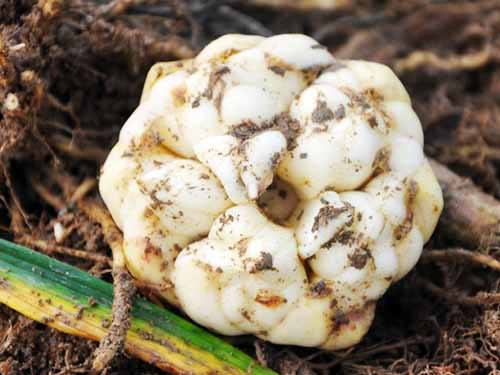
In the eyes of many people, the lily is an ornamental flowering plant, but in fact the lily is a perennial herbaceous plant. The underground stem tuber of the lily is made up of many fleshy scale leaves, with the leaves tightly clasped together, hence the name “lily”, meaning “harmony for a hundred years” and “all things going as wished”.
The lily is a plant highly prone to diseases and pests. If it suffers from pests or diseases in the field and rots, the lilies dug out will be very small and cannot fetch a good price. But the lilies in Lintao, because of the advantages of high-mountain ecological cultivation, are of excellent quality. The famous plant taxonomy expert Professor Kong Xianwu called them “extremely sweet in quality and taste, with very little fibre and no bitterness at all; not only famous throughout the country, but also worthy of being called the world's number one”.
If they cannot be sold for a price, then even sweet lilies taste bitter. Therefore, the lilies 27 km away have taken on a new identity. Wang Yongbing, who has rich entrepreneurial experience, has now developed his enterprise into a key leading enterprise in agricultural industrialisation that integrates agricultural technology research, deep processing of agricultural and sideline products, deep processing of dehydrated lily flowers, dried lilies, deep processing of dehydrated lily flowers, quick-freezing of field vegetables, pre-cooling and fresh-keeping, and cold-chain logistics.
In the lily production workshop, the washed and sterilised lily stem tubers are peeled apart by workers by hand, then placed piece by piece into special packaging bowls. After further deep processing, the lilies are made into processed foods such as dried lilies and frozen lilies, adding value to the lilies and meeting market demand for lilies. This has opened up multiple sales channels for lilies. It provides a basis for lily industry managers to improve production capacity and quality; it carries out traceability information classification, and each package of agricultural products can generate a unique label, providing endorsement for green and healthy branding; at the same time, it broadens sales channels, supports digital marketing innovation, and, combined with big data analysis of production and sales, provides guidance on production supply and demand relationships. This has enabled lilies to help 38 impoverished households get on the path out of poverty and toward prosperity.
When growing a crop, we must adapt to local conditions, so that the quality and yield of the crop are guaranteed; we must recognise the added value of the crop, so that we can open up sales channels and bring in returns. Now, you should know how to make your crops bring in returns!