What are the rare treasures of Chinese Cymbidium? Introducing you to the precious varieties
Introduction: Wanzia —— also known as the First Mei of Yuanhu Lake, it is said to have been discovered during the Tongzhi reign of the Qing Dynasty in Nanhu, Jiaxing County, Zhejiang, and was first cultivated at the Wan Family Garden in Hangzhou. The flower is a true plum petal. Because the flower color is emerald green and glossy, with a transparent quality, fine and glutinous texture, and a dignified, spirited bearing, it gives a refreshing and endlessly beautiful visual impression
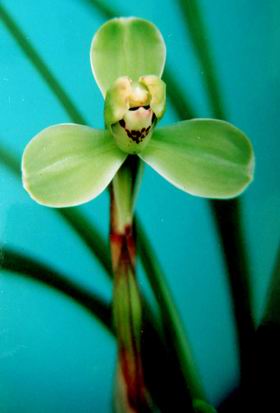
Wanzia Wanzia——also known as the First Mei of Yuanhu Lake, it is said to have been discovered during the Tongzhi reign of the Qing Dynasty in Nanhu, Jiaxing County, Zhejiang, and was first cultivated at the Wan Family Garden in Hangzhou. The flower is a true plum petal. Because the flower color is emerald green and glossy, with a transparent quality, fine and glutinous texture, and a dignified, spirited bearing, it gives a refreshing and endlessly beautiful visual impression. Wanzia exists in very small numbers and is extremely rare, truly a genuine treasure among Chinese orchids. Because many books publish Ruimei as Wanzia, some large orchid exhibitions display Ruimei as Wanzia, and even some orchid merchants sell Ruimei as Wanzia, many orchid enthusiasts have been hurt, people have doubts about the existence of Wanzia, and recognizing Wanzia is even more difficult. In fact, Wanzia is still relatively easy to distinguish.
1. Roots. The roots of Wanzia are noticeably thinner and longer than those of other Chinese Cymbidium.
2. Leaves: The leaves of Wanzia are wider than those of Songmei, soft in texture, with flat veins, and the outer leaves have longitudinal ridges. The leaf blades have a strong fleshy feel and are glossy, but are prone to black spots, which become very obvious on leaves more than two years old. The leaf tip is upturned at about 4-5 cm from the end, appearing very elegant. The central leaf is narrow and ribbon-like, generally not more than 0.5 cm at its widest point, whereas Ruimei has strong upright growth and does not have the above characteristics.
3. Flower: When the bud sheath emerges from the soil it is bright purplish red, and the short sheaths become more brilliant layer by layer. The sheath close to the flower is rich in green color and has a fleshy feel, whereas Ruimei is purplish red without obvious green color. The Wanzia flower scape is tall, about 20 cm, with the top node white-green and the node bearing red color, and the following nodes white-pale red with a green background, whereas the Ruimei flower scape is entirely purplish red. The Wanzia petals are standard silkworm-moth petals, tightly clasping the flower center, with a reddish blush on the upper side. The ru yi tongue extends straight out without curling back, and the back of the tongue base has bright red spots and patches distributed very regularly, whereas Ruimei has non-standard silkworm-moth petals and is rather inferior. The Wanzia petals are tightly rounded at the tip, finely narrowed at the base into a flat-edged shape, and overall appear compact and very spirited, whereas Ruimei appears somewhat loose and lacks spirit.
The above are some observations I have gained from cultivating Wanzia. Please criticize and correct any inappropriate points.
For more professional agricultural science and technology information, please scan the QR code to follow WeChat: NongXunNET

Please indicate the source when reprinting.