Collected Essays from the Lanfeng Tang - Read Online
Introduction: Among Cymbidium goeringii, the standard for selecting flowers is strictest for the lotus-petal type. Old lotus-petal varieties that have survived to the present day can be counted on one's fingers, which shows how rigorous the old selection method for lotus petals was. Below, regarding the evaluation method for selecting lotus petals in Cymbidium goeringii, I will share a bit of my understanding and experience of the old method from my years of studying orchids. (1) Petals: The three outer petals have a contracted base and flared corners; the attachment point of the three petals is noticeably narrowed, and the middle-to-rear part of the petals widens noticeably toward the petal tip, with the petal width generally reaching half the petal length or slightly more than half. The middle of the petal has a tight edge running toward the tip, and at the very tip it suddenly contracts into a pointed corner. There are also lotus petals whose flared corners appear as if present and yet not; if there is no obvious flared corner, it can be called a rounded petal. However, the tight edge of a lotus petal differs greatly from that of a plum petal; the tight edge of a lotus petal is generally caused by thickening at the edge of the outer petal, while that of a plum petal is very different.
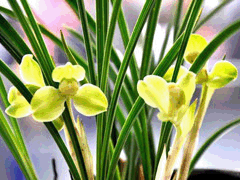 The standard for selecting flowers among Cymbidium goeringii is strictest for the lotus-petal type. Old lotus-petal varieties that have survived to the present day can be counted on one's fingers, which shows how rigorous the old selection method for lotus petals was. Below, regarding the evaluation method for selecting lotus petals in Cymbidium goeringii, I will share a bit of my understanding and experience of the old method from my years of studying orchids.
(1) Petals: The three outer petals have a contracted base and flared corners; the attachment point of the three petals is noticeably narrowed, and the middle-to-rear part of the petals widens noticeably toward the petal tip, with the petal width generally reaching half the petal length or slightly more than half. The middle of the petal has a tight edge running toward the tip, and at the very tip it suddenly contracts into a pointed corner. There are also lotus petals whose flared corners appear as if present and yet not; if there is no obvious flared corner, it can be called a rounded petal. However, the tight edge of a lotus petal differs greatly from that of a plum petal; the tight edge of a lotus petal is generally caused by thickening at the edge of the outer petal, while that of a plum petal is very different.
(2) Petals: The inner petals are best when short and round; the attachment point of the inner petals is also noticeably narrowed, widening in the middle, with a round head. The length-to-width ratio can also refer to that of the outer petals. If the inner petal edge is relatively tight, then the inner petals are round and convex like a chime-mouth; clam-shell shape is even better.
(3) Lip: The lip is best when large and round; a large round lip that is slightly curled is best, followed by the Liu Hai lip. Symmetrical red spots are best; the lip base should be pure white and the red spots should be vivid.
(4) Texture: The petal texture of lotus-petal flowers is extremely important; thick and glutinous is best. Petals with good fleshiness will split open when lightly pinched, and crack when dropped.
(5) Scape: The scape of lotus-petal flowers is somewhat thicker and shorter than that of other petal types, but if the plant is grown strong and pre-flowering techniques are in place, the scape can also be drawn taller.
(6) Form: The open form should be round and upright. Generally, the three outer petals of a lotus-petal flower are arranged in equal divisions, but if the width of the side petals reaches the grade, it can still open with level shoulders and look just as good. The central structure should be round, upright and open, like a person's heart and mind. The best open form of a lotus-petal flower is like Cuigai: the three outer petals embrace to form a circle, the central structure forms a circle, and the open form looks like a large ball embracing and protecting a small ball, which is truly beautiful.
(7) Holding: With lotus-petal flowers, one cannot look only at the early open form; the flower must remain unchanged or change only slightly after being open for a long time. If it becomes uglier the longer it opens, this shows that the flower's structure and substance are poor.
(8) Color: The old selection method regarded pure green as best, and muddy color as inferior. In present-day selection, purity of color can be regarded as best; pure green is precious, but other colors, as long as they are clean and vivid, are also top grade.
(9) Type: Those with sufficient substance but slightly insufficient shape can be called lotus type, and are also acceptable.
(10) Shape: Those with sufficient shape but slightly insufficient substance can be called lotus form, and are likewise acceptable.
The above are all my personal views, for reference only. Corrections and additions are welcome. Thank you.
For more professional agricultural science and technology information, please scan the QR code to follow WeChat: NongXunNET

Please indicate the source when reposting.