Miscellaneous Notes from the Orchid Wind Hall: Appreciating Butterflies, Closely Admiring the Beauty of Orchids
Introduction: Among the inner butterflies of the Cymbidium goeringii (spring orchid), there are roughly two types: stamen butterflies (rui die) and petal butterflies (peng die). When the petals are nearly fully lipized, it is a stamen butterfly; when the petals are not fully lipized, it is a petal butterfly. The floral standards for inner butterflies are also quite high. Below I will share my views and understanding of the floral standards of inner butterflies. (1) Petals: The outer three petals of a stamen butterfly are required to be arranged in three equal parts, and broad petals, thick flesh, and a soft, glutinous texture are also essential.
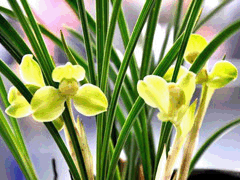 Stamen butterfly. Among the inner butterflies of Cymbidium goeringii (spring orchid), there are roughly two types: stamen butterflies and petal butterflies. When the petals are nearly fully lipized, it is a stamen butterfly; when the petals are not fully lipized, it is a petal butterfly. The floral standards for inner butterflies are also quite high. Below I will share my views and understanding of the floral standards of inner butterflies.
(1) Petals: The outer three petals of a stamen butterfly are required to be arranged in three equal parts, and broad petals, thick flesh, and a soft, glutinous texture are also essential. For petal butterflies, a standard opening is best; broad petals, thick glutinous flesh, and level shoulders are needed for it to look good. The main appeal of inner butterflies lies in the central cluster, but the requirements for the outer three petals cannot be ignored either.
(2) Petals (the inner petals): The petals of a stamen butterfly generally approach full lipization; at the base of the petals, unique lateral lobes like those on the tongue will form, and the distribution of the fetal coloration and spots on the petals is also fairly similar to that on the lip. However, the backs of the two lipized petals have a central vein and a folded angle like those on normal petals, which the tongue does not have. The requirement for petal shape is that the closer to the tongue shape, the better; if the difference is too great, it falls outside the standard. Petal butterflies generally have two petals in a semi-lipized state; a round and broad petal shape is best, and cat-ear petals are also very good. Sometimes there is a lateral lobe at the base of the two petals, and the petal shape and spots must all be symmetrical. If there is no lateral lobe, and the petal shape is acceptable and the color looks good, it can still pass, but by grade it falls outside the standard.
(3) Tongue: Whether for stamen butterflies or petal butterflies, the tongue shape is best when broad and round; pointed, narrow, and long ones do not qualify. Because inner butterflies require a comparison between the petals and the tongue, the symmetry of the tongue shape and the spots on the tongue is extremely important.
(4) Texture: The outer three petals should be glutinous in texture and thick in flesh; if the petals open without fleshy substance, the opening is generally not good.
(5) Form: Among stamen butterflies, some open facing upward and some open normally; regardless of the opening method, the flower's uniformity of shape is very important. The outer three petals should spread out generously and must not curl backward or wrinkle; it is best if they are arranged in equal parts, and the petals and tongue should also be arranged in equal parts among the three petals, forming a six-part arrangement, and the lengths of the petals and the petals-and-tongue must not differ too greatly. The petals and tongue also must not curl too much, as excessive curling reduces the visible surface and throws the entire flower shape off balance. For petal butterflies, the best opening should have broad petals and level shoulders; only when the two petals stand upright can the largest visible surface be obtained. The petals must not turn backward, and the tongue must not hang down too long. Whether stamen butterfly or petal butterfly, the more symmetrical, the better: the two petals symmetrical, the petals symmetrical with the tongue, the spots on the petals and tongue symmetrical. The better the symmetry, the higher the grade. If the petals are broad and the tongue narrow, or if the petals and tongue differ too much in length, both fall outside the standard.
(6) Color: The outer three petals should have good green coloration, while the inner petals and tongue should have white fetal coloration and red spots, and the colors must be vivid and symmetrical. Among Cymbidium goeringii (spring orchid) there are also butterfly flowers of other color series, and they too must have bright colors and strong contrast to qualify.
(7) Holding quality: For inner butterflies, the flower-holding quality is generally slightly better in petal butterflies. Because the two petals of stamen butterflies are strongly lipized, they often curl more and more as they open, but there are also stamen butterflies with relatively good flower-holding quality. In petal butterflies, the flower-holding quality generally shows more distortion in the outer petals, but there are also those that within a few days of opening have turned petals and hanging tongues.
Among inner butterflies there are also some with many petals, many inner petals, and many tongues; if their uniformity of shape is good, they can qualify, and if they can produce as many as 'Yu Hudie' (Jade Butterfly), they should be graded as fantastic flowers. If they fall far short and the flower shape is not good-looking, they all fall outside the standard
For more professional agricultural science and technology information, please scan the QR code to follow WeChat: NongXunNET

Please indicate the source when reprinting.