What are the identification methods for South African marigold essential oil?
How to identify marigold essential oil
1. Scent
Essential oil is highly concentrated, carrying a scent more than 70 times more concentrated than that of the original plant, with a natural, lasting, multi-layered aroma. Essential oil contains hundreds of different molecules, which act together on the brain and let us perceive distinct top, middle and base notes, with a long-lasting lingering quality.
2. Color: the essential oil is golden yellow
3. State of the oil liquid
Drop a single-note essential oil on a paper towel, wait a while and then look at the oil stain. If the stain spreads noticeably, it means carrier oil has been added; if the stain shrinks or even disappears, it means it is pure essential oil, because essential oils are volatile.
Although essential oil is an "oil", most essential oils are not greasy or oily, but clear and transparent, like water. We can drop 1 drop of essential oil on a facial tissue or white paper and observe its state. (See the picture above.) After the essential oil evaporates, it generally leaves no oil stain. Some essential oils containing iron may leave a faint yellow-brown color, and certain citrus essential oils leave a pale yellow trace.
In addition, when essential oil is dropped into cold water, some will float on the surface as a layer, and some will sink to the bottom as a whole drop; although it does not spread, the scent already fills the entire cup. When dropped into hot water, pure essential oil quickly disperses into fine particles in the water, while impure essential oil forms a floating oily film.
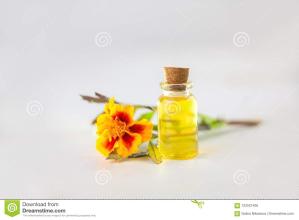
Characteristics of South African marigold
South African marigold is a perennial herbaceous flowering plant of the Asteraceae family, native to South Africa. In recent years it has been introduced into China from abroad and cultivated as an annual or biennial herbaceous flower. The dwarf variety is 20-30 cm tall, with green stems, head-like inflorescences mostly clustered into corymb-like heads, in colors such as white, pink, red, purplish red, blue and purple, with single petals and a flower diameter of 5-6 cm; 1000 seeds weigh about 11 grams. It likes sun and is moderately cold-tolerant, able to endure low temperatures of -3°C to -5°C. The tall variety of the same genus is 60 cm tall, is a subshrub, and can be cultivated as a cut flower in its place of origin.