Solar power on farmland sparks another wave of speculation, leaving local governments and the Council of Agriculture passing the buck
Kouhu Township in Yunlin County lies on the coast of Taiwan, China, where the sea winds are bitter and the groundwater has been invaded by seawater, so that salt appears on the soil surface like white frost. In such an environment, one solar power operator nevertheless set up a "net house" here to grow coffee, erecting dual-axis tracking solar panels under the name of "green energy facilities attached to agricultural facilities."
Walking into the operator's "net house," there is only the farm's four-sided perimeter netting, and the coffee seedlings on the ground are sparsely scattered about, sometimes catching a bit of sunlight and sometimes sitting in shadow, entirely depending on when the dual-axis tracking solar panels three meters above the ground adjust their angle; the coffee seedlings have been reduced to decorative agricultural planting attached to solar facilities, becoming the ornament of "growing solar power on farmland."
In October of the year before last, the Council of Agriculture amended the "Regulations Governing the Review of Applications for Agricultural Land to Be Used for Permitted Agricultural Facilities," allowing agricultural production facilities in special agricultural zones and general agricultural zones to have attached green energy facilities with no limit on area size. After the rule formally took effect last year, many operators spotted the business opportunity, persuaded farmers to sign 20-year leases, and erected solar panels.
Although the Council of Agriculture stipulated that green energy facilities must be "integrated" with agricultural operations, what is "integration"? How much light transmittance is needed so as not to affect crop growth? What crop survival rate must be reached? Are there restricted categories? To what extent must the cultivation scale of different crops reach in order for there to be actual agricultural operation? The Council of Agriculture defined none of this, leaving local governments to assess on their own, which has led to chaos everywhere and left local governments deeply troubled.
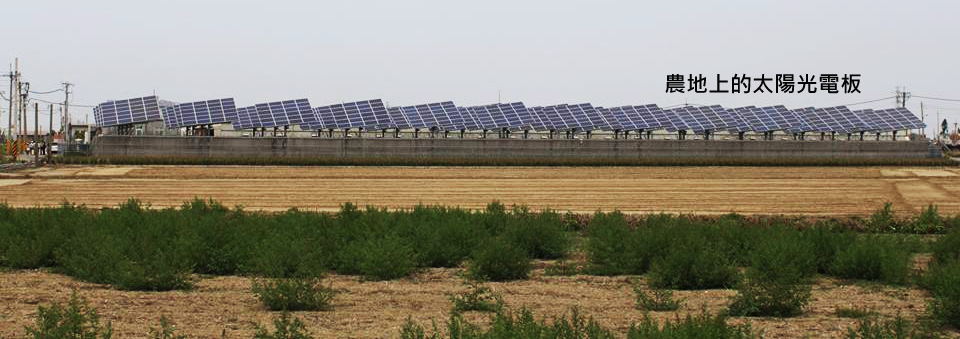 Green power operators apply to grow solar power on farmland under the name of "green energy equipment attached to agricultural facilities," but the so-called agricultural facility is merely a symbolic setup of "insect netting" claimed to be a net house, and the crop chosen for planting is coffee grown in the land subsidence area of Kouhu Township. (Photo / Wang Wen-hao)
Opening the door to growing solar power is like a Pandora's box that cannot be contained
Opening up heated net houses to solar power generation is like Pandora's box: once opened, it cannot be contained. Excluding cases already applied for before the new rule took effect, the three major agricultural counties of Changhua County, Chiayi County, and Pingtung County have still not issued their first licenses for green energy attached to heated net houses.
Li Chiu-ying, section chief of the Agricultural Operations Section of the Chiayi County Agriculture Department, said that operators most often retort: "You won't even let me plant and see, so how do you know the solar panels will affect production?" But once it is opened up, subsequent inspections will become even more difficult, because there is no legal definition of what constitutes agricultural operation; unless there are truly no crops planted at all, operators will always have something to say.
Su Chi-huai, section chief of the Agricultural Operations and Plant Protection Section of the Changhua County Government Agriculture Department, said bluntly that once the first case is approved, operators will certainly demand to be treated the same way. Even now, some operators are asking why Yunlin can do it but Changhua cannot. The county government does not have much manpower, and once it is opened up, inspections will be very difficult; moreover, whether crops grow well or poorly leaves much room for argument, and even if operators plant perfunctorily just to show the government, it is still hard to say they are not making agricultural use. The Council of Agriculture should clearly define exactly what types of operations may have attached green energy, otherwise operators will use the name of growing crops to actually grow solar power. (To be continued; to keep reading, please click here)
Disguised green power, actual farmland plunder: who gets fat from growing solar power on farmland?