Fipronil suspension concentrate to be banned starting next year; Council of Agriculture: granular formulations can still be used on specific crops
The hand-shaken tea storm: inspections by local health authorities found that most imported tea leaves had fipronil pesticide residues exceeding the limit, and some domestic tea factories also used it on tea leaves in violation of regulations. Kang Chao-chou, an official of the Council of Agriculture (COA) and director of the Executive Yuan's Food Safety Office, said today at the Legislative Yuan that starting January 1 next year, fipronil suspension concentrates will be completely banned, and only granular fipronil may be used in corn and paddy fields.
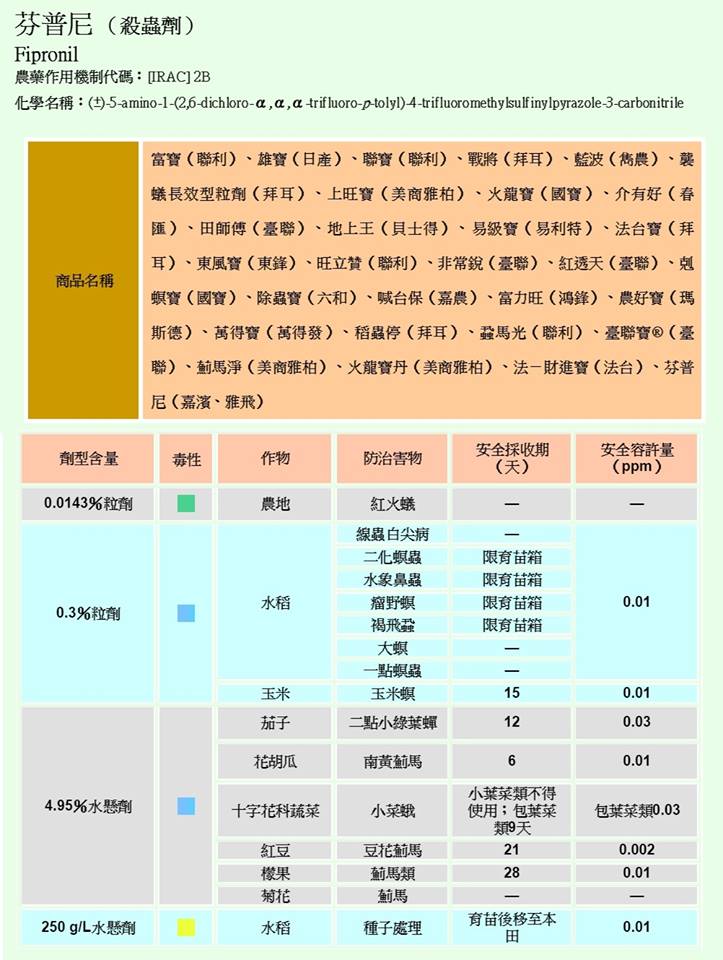
In fact, this regulation restricting the complete ban on fipronil suspension concentrates was a policy announced by the COA as early as the beginning of this year, originally intended to take effect on January 1, 105 (2016) after a one-year buffer period for businesses. According to data from the COA's Pesticide Information and Use System, 4 fipronil products are currently permitted for use on crops in our country, including 2 suspension concentrates and 2 granules; starting next year, the suspension concentrate portion will be completely banned.
In addition to fipronil suspension concentrates, starting January next year, liquid damasone and mecisulfan will also be banned. These insecticides are mostly used to control pests such as diamondback moths in paddy rice and red bean crops, but because they easily cause contamination of neighboring fields, it was decided to ban them together next year. And because the ban on the three pesticides will affect red bean cultivation, the COA's Bureau of Animal and Plant Health Inspection and Quarantine is seeking alternative pesticides.
Fipronil has tumor-causing risk; banned for use on tea leaves in our country; expert: granules are safer than suspension concentrates
Fei Wen-chi, director of the COA's Taiwan Agricultural Chemicals and Toxic Substances Research Institute, said that in the past some businesses tried to apply for legal use of the pesticide fipronil on tea crops, but experiments by agricultural authorities found that fipronil residues sprayed on tea leaves dissipate very slowly, and the residue levels in harvested leaves remain very high; because field monitoring concerns were high, the institute has never approved this pesticide for use on tea leaves.
"However, fipronil suspension concentrates can still be sprayed on corn and some vegetables." Fei Wen-chi emphasized that the maximum daily intake of fipronil per kilogram for our people is 0.0002 mg/kg. Taking 60 kg as one human body unit, an adult must not ingest more than 0.012 mg/person of fipronil per day. Government agencies use this to set pesticide residue limits for various crops, but spray-type fipronil used on tea leaves often "goes off the charts," so it has never been approved; for other crops, because fipronil residues easily exceed limits, it was decided to ban it completely next year. However, farmers can still choose granular fipronil applied to the soil to eliminate pests.
Weng Su-shen, former head of the Residue Control Division at the institute, pointed out that granular fipronil does not drift, and its pesticide content is lower than that of suspension concentrates, making it safer in terms of management. However, internationally, many tea farmers still spray fipronil on tea leaves to control pests, and Sri Lanka has also intended to promote it in recent years, because fipronil is classified as Group 2B by the World Health Organization's International Agency for Research on Cancer (IARC), meaning research reports clearly indicate that this type of pesticide is tumor-causing in humans; as for carcinogenicity, more scientific research evaluation is still needed.
Currently fipronil may be used as granules and suspension concentrates for spraying; starting next year, only granules and specific crops will be permitted

Concerned about harming bees, the EU bans fipronil for two years, with monitoring by scholars
In addition to fipronil being difficult to dissipate as residue when applied to tea leaves, early last year the EU, in order to find countermeasures for disappearing honey, was the first to issue a two-year ban, prohibiting the use of three neonicotinoid pesticides, clothianidin, imidacloprid, and thiamethoxam, as well as the insecticide fipronil. In response, both Fei Wen-chi and Weng Su-shen pointed out that opinions on this ban are polarized, and whether fipronil endangers the survival of bees still awaits monitoring by researchers during the two-year ban period.
Regarding the COA's decision to completely ban fipronil suspension concentrates, Pan Chih-kuan, head of the Food Division of the Ministry of Health and Welfare's Food and Drug Administration, said that the FDA will not re-evaluate the safe tolerance levels of fipronil in various crops because the COA this time is only banning the "spraying method," not banning the use of fipronil.