Land Art: Fram Kitagawa Reshapes Regional Value Through the Symbiosis of History, Culture, and Environment
Series introduction:
The "Echigo-Tsumari Art Triennale" and the "Setouchi Triennale" are major Japanese art events and world-class art exhibitions. Artists from all over the world use the public spaces of rural Japan as their stage, carrying out remarkable artistic actions in which history, culture and the environment coexist. Besides stimulating regional revitalization in the countryside, they also remind the public to feel the shared pulse of people and their environment.
The Echigo-Tsumari Art Triennale, held once every three years, is currently taking place in Niigata, Japan. The author of this article (secretary-general of the Taiwan Association of Historical Resources Management) has written in detail, especially for readers unable to attend in person, about the context in which the two art triennales emerged and their exhibition content, as well as the impact such artistic actions have on the local area and on Japanese society. This is the first in the series; to read other articles in the series, please see the appendix at the end of the article.
Cultural tourism thinking that starts from local life
Aldo Leopold (note 1) (1887-1947), the father of modern environmental conservation who emphasized "The Land Ethics," once wrote a famous line regarded as a maxim by the conservation world: "A thing is right when it tends to preserve the integrity, stability, and beauty of the biotic community. It is wrong when it tends otherwise."
Aldo Leopold's so-called land ethic extends the scope of the life community, holding that land is not merely soil; the land we live on actually includes soil, air, water, plants, animals and so on. The inspiration Aldo Leopold gives to the present day is a reminder that if humans can feel empathy with nature, the life of the land will resonate with the pulse of our lives, and many conflicts and destruction of nature can thereby be avoided.
Since the twentieth century, massive and unrestrained human activity has led to energy consumption and placed a heavy burden on the natural environment; climate change, species extinction and food shortages have become urgent issues of survival for us. The World Expo, arguably one of the largest international gatherings of people, has moved from the past competitions in which nations displayed their power to a recent focus on local history and culture and contributions to the global environment, clearly showing that humanity has recognized the importance of the "human and nature" relationship.
Unfortunately, whether it is bidding to host the World Expo, the Olympics and other major sporting events, or cities holding their own art festivals and carnivals, or moving along the path toward becoming a "Creative City," these large events are often means of marketing urban tourism or conducting urban planning at the national or city level, and rarely offer comprehensive care that assists localities and attempts to solve environmental problems. Large cultural events often bring enormous construction; with short-term injections of funding they accumulate excessive visitor numbers and media impact. Yet if the events themselves cannot clearly convey their message to the public and think about ways to empathize with local life, they easily lose focus amid media opinion and waves of information and are difficult to sustain.
Compared with the expensive, luxurious and standardized consumption specifications of large amusement facilities or international chain stores, localities have a greater need for everything that most closely reflects daily life, developing through humanities, history, tradition and the existing conditions and resources of nature to "enrich local knowledge and culture and integrate community education networks," so as to achieve the goal of safeguarding the sustainable development of the homeland.
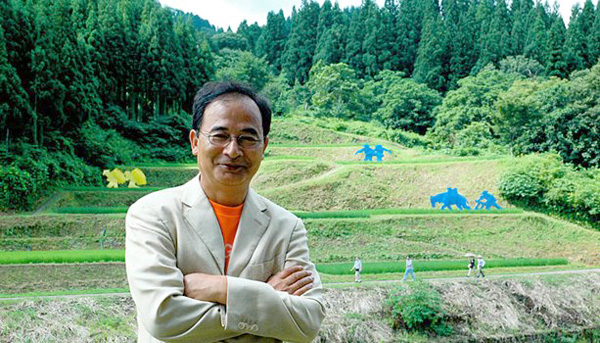
The Japanese "Echigo-Tsumari Art Triennale" and "The Setouchi Triennale," curated by Fram Kitagawa (translated here in Chinese as "Beichuan Fulang"), are precisely cases worth Taiwan learning from and reflecting on.
The author has met with curator Fram Kitagawa many times to exchange views, and has also introduced the art triennale cases on various occasions to domestic audiences, government personnel at all levels and frontline workers engaged in rural regeneration. Through field visits and interviews with Fram Kitagawa, and with the assistance and guidance of Professor Yukio Nishimura, vice-president of the University of Tokyo, this study gains an in-depth understanding of Fram Kitagawa's curatorial philosophy and thinking, seeking future possibilities for the cultural tourism and regional regeneration that Taiwan is still learning about.
Note 1: Shortly after graduating from Yale University, Aldo Leopold joined the U.S. Forest Service, serving as assistant forest ranger in New Mexico and Arizona. He devoted his entire life to nature conservation and became a pioneer of the American conservation movement.
Note 2: The World Expo began in 1851; its themes over the years reflect world trends and the spirit of the times. Early themes focused on "technology" and "invention," while after World War II they appealed to "peace" and "building tomorrow." At the start of this century, the first to make natural issues a central focus was the 2000 World Expo in Hannover, Germany, with the theme "Humankind, Nature, Technology," which began to consider the sustainable development of the expo grounds; the theme of the 2005 World Expo in Aichi, Japan, was set as "Nature's Wisdom," the first time a "citizen-participation" approach called on the whole world to learn together from the great wisdom of nature; the theme of the 2010 Shanghai World Expo was "Better City, Better Life"; and the 2015 host country Italy set "Feeding the Planet, Energy for Life" as the theme of the Milan Expo.
(Note 3) Taken from the Italian word Fare (to create), plus the first letter T of Tachikawa, the word Faret was coined.