Friendliness toward the ocean is indicated by a score, encouraging fishers and consumers to improve together.
Scores Replace Red-Yellow-Green Lights, Encouraging Fishers and Consumers to Improve Step by Step
Developed by a civil society organization in Taiwan, China with reference to international standards, the locally created "RFI Responsible Fishery Index" draws all its indicators from existing international data, yet its use of scores for measurement is a mechanism rarely seen anywhere in the world.
Hsu Cheng-yu said that existing mechanisms such as MSC offer only two outcomes, pass or fail, and seafood purchasing guides only have red, yellow and green, which is somewhat harsh on producers. "Sustainability means everyone takes responsibility for their own part and keeps improving, and only then can it finally be achieved." For example, he said, a fisher might start with only 4.2 points, but improve to 3.5 points next time, then 3.2 points the time after that, and the ocean keeps moving toward sustainability. That is why the score format was adopted, taking an "improvement principle" to encourage more producers to join. "We want everyone to chant the sutras, not just the monks."
A closer look at the design of the RFI mechanism shows that there is virtually no application threshold; as long as a fishery is not IUU (Illegal, unreported and unregulated fishing), it can take part. For example, even if fishers use bottom trawls to catch endangered fish, they can still apply for RFI, though the score may be 5 points, the category least recommended for consumption.
The scoring system encourages not only fishers but also gives consumers a goal to work toward. After consumers create an account on the RFI website, they can record the RFI score of each seafood purchase, and the website will automatically tally and analyze it for them. If this month's average is 3.5 points, next time they can aim for 3 points.
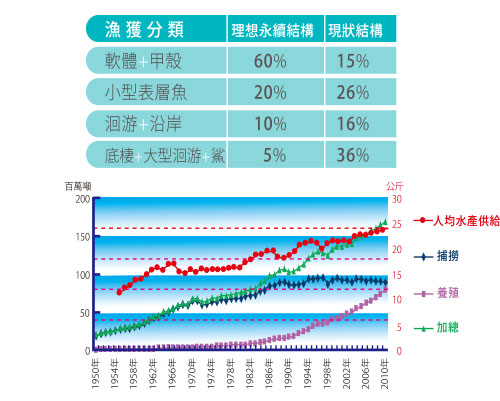
Hsu Cheng-yu stressed that sustainable fishing does not mean certain species can never be eaten at all, but rather that they should be taken appropriately according to the existing structure of fishery resources. Globally, mollusks and crustacean seafood account for 60%, while benthic species and large migratory fish and sharks account for only 5%, yet the proportion people consume is 36%, while crustacean and mollusk seafood accounts for only 15%. Sustainability means adjusting the structure of fishery use while taking into account the environment, producers and consumers.