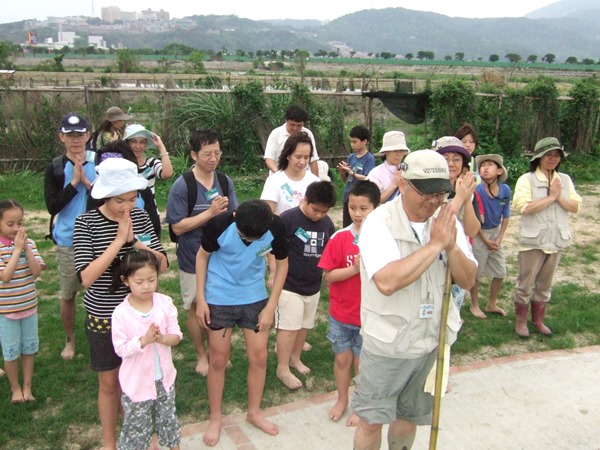
Paddy Field Class Enters the Reserve: Guandu Nature Park Four Seasons Camp
Text/Water Drop
Introduction: The Four Seasons Camps at Guandu Nature Park
Guandu Wetland, located at the confluence of the Tamsui River and the Keelung River, has been an important habitat for migratory birds since ancient times. Rice paddy cultivation here has a history of more than 100 years. In 2001, the Taipei City Government spent more than 15 billion yuan to acquire the land by expropriation, and the "Guandu Nature Park" was entrusted to the Taipei Wild Bird Society to manage free of charge. How to use this important wetland environmental learning center in northern Taiwan to let the public experience and identify with the value of wetlands became the mission of the park team. Among these efforts, the spring plowing, summer weeding, autumn harvest, and winter storage paddy field four-season camps, themed "Guandu Farmer's Journal," have gone through ten years of refinement and growth. This article attempts to interview working partners and sketch and organize the process along the way.
The Park Wants to Farm!
In the early days of the park's establishment, everything was waiting to be done. Part of the area consisted of rice paddies that local farmers had already been cultivating, and these were still provided to farmers free of charge for rice production. In order to let more people deeply experience rice paddy culture, ecology, and value, and because many local volunteers who had lived there for generations missed the past scenes of crisscrossing field paths and memories of labor, they constantly urged the environmental education department colleagues to "farm!"
In 2005, under the commission of the city government's Construction Bureau (predecessor of today's Department of Economic Development), the original version of the paddy field camp came into being. The full-time staff had never planted rice, and everything started from zero. Chen Shih-hung, who was then an environmental education specialist and is now the director, recalled: "We were very funny back then... for transplanting rice seedlings we first had to pull ropes, and to make field ridges we first used wooden boards as dividers!" In the beginning, only two programs were developed, transplanting and harvesting, relying heavily on the vigorous input of local farmer volunteers, who helped plan courses, impart farming knowledge, and even help patrol the field water. In 2006, the prototype framework of the four seasons - spring plowing, summer weeding, autumn harvest, and winter storage - was developed. The following year, it was further expanded from a half-day activity to a full day.
In the process, in addition to caring for the paddy field with farming methods that use no pesticides or chemical fertilizers, allowing the animals in the field to grow together with the rice, participants also walked into this former rice granary of Greater Taipei through games, indoor classes, and hands-on practice, personally experiencing and understanding the various values of rice paddies. From the "preparation" of spring plowing - land preparation and transplanting; the "care" of summer weeding - hand weeding and making scarecrows; the "harvest" of autumn - cutting rice, winnowing, and threshing; to the "gratitude" of winter storage - field brick ovens and making rice cakes used by local farming families to thank heaven. Through the rhythm of the four seasons, the public experiences a miniature of rice cultivation and its culture. Many adults and children who had never stepped barefoot on soil went into the field for the first time in their lives, putting on the most natural black socks for their feet, or having close encounters with the animals in the field.
Team members constantly questioned each other: "What is different between what we do and a leisure farm?" Throughout the process, they kept trying, experimenting, and revising: "We even went to the agricultural improvement station to get green lacewings to raise, wanting to let participants learn about biological control... later we found it was too hard to care for them!" The scarecrows currently made using cyperus sedge were originally made from barnyard grass, a weed in the field that pricks people. The overly "joyful" water gun game was also replaced by a bird-scaring flag DIY with environmental ethics meaning.