Food safety: proving it through testing is futile
Editor's note: On May 20 the new government formally took office. The agriculture and food industries have expectations for the new administration, hoping to make Taiwan a country friendlier to farming and safer for all. In the[New Government, I Have Something to Say]series, we interview people in agriculture- and food-related businesses, who share their ideas on how to make Taiwan better. What follows is the interviewee's oral account, compiled by News & Market reporters from the interview.
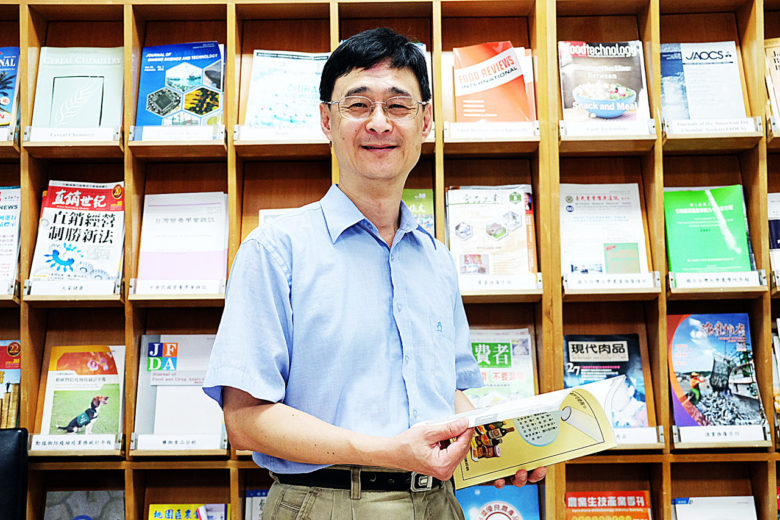
[Interviewee]Lu Ting-chang, Director of the Institute of Food Science and Technology, National Taiwan University
I have taught for about 20 years. Since my student days I have been involved with food chemistry and "carbohydrates" - whether sugary sugars, easily digested starches (such as rice), or indigestible polysaccharides (such as reishi). Through chemical testing tools I study the carbohydrate composition and various complex components in food, and I have found that food is so complex that many unknown chemical components still cannot be grasped today. So food safety problems cannot be solved by testing alone. "Testing only discovers problems; the key is that after discovery, you go back and review the manufacturer's process quality control - that is the root."
Using testing to prove food safety is futile
After graduating in 1995 from the Department of Food Science and Human Nutrition at Iowa State University in the United States, I returned to Taiwan to teach and continue researching carbohydrates. For those of us who study food chemistry, natural and chemically synthesized nutrients are the same; eating is all about absorbing the chemical components in food. It is just that natural foods are closer to the original form of the food, with complex, diverse and balanced composition, whereas chemical nutrients are highly pure and relatively simple, like vitamin A and so on. To a certain degree, natural foods and chemically synthesized nutrients are like Chinese and Western medicine - each has its own advantages.
The research work of food chemical analysis is to understand the composition of food and what changes these compositions undergo when processed. Besides known chemical components, foods all contain unknown components. Therefore, if you want to use chemical analysis and testing to prove the safety of food, that is doing the opposite, because complex food composition produces complex changes, and testing them one by one is almost impossible.
Take acrylamide, which has been much discussed in recent years. Before acrylamide was listed by the International Agency for Research on Cancer (IARC) as a possible carcinogen, it had already existed for hundreds of years in fried and baked high-starch foods, but past analytical techniques were not advanced enough to know it was there. Another example is methanol - in fact every kind of alcohol contains methanol; it is not the "patent" of fake liquor, only a difference in how much is present, because plant cell walls contain methanol components, and after brewing, alcohol naturally has it. Both of these substances are harmful to the human body, but the risk can be controlled through the process.
So a safe food, besides having good raw materials, also needs well-managed processes. The quality of raw materials can be judged from the growth conditions of crops in the field, and whether process management is good can be analyzed from production records. If this front-end quality management is not monitored, and instead only the test results of each individual product at the end are emphasized, then no matter how much is done, it is futile.

"Food identity standards" should be established, defined by food raw materials and process management
Take the case of dried tofu testing that found excessive preservative added. The current management approach is to take it off the shelves, recall it, issue fines, and increase the number of tests, but the more fundamental approach should be to think about "why does the manufacturer add excessive preservative?"
The main problem is mostly that the factory area is too dirty and messy, making microorganisms hard to control, or that the manufacturer ignores regulations. So directly inspecting the factory, checking incoming and outgoing material management, strengthening hygiene management, guiding dosage control, and adding food professionals is what can possibly prevent recurrence. Therefore testing is only a tool, not a method of solving the problem.
When facing disputes over food fraud, we also very much like to use testing to solve them, but testing does not necessarily really catch fake products, because many substances can be artificially blended. So formulating "food identity standards" and clearly stating the definition of real food is very important, but defining food by "chemical composition" should be avoided.
For example, not long ago the National Treasury Administration of the Ministry of Finance, to prevent a Pandora-style fake red wine from reappearing, issued reference standards for wine, specifying that among the organic acid components of wine, succinic acid calculated as pure alcohol must be 0.03% or more, tartaric acid 1.2 grams or more per liter, citric acid 1 gram or less per liter, and so on. Using these to define it easily becomes a blind spot in testing. For instance, Taiwan's grape varieties and sweetness are very different from Europe's; if one grape variety's organic acid composition does not meet the current standards, would that create trouble?
The industry should proactively offer opinions and formulate reasonable standards
Therefore food identity standards should be defined directly by food raw materials and process management, supplemented by composition specifications, in order to prevent fraud. Take real and fake longan honey. Taiwan's longan planting area is limited, the flowering period is only a short few months, and Taiwan's total longan honey output is limited. How to control the quality of longan honey is a very important management matter.
For instance, can the allowed proportion of other nectar sources in longan honey be controlled? Outside the flowering period or during days of heavy rain, bees cannot collect nectar; if the manufacturer feeds syrup to the bees, can it still be harvested? After feeding syrup for how long can it count as meeting the standard? I think the industry must proactively offer opinions and build consensus on these standards, and formulate them for the Food and Drug Administration's reference, because only the industry best understands these practical situations, and only then will the rules and standards set be reasonable and feasible.
I think that in this area the relevant food associations and guilds (such as the Taiwan Beekeepers Association, the Beverage Industry Association, the Bakery Association, etc.) need to make good use of their own organizational functions, discuss the technical aspects of the industry more, and, together with the existing CNS national standards, TQF Taiwan Quality Food Development Association and other organizational foundations, the industry should communicate more and confront issues head-on, which can also raise the strength of the industry.
How can people's dietary safety be guaranteed?
Current food safety management exists in a skewed state. Regulations fail to align with international ones and keep changing, and before announcement there is insufficient communication, causing law-abiding food factories endless trouble, while smaller food factories lack the ability to comply, leaving everyone anxious. There are even reports that some manufacturers reduce capital and downgrade in order to lower their responsibility for self-management - this is simply behavior that shifts into reverse.
How can people's dietary safety be guaranteed? Besides the industry proactively standing up to discuss, food management authorities should run through from agricultural production all the way to food service, and set basic specifications, such as food identity standards, food additive management systems, and so on.
It is like playing basketball: the rules of the game are the clearly set core norms, such as no traveling, no hitting people - these are the red lines the food management authorities can draw. As for what methods and tactics players use to score, that is left to the manufacturers' self-management to be effective. I believe this kind of management will have a good positive cycle.
r