Taiwan, China: PhD student at National Pingtung University of Science and Technology develops pectin as a substitute for clouding agents, turns down US green card and is strongly invited
News of unscrupulous manufacturers replacing the food additive clouding agent with plasticizers surfaces from time to time, making society extremely jittery about food safety. Wu Ming-chang, a professor in the Department of Food Science at National Pingtung University of Science and Technology, and Wang Yu-tai, a professor at Hsing Wu Institute of Technology, jointly supervised doctoral student Huang Ping-hsiu in extracting natural pectin from fruit peels and then modifying it with enzymes to develop "enzyme-modified pectin," which can not only replace clouding agents, but was also found during experiments to have an inhibitory effect on cancer cells.
This technology has now been patented and, in addition to drawing attention from the food processing industry at home and abroad, also has enormous potential for subsequent applications in the development of health foods.
Because of this technology, Huang Ping-hsiu was invited to the USDA Eastern Regional Research Center (Eastern Regional Research Center; ERRC-USDA) for eight months of academic exchange. Afterward, the other side offered to help him apply for a green card as a condition for strongly urging him to stay in the United States to continue his research, but Huang declined. Some American health food manufacturers are already deeply interested and are negotiating with National Pingtung University of Science and Technology about the feasibility of purchasing this patented technology.
Enzyme-Modified Pectin TurnsFruit PeelInto Gold
Wu Ming-chang, a professor in the Department of Food Science at National Pingtung University of Science and Technology and dean of the College of Agriculture, said that after fruit is processed into food, a large amount of peel often remains, especially in Pingtung, where there is a particularly large amount of peel after lemons are juiced. These peels are rich in pectin, and discarding them is a great waste. Therefore, the food science laboratory believes that if the peels can be processed and reused, it can effectively reduce agricultural waste and further raise the added value of agricultural products.
Huang Ping-hsiu said that after confirming that the processing and application of fruit peels was a direction worth researching and developing, they once discovered during an experiment to develop a food additive for stuffing sausages that the pectin component extracted from fruit peels had emulsifying properties. Further research found that enzyme-modified pectin could even replace the food additive clouding agent, while the production cost was only half that of clouding agents.
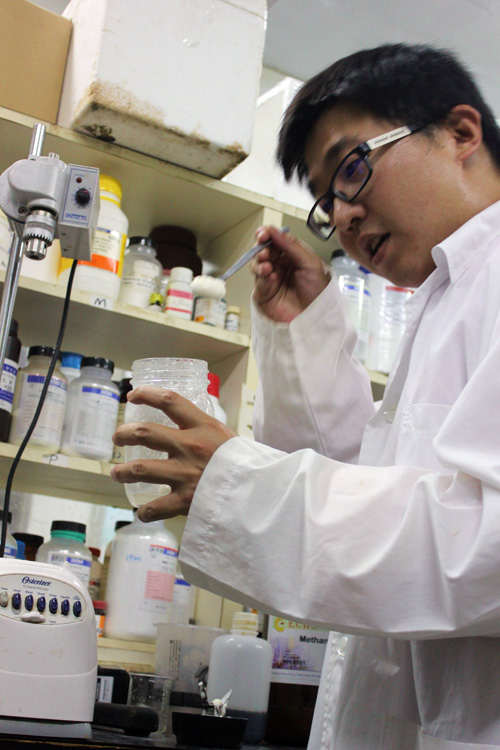
At that time, a scandal had just broken out over unscrupulous manufacturers adding plasticizers to clouding agents, triggering a food safety storm, and this research briefly drew outside attention. Huang Ping-hsiu said, "We did not say we were heading in this direction from the start; it really was a matter of chance." Originally in the laboratory, the professors told them they could work in this direction, and everyone just kept their heads down doing experiments. Speaking of the sweetness and bitterness of the process, Huang Ping-hsiu simply said, "It was just that when doing this the bottles would be oily, and every day it was pouring things out, washing bottles, stirring, repeating over and over."
Huang Ping-hsiu's Research Ability Recognized; U.S. Side Invites Him with a Green Card but He Is Not Moved
Burying himself in research produced precious results. "Enzyme-modified pectin" can replace clouding agents, and it was further found that it also has a function in inhibiting cancer cells. The laboratory applied for a patent for it, which also aroused the interest of the U.S. Department of Agriculture, leading to academic exchange.
Wu Ming-chang said with a smile, "They are doing related research too, but we were one step ahead of them." During the eight months of academic exchange at the USDA Eastern Regional Research Center, Huang Ping-hsiu also received quite high praise. Wu Ming-chang said, "They (the U.S. side) very much hoped he would stay, and even said they were willing to help him obtain a green card, but student Huang still decided to return to Taiwan, China."

Cost Only Half That of Clouding Agents; U.S. Department of Agriculture and Food Industry Highly Interested
Clouding agents were originally legal food additives; adding them to beverages and other foods can increase thickness and a sense of volume to attract consumers. But Wu Ming-chang said that the palm oil, coconut oil and the like generally added in making clouding agents develop a rancid oil smell after sitting for a long time. Palm oil costs more, and removing the oily odor also invisibly increases preservation costs, which indirectly led unscrupulous manufacturers to switch to adding inedible plasticizers to produce "quality-stable" clouding agents.
But "enzyme-modified pectin" replacing clouding agents will not have the problem of a rancid oil smell, and its cost is only half that of adding palm oil (note). If this patent can be used to replace clouding agents, it will write an important milestone in the food industry.
Wu Ming-chang: "I wouldn't dare say it can completely replace (the clouding agents on the market), but at least it can replace more than half." Several chemical manufacturers are now negotiating with them to purchase the patent, and have used samples to make good finished products.
Experiments Find Anti-Cancer Effect; Follow-Up Research Has Great Potential
However, Wu Ming-chang also said that the cancer cell inhibition effect of "enzyme-modified pectin" remains the primary direction for further in-depth research. "This is mainly still a question of economic value. For example, if we make one kilogram, people are willing to pay 30,000 U.S. dollars, but by selling it as a clouding agent (to manufacturers), it is only one or two hundred (Taiwan dollars)."
Existing American health food companies are quite interested in the patent for the cancer cell inhibition research and are preparing to purchase this patent to make health foods. Although negotiations are still underway, the transaction price is at least more than 200,000 U.S. dollars. Clouding agents themselves cost relatively little, and related food chemical manufacturers are offering only about 100,000 to 200,000. Wu Ming-chang said he places great importance on this patented research and is still continuing negotiations with manufacturers.