Biopesticides are sweeping the globe, with an estimated trade value of 5 billion USD in 2020.
Too many pesticides and you worry about residues; too much fertilizer and you worry about nitrate levels exceeding the limit. Faced with consumers' concerns, farmers might throw up their hands and ask: then what do you want me to use? If I use nothing at all, the crops just won't grow well!
A group of experts and scholars believe that biopesticides and biofertilizers will be the answer to sustainable agriculture.
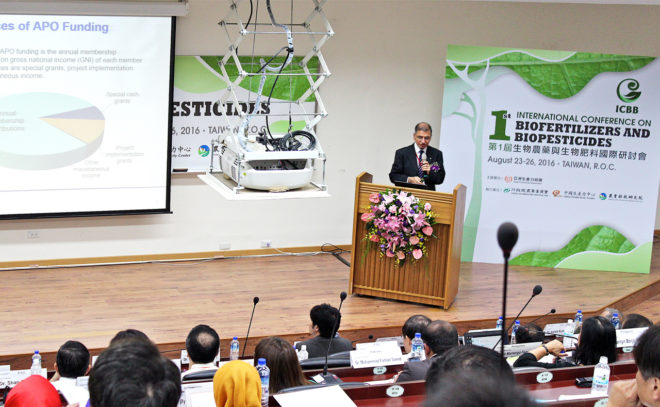
The "First International Symposium on Biopesticides and Biofertilizers," organized by the Council of Agriculture and the Asian Productivity Organization, was held on August 23 at National Chung Hsing University. Professionals on site came from 15 countries including India, Japan, the Philippines and Sri Lanka, introducing the current state of biopesticide and fertilizer development in various countries and, through exchanging experience, seeking possibilities for regional cooperation.
Hung Liang-cheng, head of the International Affairs Section of the Industry Development Center at the Agricultural Technology Research Institute, one of the organizers, said that under the trend of environmentally friendly, safe and non-toxic agriculture, biopesticides and biofertilizers will be an important trend, and Taiwan is also actively developing them. However, in agricultural application, countries still lack clear and unified regulations, and it is hoped that consensus can be reached through this international symposium.


An emerging industry urgently needs government support and farmers' recognition
When it comes to biopesticides and fertilizers, India is a major country in Asia. Dr. Yadav, an official representative of India's agricultural export department, estimates that India's annual use of biopesticides reaches as much as 1.3 million metric tons, with as many as 450 manufacturers. The reason for such vigorous development is that the Indian government provides a great many subsidies: "Each kilogram sells for 50 rupees, and the government subsidizes 30 rupees, attracting farmers to buy."
Compared with our government, which spends a large budget every year subsidizing chemical fertilizers, causing farmers to frequently over-apply them and creating soil salinization problems, the approach of the Philippine or Indian governments is clearly more advanced.
Domestic farmers' acceptance of biopesticides and fertilizers also needs stronger promotion. After all, chemical pesticides and fertilizers take effect immediately, and farmers are used to them: "He feels that only when the insects die immediately after spraying is it effective. When he sprays biopesticides and turns around to see the insects still wriggling, he just can't accept it." That is how a Meinong farmer described it.
Besides acting more slowly, biopesticides and fertilizers have some limitations, such as higher production costs, being easily damaged by ultraviolet light, a shorter shelf life, and improper temperature and humidity during storage and transport affecting their effectiveness, and so on. Dr. Reddy added that when developing biopesticides and fertilizers, field trials must be conducted according to the climate, soil and crop of each place, because environmental conditions differ from country to country, and a product designed in one country may not necessarily be applicable to other countries.
Countries also have not unified their regulatory frameworks for biopesticides and fertilizers, creating barriers to international trade. In our country, several biotech companies have already developed excellent products, yet exports are blocked for this reason.
According to a survey by the Taiwan Institute of Economic Research, our country's biopesticide market accounts for only 4% of the overall pesticide market, and is in an early stage of development; the most commonly used Bacillus thuringiensis is mainly imported. Biofertilizers are also an emerging industry, with only 20 currently registered, all domestically produced. In the future, joint cooperation among industry, government and academia will still be needed to promote the development of organic agriculture
(This article was funded by the Jianzhen Environmental Education Foundation for personnel expenses under a special project, but the foundation completely does not interfere with news topics or interview writing, ensuring journalistic independence)