Stainless steel tableware exceeds manganese limits, and the Ministry of Economic Affairs and the Ministry of Health and Welfare pass the buck with no one taking responsibility.
The storm over excessive "manganese" in stainless steel tableware has escalated, and it has even led to the Bureau of Standards, Metrology and Inspection under the Ministry of Economic Affairs and the Food and Drug Administration under the Ministry of Health and Welfare passing the buck to each other over who is responsible for setting tableware specifications.
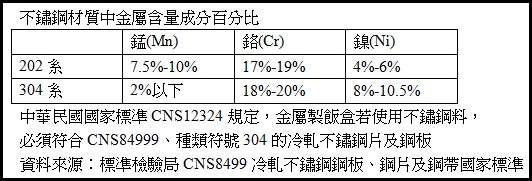
The Taipei City Department of Health announced on the 14th the results of random testing of stainless steel tableware on the market: of 20 samples, 5 had manganese levels exceeding the standard, ranging from 10.60% to 13.38%, far above the national standard CNS12325 (metal multi-layer food containers) and CNS12324 (metal lunch boxes), which require tableware to be made from 304-series stainless steel (manganese content below 2%). Public opinion sharply criticized government agencies for leaving people exposed to risk, and some doctors also expressed anger over this!
Facing public pressure, Wu Guolong, Section Chief of the Third Section of the Bureau of Standards, Metrology and Inspection, said that tableware specifications fall within the scope of food safety and should not fall under the bureau's purview, and he hoped responsibility would return to the Food and Drug Administration under the Ministry of Health and Welfare. But Tsai Shu-chen, head of the food management division at the Ministry of Health and Welfare, repeatedly stressed in an earlier interview that "this is not a food safety issue; the amount of manganese merely provides manufacturers with a procurement standard," and she did not believe the Ministry of Health and Welfare should oversee the matter.
Tsai Shu-chen also said that manganese is an essential element for the human body, that much manganese also exists in nature, and that the public need not panic excessively; she also said the current CNS national standard's regulation of manganese content in stainless steel tableware is too strict. In response, Wu Guolong replied that if the Ministry of Health and Welfare has objections, it can formally submit a document to reflect them and refer the matter to the technical committee to deliberate whether to revise the standard.
Stainless steel tableware flooded with lower-grade substitute materials: Is it safe? Even doctors are anxious
A retired China Steel employee who worked in the steel industry for a long time said that in the eyes of professional technicians, "because international nickel prices are too high, downstream operators mostly use 200-series stainless steel as a lower-grade 'substitute' to save costs." As far as he knows, customers dealing with high-grade stainless steel plants mostly specify 304- and 316-series stainless steel, and orders for the 200 series are rarely seen.
Manufacturers such as Miaochushi and Caili, whose products were found in this random inspection to have excessive manganese levels, did not give a clear response to the Taipei City Department of Health's test results. Wu Zhenhui, a representative of the business department of the Ox-Head brand stainless steel tableware, which passed this inspection, said that its entire product line uses 304-series stainless steel, but that to accommodate modern people's habit of mostly cooking with induction cookers, other metal elements are added to increase electrical resistance. Regarding Wu Zhenhui's statement, Wu Guolong of the Bureau of Standards, Metrology and Inspection countered, "If other elements are added beyond the proportion and cause the chemical composition or mechanical properties of the stainless steel to change, then it can no longer be called 304-series stainless steel."
Yu Shang-ju, a family medicine physician practicing in the Chiayi area who has young children at home, is very concerned about the safety of stainless steel tableware and sharply criticized, "The government keeps passing the buck and has no sense of risk management. If consumers have to save themselves in everything, what is the government for?"
Yu Shang-ju said that he and his wife had already tried every testing method on the market, including magnets, reagents and test strips, and still could not determine whether the stainless steel in their home could be used with peace of mind. "I hope the relevant agencies will stop passing the buck, quickly set clear standards and enforce them strictly."