Wildlife Showdown: Birds, Squirrels and Monkeys in the Orchard
Our shift at Shifeng Orchard toward natural farming was in fact gradual and followed a pattern, and the driving force behind it came from not killing living things. An earlier article described the inner journey of turning away from killing toward natural farming, but most people probably do not know that I once waged a great battle with the creatures around the orchard. When I shared with our partners upstream and downstream at the News Market the process of battling the Taiwan macaques near the orchard, they found it quite interesting and asked me to write this article, so I will share with you the process of these years of battling the creatures. Perhaps the article can also help you get along well with the wild animals around you. Of course, the ability I still lack is communicating with animals, so if you have any good methods, you are welcome to share them generously.
The birds that are especially enthusiastic in the orchard
I still remember that in the past the biggest worry near the orchard was bird damage. When I first took over my father's orchard, at the very beginning I even set up bird nets, but every time I saw birds caught in the nets that were not the harmful species, I always could not bear it. Of course, if they were still alive, I would release them immediately, but as for the harmful birds, I caught them and took them home to raise.
But I overlooked one point: birds are omnivorous, so although I provided them meal after meal with the delicious sweet persimmons of Shifeng Orchard, some of them still could not make it through the production season. Even if they luckily survived the season, after release they did not have much strength to flap their wings. Only later did I understand clearly that birds also need to eat some insects to supplement calcium, protein and other nutrients. So the next year I decided not to set up bird nets, but does not setting up bird nets mean there will be no bird damage? The answer, of course, is no.
However, through observation, in the years and periods when birds ate heavily, prices at that time were continuing to rise; even if they did not rise, sales were especially brisk. Although the birds ate quite a lot, the remaining fruit happened to sell better than in previous years, so I treated it as heaven compensating us for our losses, and the two offset each other, breaking even.
Of course, when bird damage was severe, we still had some control measures, but the effects were all poor. I still remember that every sweet persimmon harvest season, everyone in every orchard would set off firecrackers, and I thought everyone was celebrating a bumper harvest, or whose family was taking a bride? Only later did I learn that this was everyone's way of driving away birds.
But by the end of the production season, if we were the only ones left around who had not harvested, all the birds would gather in our orchard. Every day hundreds of birds foraged in the orchard, and at this time the firecrackers actually became harmful. As soon as the firecrackers sounded, the birds merely flew from this tree to another tree and kept eating, so the damage actually became worse. So I simply left the already damaged fruit for them to keep eating.
Another approach was to harvest a bit faster. Of course, when birds eat a lot, the sweet persimmons are ripe enough and especially sweet. I remember that one year alone, in the current natural farming area, the birds ate more than 4,000 sweet persimmons. But that year sweet persimmon production was in oversupply, and both quality and price were poor, so I treated the birds as coming to cheer us on, and after the cheering the persimmons sold especially well.
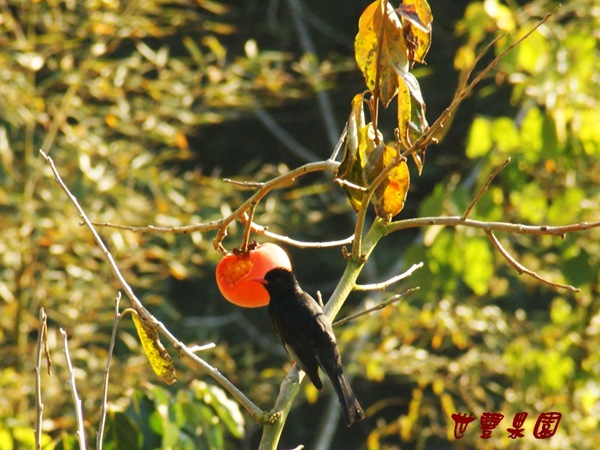
Food shared with the animals
Between killing and living: how I shifted from conventional farming to natural farming