New Taipei students' nutritious lunch vegetables have daily label certification
Over the past three years, New Taipei City has promoted organic vegetables in school lunches. At first only three schools took part in the trial, and last September it expanded to all elementary and middle schools across New Taipei City. Now it is going further: in addition to the original one day of organic vegetables per week, GAP (Good Agricultural Practice) vegetables will be supplied on the other four days, so that all 346,000 students in New Taipei City can eat certified vegetables every day. This policy will launch in the new semester this February.
One day of organic vegetables and four days of GAP vegetables per week
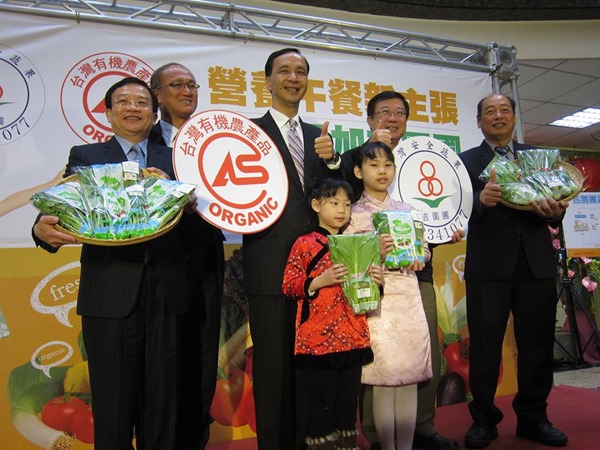
"I am honored to be called the 'organic mayor,'" said New Taipei City Mayor Eric Chu at yesterday's (1/21) press conference announcing the policy. "Starting this February, elementary and middle schools in New Taipei City will eat organic vegetables one day a week and GAP vegetables four days a week. Schoolchildren will eat certified vegetables every day, giving parents peace of mind, and we also hope to use contract farming to encourage more farmers to take up good agricultural practices."
School lunches will use GAP vegetables four days a week. This February, priority will be given to 109 schools with their own kitchens, and it will be fully implemented in September, supplying all 280 schools in New Taipei City and benefiting an estimated 346,000 elementary and middle school students.
New Taipei City: School lunch prices will not rise, and vegetable supply will not run short
Eric Chu said that after the policy of one day of organic vegetables and four days of GAP vegetables per week is launched, school lunch prices will not rise, and the roughly NT$120 million needed each year will all be paid by the New Taipei City Government. Liu Shu-fen, section chief of the Agricultural Production and Marketing Management Section of the New Taipei City Agriculture Department, further explained that in order to ensure the supply of GAP vegetables, when New Taipei City enters into contract farming with farmers, it subsidizes farmers NT$5 more per kilogram than the purchase price of conventional vegetables.
On the supply side, the Council of Agriculture is helping New Taipei City secure supply through contract farming. For the organic portion, the Council of Agriculture has matched eight distributors with 98 organic vegetable farmers under contract farming, covering 243 hectares and supplying 145 metric tons per week; for the GAP portion, it has also helped the New Taipei City Government enter into contract farming with 850 farmers, covering 434 hectares and supplying at least 450 metric tons per week.
Chen Bao-ji, chairman of the Council of Agriculture, said: "New Taipei City's use of organic and GAP vegetables in school lunches, supplied directly from contract farming at the place of production, not only ensures New Taipei City's demand but also helps organic farmers establish stable sales channels."
In addition to New Taipei City, some schools in Yilan County, Taoyuan County, Taichung City, Hsinchu County, Miaoli County and Pingtung County also serve organic school lunches. At present, 662 elementary and middle schools across Taiwan, with 511,000 students, eat organic ingredients for lunch.
New Taipei City Mayor Eric Chu said: "I hope New Taipei City will drive more counties and cities to get involved, encouraging farmers from the consumption side to adopt GAP or even organic farming methods. I believe this policy of using organic ingredients in school lunches can find new vitality for Taiwan's organic agriculture."

Food and agriculture education helps consumers and producers understand each other better
Yang Cong-gui further explained with the story of how water spinach (morning glory) lost out as a purchased item. From the cutting process, bok choy has a thick stem base, so its cutting waste rate is higher than that of ordinary vegetables, while water spinach does not have this problem and is suitable for cutting; however, because it does not look attractive after cooking, it is not among the purchased items.
The six leafy vegetables currently purchased by New Taipei City, including the Chinese cabbage family and the mustard family, are all cruciferous (Brassicaceae) and share common pest and disease problems in cultivation. The most feared is the striped flea beetle, which is partial to cruciferous plants. This little insect is very devoted and will not eat plants that are not cruciferous. In other words, if organic cruciferous vegetables have wormholes, eight times out of ten they are the traces of the striped flea beetle's passionate love.
How can this be solved? Yang Cong-gui said water spinach can help. Using a rotation system, one season plant cruciferous cabbage or rape, and one season plant water spinach of the Convolvulaceae family. Relying on the striped flea beetle's devoted habit of eating only cruciferous plants, "when it encounters water spinach, the striped flea beetle stops eating, and the wormholes in the vegetables naturally decrease."
"If, through food and agriculture education, children know the connections between wormholes in organic vegetables and vegetable species and farmers' growing methods, then although children may not immediately support organic vegetables, at least in their minds they will have a little more motivation to understand organic and choose organic," Yang Cong-gui said.
As for the current direction of one day of organic and four days of GAP vegetables in New Taipei City school lunches, Yang Cong-gui strongly agrees, hopes the public sector will keep promoting it, and looks forward to the day when organic agriculture can become a long-term national development policy, letting children use organic vegetables across the board and use all kinds of organic ingredients. "As the father of two children, of course I hope my children can eat organic ingredients. Not only are they healthier, but it is also environmentally friendly. If the government can consider spending a bit more on purchasing organic ingredients, Taiwan's organic agriculture can develop steadily. Over a few years, not only will the people's health improve, but the land can also be sustainable. This investment is absolutely worth it!"