A Young Returnee's Bird-Racing Falconry Expert: Biological Control and Habitat Creation Go Hand in Hand for a Sustainable Ecology
Bird damage in autumn and winter is a nightmare for many farmers. Lu Chi-yeh, a farmer in Shoufeng, Hualien, imported a Harris's hawk (Parabuteo unicinctus) to serve as a "living scarecrow," and it really did scare off many sparrows and pigeons. But the move drew both praise and criticism. Some people believe raptors should not be kept in captivity. Lu Chi-yeh said that many people want farmers not to poison birds or set bird nets, but they must offer corresponding alternatives. He hopes to let farmers see the effects of biological control so that they can be further persuaded to switch to pesticide-free or organic farming methods.
Sun Yuan-hsun, a professor at National Pingtung University of Science and Technology, said that biological control is indeed a global trend, but the ecological impact of introduced animals on the local area must be assessed. He believes that starting with habitat creation and allowing local raptor populations to recover naturally is a more sustainable approach.
A returning young man trains a hawk to drive away birds, establishing the concept of biological control among farmers
Every autumn and winter, when fields switch to coarse grains or rice is harvested, farmers have to use every trick they have to deal with troublesome bird damage. Beyond the basic sky rockets, reflective CDs and bird nets, some even use poisoned bait to kill birds. Lu Chi-yeh, 33, returned home four years ago to care for his sick father. Seeing farmers distressed by bird problems and even using poisoned bait, which not only killed sparrows and pigeons but also harmed large raptors that ate the poisoned birds, he saw that with sparrows' natural enemies gone, their numbers actually increased the following year, creating a vicious cycle. Last year, through the Taiwan Falconry Culture and Raptor Conservation Association, he spent 70,000 yuan to buy a Harris's hawk, a non-protected species, hoping to use ecological control methods to change farmers' thinking.
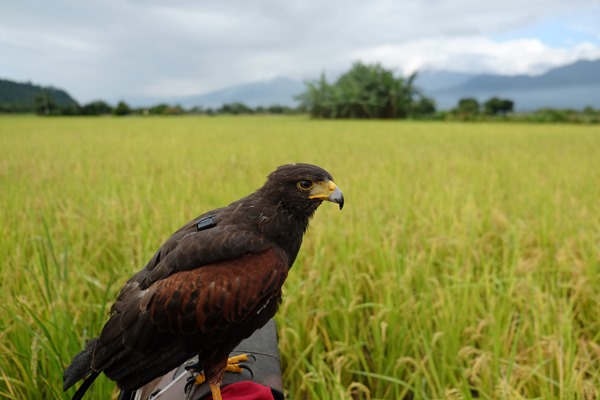
Lu Chi-yeh said many places abroad use similar methods. This Harris's hawk is already three years old and was named "Rabbit King." He had originally hoped it could catch rabbits in the fields, "but the rabbits were too big, and it simply couldn't carry them." However, "Rabbit King" is very good at driving away birds. Using his uncle's field as a test area, Lu Chi-yeh trained it to fly for one hour every day. Unlike some raptors that circle in the air, the Harris's hawk stands on utility poles. Many sparrows, pigeons and common moorhens, once swept by its sharp gaze, were so frightened that they did not dare return for hours. The results were very good. His uncle praised it directly: "This works!" and even donated 300 jin of "falconry rice" for Lu Chi-yeh to try selling.
The Harris's hawk is about 45 cm long. Lu Chi-yeh trained it for three to four months, feeding it 80 grams of raw meat a day. Following falconry methods, he first kept the Harris's hawk in a large cage without contact with people, then gradually let it adapt. Now it is kept at home, where it watches cars, people and dogs, getting used to human society, and is trained not to prey on these things.
Lu Chi-yeh stressed that the Harris's hawk and he are partners, not master and servant. Similar to how farmers once raised water buffaloes to plow fields, the Harris's hawk is also a helper at the field's edge. Moreover, the Harris's hawk was introduced not for hunting but for driving away birds. Sometimes when the Harris's hawk accidentally catches a live bird, he releases it.

Biological control methods ultimately still require habitat creation
Sun Yuan-hsun, a professor in the Bird Ecology Laboratory of the Institute of Wildlife Conservation at National Pingtung University of Science and Technology, also feels strongly about bird poisoning in fields. Over two consecutive years, they found that black kites in the Pingtung area died after eating poisoned bird carcasses, and in an 18-hectare field they even saw the carcasses of more than 1,000 small birds such as sparrows, scaly-breasted munias and red turtledoves. He believes that not many people keep hawks, so the impact on the ecosystem should be limited. If the Harris's hawk was legally imported, he does not oppose keeping hawks to drive away birds, but attention must indeed be paid to ecological contamination if it escapes. Agricultural authorities could sit down and communicate with raptor-related associations to at least ensure legal importation.
He said that countries around the world are currently trying ecological control. For example, Malaysia and Israel install nest boxes in trees to attract barn owls to farmland to help catch rats. Taiwan is also studying which candidate bird species could serve as field helpers. National Pingtung University of Science and Technology has preliminarily selected the collared scops owl and hopes to cooperate with government agencies to plant trees and hang nest boxes on marginal fields, inviting collared scops owls to help farmers drive away birds.
But Sun Yuan-hsun said these methods presuppose that raptors already appear locally; the task is to restore terrain and landscape and create biodiversity so that organisms can reach a natural balance. Compared with the cost and effectiveness of keeping hawks, habitat creation is less controversial and more sustainable.
However, habitat creation takes relatively more time and effort. Hualien farmer Zeng Guo-qi began growing wheat in the Changliang Organic Zone in Yuli more than three years ago. Because he does not poison birds, the "airborne brigade" ate its fill every time. But after rats and snakes began appearing in the field area, last year he found raptors circling over the fields, and this year three pairs even came, one of which was a protected species, the black kite, watching hungrily from above when the soil was turned. Some raptors also chased munias.
Zeng Guo-qi believes that letting the ecosystem naturally return to balance is the best approach. However, the Changliang Organic Zone covers more than 40 hectares. If the organic field area is small and surrounded by conventional fields, establishing an ecological chain is very difficult, so keeping hawks to drive away birds can be considered.
Lu Chi-yeh said he knows outside opinions on keeping hawks are polarized, "but if you tell farmers not to poison birds, not to use bird nets, not to do this and not to do that, you have to offer solutions." He said he is also a farmer and knows farmers' hardships. Keeping hawks to drive away birds is only a beginning: first establish the concept of biological control among farmers and let them know that yields will not decrease this way, and only then can they be further persuaded to reduce pesticide use and adopt pesticide-free cultivation. "Persuading conventional farmers to use fewer chemicals is extremely difficult; you have to let them see results first."
He said he is willing to try any method but will not count on government agencies. Habitat creation will also proceed in parallel. Next year he will also make comparison fields for hawk-keeping bird control so that more farmers learn about the concept of biological control.