Air quality remains below standard after 49 consecutive hours of purple alert; environmental groups demand the EPA make corrections
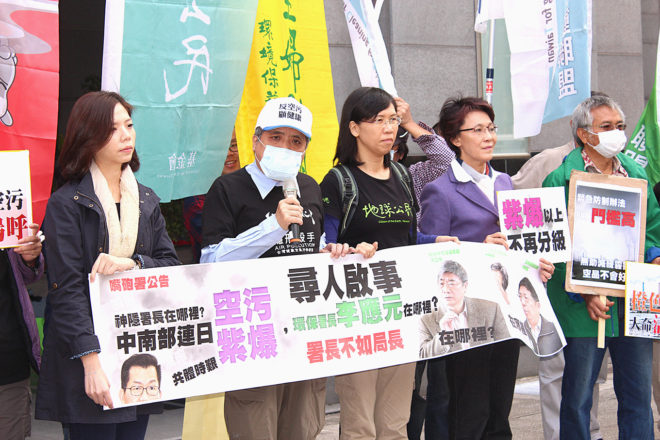
After the start of autumn, central and southern Taiwan saw consecutive days of purple alerts, and since November, PM2.5 readings in various administrative districts of Kaohsiung successively surged to peaks of 133 micrograms per cubic meter, 146 micrograms per cubic meter and 149 micrograms per cubic meter, with purple alerts even lasting as long as 49 consecutive hours; sensitive groups complained endlessly, yet none of these readings reached the preliminary threshold of 150 micrograms per cubic meter set by the Environmental Protection Administration, so the factory load-reduction and emission-reduction mechanisms could not be activated.
The Environmental Protection Administration is now drafting amendments to the "Measures for Emergency Prevention and Control of Serious Deterioration of Air Quality," which, in addition to including PM2.5 among regulated air pollutants, adds a new "warning" level: once PM2.5 reaches 35 micrograms per cubic meter, the warning mechanism is activated; the preliminary and intermediate threshold standards are maintained at 150 micrograms per cubic meter and 250 micrograms per cubic meter respectively, and once reached, the factory load-reduction and emission-reduction mechanisms are activated.
But Yeh Kuang-peng, chairman of the Taiwan Healthy Air Action Alliance, said that according to local research, 17 micrograms may trigger asthma in children; 28 micrograms may cause a decline in lung function; the United States has even found that 12 micrograms may cause medium- and long-term effects on human health, and "the Environmental Protection Administration should lower the warning threshold to 12 micrograms; the preliminary threshold should be adjusted to 35 micrograms."
"But with the tiered thresholds set so high, they simply cannot improve the haze problem!" Civic groups from central and southern Taiwan traveled north to the Environmental Protection Administration to voice their anger, questioning that the Administration had set the high-threshold air pollution tier values too high, and that the factory load-reduction threshold values were even harder to reach, making it impossible to use them to require factories and coal-fired power plants to reduce loads and emissions.

-660x425.jpg)