Hand-shaken tea repeatedly fails inspections for multiple residues; yellow flower honey tea exceeds pesticide limit by 120 times
The Food and Drug Administration (FDA) today (the 26th) announced the latest progress of county and city inspections of hand-shaken drinks, adding 6 non-compliant products from Kaohsiung, Yunlin and Nantou, among which 4 pesticides are by regulation not permitted to remain as residues, and the most excessive, hexaconazole, reached as much as 120 times the limit. So far a total of 862 items have been sampled and 753 items have completed testing, with 66 items non-compliant in total, a rate of 8.63%.
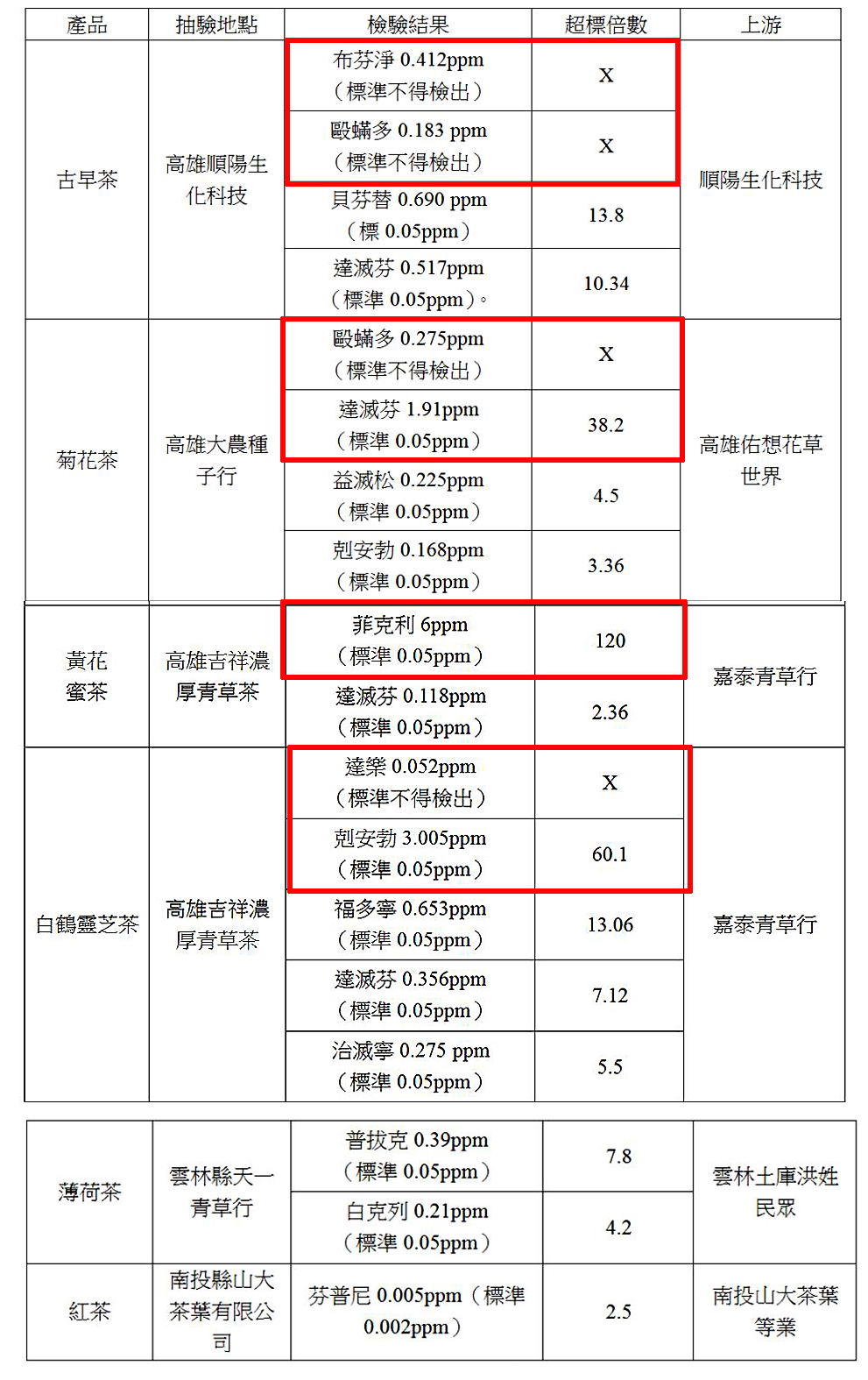
Among the newly added non-compliant products, the one with the greatest excess, reaching 120 times the limit, was the yellow flower honey tea sold by Kaohsiung Jixiang Strong Herb Tea, which contained 6ppm of hexaconazole (standard 0.05ppm), and also tested positive for difenoconazole 0.118ppm (standard 0.05ppm); the white crane lingzhi tea sold by the same shop also had undetectable-permitted levels of metamidophos 0.052ppm, chromafenozide 3.005ppm (standard 0.05ppm), difenoconazole 0.356ppm (standard 0.05ppm), fluazinam 0.653ppm (standard 0.05ppm), and procymidone 0.275 ppm (standard 0.05ppm), among others.
Kaohsiung Danong Seed Shop's chrysanthemum tea, besides containing undetectable-permitted levels of fenbutatin oxide 0.275ppm, also had difenoconazole at 38 times the limit, 1.91ppm (standard 0.05ppm); others included chromafenozide 0.168ppm (standard 0.05ppm), (standard: not permitted to be detected), and fenitrothion 0.225ppm (standard 0.05ppm).
Kaohsiung Shunyang Biochemical Technology's ancient-flavor tea contained 2 pesticides that by regulation must not be detected, namely buprofezin 0.412ppm and fenbutatin oxide 0.183 ppm; it also tested positive for benomyl 0.690 ppm (standard 0.05ppm) and difenoconazole 0.517ppm (standard 0.05ppm).
In addition, the mint tea sold by Yunlin County Tianyi Herb Shop tested positive for procymidone 0.21ppm (standard 0.05ppm) and propamocarb 0.39ppm (standard 0.05ppm); the black tea from Nantou County Shanda Tea Co., Ltd. tested positive for fipronil 0.005ppm (standard 0.002ppm).
All non-compliant products have already been taken off shelves and sealed for storage by the local health bureaus. The sources of these problem products have now been traced, with upstream parties including Kaohsiung Shunyang Biochemical Technology Co., Ltd., Kaohsiung Youxiang Flower and Herb World, Jiatai Herb Shop, a resident surnamed Hong in Tuku, Yunlin, and Nantou Shanda Tea, among other businesses.
The FDA called on food businesses that if tea leaves are found to have pesticide residues exceeding the safe tolerance level, under Article 15, Paragraph 1, Subparagraph 5 of the Act Governing Food Safety and Sanitation, it is prohibited to manufacture, process, sell, export or import non-compliant raw materials or products containing excessive pesticides, and violators are subject to a fine of NT$60,000 to NT$200 million under Article 44 of the same Act. Furthermore, under Article 7 of the Food Safety Act, food businesses that discover a product posing a risk to health and safety shall immediately and voluntarily stop manufacturing, processing and selling it and carry out a recall, and shall notify the health bureau with jurisdiction, and violators will be subject to a fine of NT$30,000 to NT$3 million under Article 47 of the same Act.