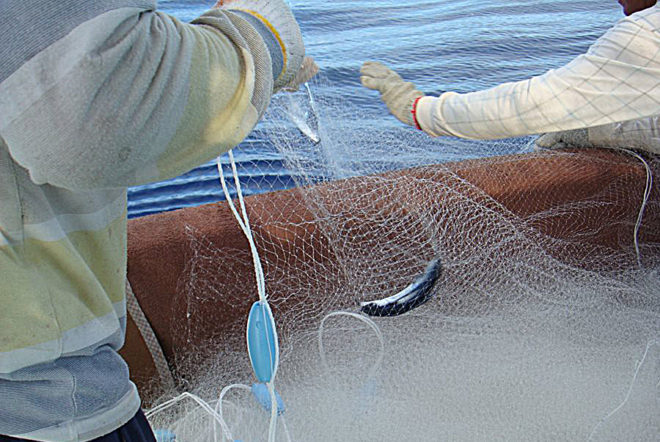
Are drift gillnets really the culprit killing corals on the seabed?
"Drift nets, the undersea walls of death, often cover coral and cause coral death." In the past, descriptions like this were often seen in newspapers and magazines, but is such a description correct?
Let us first clarify: there are many kinds of gillnets, and the "drift net" is one of them; its operating range is at the sea surface, drifting with the current. The other two common types of gillnet gear are the "floating gillnet" and the "bottom gillnet"; the floating gillnet has more buoyancy than sinking force and is gear fixed at the sea surface, but floating gillnets are rarely used in Taiwan, China, and only in the east are they briefly used during typhoon season as a substitute for set nets. The surrounding gillnets once used to catch cuttlefish are now rarely seen because alternative fishing methods later emerged.
Today, large-mesh drift nets in Taiwan, China, are often used to catch Japanese Spanish mackerel (commonly known as the "toro" type of fish) and large fish such as sharks, while small-mesh drift nets are used in spring to catch flying fish; the use of drift nets depends on the target fish species, using nets of different mesh sizes, so drift nets are not a fishing method that catches all sizes indiscriminately.
The structure of a drift net is a long main net, with floats on the upper edge and heavy weights on the lower edge. When put into the sea, it opens naturally, lying crosswise or diagonally to the current; multiple nets can be joined together, stretching for several kilometers across the water surface. Drift nets catch fish species active in the surface layer. When a fish swims at the surface and encounters a drift net, its head becomes "pricked" into the net, and its body, hard spines, or gills become stuck, leaving it unable to move.