What is agriculture like in China? Follow the perspective of an exchange student from Taiwan, China, to find out.
Author: Huang Junhao
China's changes over the past few years are now a presence in the world that cannot be ignored. Yet at the time, while I was still in Taiwan, China, the China in my eyes was still as if veiled in a layer of gauze. Thinking it over carefully, from reform and opening up, Made in China, the red supply chain... if you really asked me to talk about it, I honestly could not say how much I understood about China, until I set foot on this land and tried to record from the perspective of agriculture all that I have experienced so far. Even now, this only depicts a small part of it. In the field of agriculture, China on the one hand hopes to take the lead in the development of agricultural science and technology, and on the other hand must turn back to look after rural areas to make up for the wealth gap brought about by urban-rural development. The impact created at every link can bear on the well-being of hundreds of millions of people, and even affect the international community. So I think that since it is such a presence, we can still choose to ignore it, or else include it as one of the subjects we study and ponder. Taking advantage of this exchange opportunity, I want to talk about my personal understanding of China's agriculture.
The Advantages of China's Agriculture
Achieving 'twelve consecutive years of growth' in China's total grain output
1. Attention from government departments
For 13 consecutive years since 2004, in the "Central Document No. 1"[1] attention has been paid to the three rural issues (rural areas, agriculture, and farmers). In recent years, the Chinese authorities have continuously provided policy guidance on issues in every aspect of agriculture, such as water conservancy construction, agricultural mechanization, the extension of agricultural technology, encouraging rural land circulation[2][3] This shows that among all industries, the Chinese authorities still hope to stabilize the development of agriculture and rural areas, and one can find that in agricultural policy-making, the Central Rural Work Leading Group[4] makes comprehensive plans based on the international situation and cross-ministerial coordination. At present, the focus of the "Central Document No. 1" is still mainly on ensuring food security, and while strengthening the competitiveness of domestic industry against foreign agricultural products, rural supply-side reform is being carried out vigorously[5] Source: http://www.100ppi.com/mac/world_zt—ZT22.html A brief summary of the projects Chen Zhangliang summarized in his speech as needed for the future development of China's agriculture 1. Improve the efficiency of land circulation 2. Establish cold-chain processing, transportation, and storage systems for agricultural products 3. Make good use of drones to reduce labor costs and increase the level of agricultural mechanization 4. Use the Internet of Things (to grasp rainfall, climate, soil, previously planted crops, changes in pests, diseases, and weeds, temperature, and humidity) as well as big data to precisely grasp the use of agricultural resources 5. The advantages of e-commerce in the future transportation and marketing of agricultural products 6. The importance some consumer groups attach to organic agriculture and the ecological environment 7. The agricultural insurance system and rural financial services As policies formulated under the circumstances of that time, in different times and spaces today we of course cannot equate them. Because back then the rulers of the time had their considerations, and the reason earlier policies could continue was precisely that they solved the problems of that time. So the problems derived from previous policies should serve as opportunities for current reform, rather than being regarded as the result of failure. I like to cite the example of Taiwan, China's earlier fallow land policy, which even paid subsidies to farmers to encourage leaving farmland fallow. For Taiwan, China today, with its low food self-sufficiency rate and pitifully little land, this is truly not a good method, but back then it did quickly ease the crisis of excess rice production. Therefore, if one can carefully assess the whole course of a matter, I think that when looking at a matter one will not be too narrow-minded. When I was originally organizing the relevant materials, I simply felt that I knew very little about China. Especially when China's agriculture was mentioned, my mind suddenly went blank, and I wanted to know what kind of agricultural model supports a country with such a large population. In addition, for Taiwan, China, unless we do not cooperate, the Chinese mainland should be one of the subjects we must continue to pay attention to! So taking advantage of this opportunity to exchange on the mainland, I wanted to record the current state of China's agricultural development. Note 1: Explanation of terms Note 2: Some content is taken from 2. China Agricultural Development Forum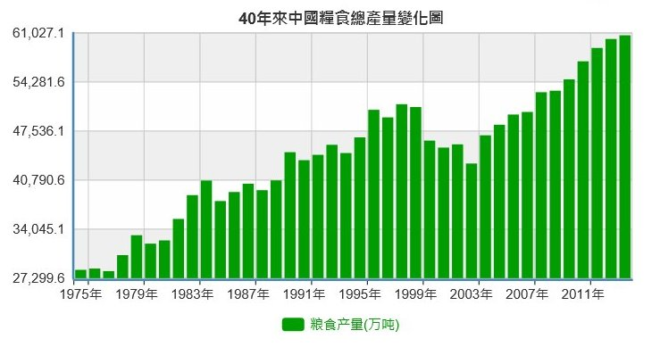
The Way Out for China's Agriculture?
The Author's Thoughts
[1][Central Document No. 1] The first document issued each year by the Chinese Communist Party. Since 2004, for 13 consecutive years, [Central Document No. 1] has focused on the three rural issues, and it has virtually become a proper term for the Chinese Communist Party's emphasis on rural issues.
[2][Rural land circulation] The concept is similar to the small landlord, large tenant farmer system promoted in Taiwan, China. Because the Chinese Communist Party divides farmland into three concepts: ownership rights, contract rights, and management rights. Ownership rights mean that farmland is collectively owned by farmers; contract rights mean that individual farming households can transfer the farmland they originally managed but still retain inheritance rights; those who hold management rights can use the contracted farmland to expand the scale of farmland management.
[3][Giving priority to the rural welfare system] At present, the Chinese Communist Party mentions in Central Document No. 1 that "to build a moderately prosperous society in all respects, agriculture and rural areas are the weak links," so efforts must be made to reduce the urban-rural gap. Therefore, the social welfare system is given priority in rural areas, such as implementing exemption of tuition and miscellaneous fees for ordinary high schools and rural poverty alleviation policies.
[4][Central Rural Work Leading Group] The leading group is an organizational method and working mechanism unique to China. In China there are a large number of deliberative and coordinating bodies named "leading groups," such as the Rural Work Leading Group and the Central Foreign Affairs Leading Group. They belong to the Party and government systems and hold cross-departmental coordinating power in specific periods. Their members include the Minister of Agriculture, the Minister of Water Resources, the Director of the State Forestry Administration... However, the Central Rural Work Leading Group is an institution directly under the Central Committee, while the Ministry of Agriculture is a component department of the State Council, so the two are independent of each other.
[5][Rural supply-side reform] This refers to the reform of China's minimum purchase price system for grain prices adopted in 2004. As prices and farmers' production costs rose, the purchase price announced by the government also increased year by year, and it is now far higher than the market price. Due to many reasons in recent years, foreign imported grain has been dumped into China at low prices, causing rural grain in China to be sold only to the national treasury,
[6]Unit (yuan/jin): In China this is often used to measure the price per unit weight of crops. 1 jin refers to 500 grams, not Taiwan, China's 600 grams per jin. The resulting consequence is that import volume and inventory have risen steadily, so the Chinese Communist Party hopes to solve the current predicament by implementing reform on the rural supply side.
1. China Agricultural University Jiashe Forum
Topic: Opportunities and Challenges of China's Agriculture
Speaker: Chen Zhangliang
Profile: Former president of China Agricultural University and vice chairman of the Guangxi provincial government, currently vice chairman of the 8th National Committee of the China Association for Science and Technology. He was invited to serve as the lecturer of the first session at the China Agricultural University Jiashe Forum lecture.
Topic: China's agricultural development in the 13th Five-Year Plan
Speaker: Chen Xiwen
Profile: Currently deputy head and office director of China's Central Rural Work Leading Group. He was invited to serve as the guest of the first session at the China Agricultural Development Forum.