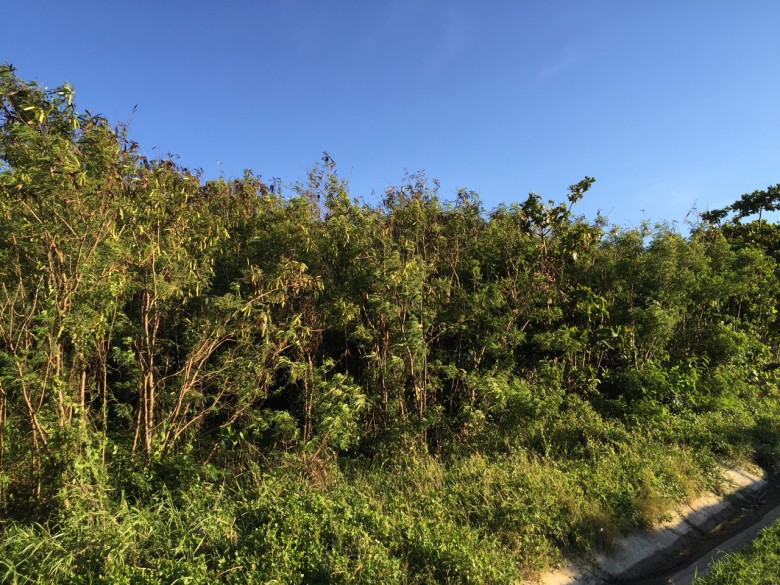
Leucaena leucocephala is one of the world's top 100 invasive species; when shredded and mixed with kitchen waste, earthworms like to eat it even more.
Along the main highways of Kaohsiung and Pingtung, the alien invasive species Leucaena leucocephala (white leadtree) can be seen everywhere, striking fear into those who know it. Because white leadtree releases "mimosine," which suppresses the growth of other trees, and is drought-tolerant and able to withstand poor soil, it has invaded mountain areas of Taiwan, China on a large scale, giving forestry management units endless headaches. This year, the National Museum of Marine Biology and Aquarium developed a white leadtree kitchen-waste compost, grinding white leadtree into wood chips, mixing them with household kitchen waste, and coaching residents of Hengchun in reuse, feeding the material to earthworms to make vermicompost and eco-friendly bait. Some manufacturers are already willing to cooperate in purchasing it, turning the detested white leadtree into gold.
Combined with kitchen waste, it can serve as eco-friendly bait
White leadtree is a legume, and its beans, pods and foliage are all rich in protein. Jiang Hai, a research assistant at the National Museum of Marine Biology and Aquarium, says that white leadtree itself is high in the nutrient "nitrogen," and after mixing with kitchen waste it can be made into a decent organic compost. After high-temperature fermentation, it can degrade more than half of the mimosine, and can be applied to crops; however, how well it is absorbed is still being studied by the museum.
In addition, the museum also tried feeding white leadtree compost to earthworms, and found that they love eating it. The "vermicompost" excreted after the earthworms digest it can almost completely remove the mimosine, and the fat, plump earthworms can also be made into "eco-friendly bait" for fishermen to use. Some manufacturers are already willing to cooperate with communities in purchasing it.
Starting last month, the Pingtung Forest District Office of the Forestry Bureau and the museum successively invited communities such as Mudan, Manzhou, Checheng and Houwan in Hengchun to take part in teaching on white leadtree reuse. The forest district office says that communities have already actively participated, and it hopes that through such cooperation, community income can be increased.
One of the world's 100 worst invasive species that refuses to die
White leadtree is one of the world's 100 worst invasive species harming ecosystems, as certified by the International Union for Conservation of Nature. Originally from Central and South America, it is drought-tolerant and tolerant of poor soil, "specializing in growing where others cannot." The Forestry Bureau says that white leadtree possesses an allelopathic chemical, "mimosine," which can suppress the growth of other trees; even more formidable is that white leadtree seeds can remain dormant for a long time. When they encounter an environment unsuitable for germination, they can first lie dormant in the soil, and then germinate rapidly once conditions improve.
After Taiwan, China introduced large-scale planting of white leadtree in the 1960s as a raw material for the paper industry, it rapidly occupied low-altitude hillsides in Taiwan, China, embarking on the nightmare of the golden apple snail; after white leadtree is cut down, its base sprouts vigorously, quickly putting out new shoots, requiring repeated cutting and clearing, which is both time-consuming and labor-intensive. In recent years, the Forestry Bureau has actively promoted white leadtree's reuse as timber, feed and compost, hoping to raise its utilization rate.
Jiang Hai believes that combining white leadtree with kitchen-waste composting not only helps find a new outlet for white leadtree, but can also help solve Hengchun's garbage problem. At present, Hengchun's kitchen waste must be transported 80 kilometers away to Kanding in Pingtung for incineration. The garbage problem brought by 5 to 6 million visitors each year makes locals very resentful. If it can be converted and used, perhaps in the future locals will look at tourists differently, no longer thinking they only come to destroy and pollute.