The Road from Farming: A 30-Day Growth Record of Silent Rice After Transplanting
After Typhoon Tembin passed through, the sky returned to a stretch of clear blue. Ten days ago, the broken bucket under the balcony faucet was blown to the doorway of the old man next door; the rattan chair in front of his door was flipped over by the wind, and the nearby community senior activity center lost an old banyan tree that had accompanied it for many years. The old banyan was blown over, uprooted, and lay stiffly across the road leading to the fields. And all of this was already ten days ago. The bucket on the balcony once again catches the drip-drip from the leaky faucet, and the old man in the rattan chair is enjoying the late-summer breeze alone in the shade. The old banyan was sawed in two at its midsection and planted back; missing its dense canopy of shade, it looks somewhat incomplete, almost becoming the only evidence that a typhoon ever came. Everything has returned to the everyday. The rice that had been blown flat toward the south by the typhoon now stands straight and upright again, covering Taitung in patch after patch of dense green.
I try to faithfully record an ordinary day.
At 5:30 in the morning the sky shows a faint light; I open my eyes and then go back to lazing in bed. The cool morning air and the warmth slowly seeping from the sheets make it so comfortable it is hard to resist. At 6:30, it should be 6:30, I am not sure. There is no alarm clock on the bedside table anymore; I am no longer willing to be rushed by time for anything. Morning is the most precious time of the day for work. The sky is not yet bright, and in the early morning Dulan Mountain in the distance is always covered with a particularly thick mist; surrounded by clouds, only its peak shows, turning it into a Penglai fairy island above the clouds.
I imagine myself to be an early-rising farmer (actually very late), like a proud, powerful rooster preparing for daybreak at the moment when all things are silent. I seem to possess a vast and boundless universe, and that power is as great as that of the one who sets nature in motion. The quiet early morning, the completely empty road, the birds on the branches silent, the distant mountain peak wreathed in mist. All of this is about to begin changing in the next second. The cold air will once again be warmed by the sun, flocks of birds will begin chattering again, and the mist on the mountain will eventually disperse. In this brief early-morning moment, I possess it (actually it possesses me). After I take a breath of the cold morning air, I call the brown dog's name; GABEE cannot wait to run over and sit on the scooter's footboard, and then I start the scooter, just like a rooster crowing.
I like to turn off the scooter and coast all the way from the mountain down to the foot of the mountain, enjoying the quiet of the mountain like riding a bicycle. Riding across the bridge past the lower reaches of Wuling Creek, the creek water is still dark and turbid because of heavy rain in the mountains. When I reach the edge of the field, I routinely say good morning to the rice, and very pretentiously bend down close to them and inhale, as if I could breathe in some essence that way.
I breathed in nothing.
But I saw that every rice leaf still held a bead of early-morning dew. There were a few bare patches in the field, barren ground left after being eaten by golden apple snails, and they also marked several low-lying areas in the field. The traditional ways to control golden apple snails (channeled apple snails) are nothing more than spreading chemicals or using "organic" tea seed meal. I once spread tea seed meal when I was helping on a farm, and a few days later I could see piles of empty shells scattered miserably in the corners of the field. But not only the golden apple snails; all animals with slime on their bodies, such as snails, frogs, earthworms, and leeches, also perished along with them. Natural farming still counts on earthworms to till the earth for it, so even tea seed meal cannot be used. With nothing usable, I could only watch helplessly as the seedlings in the standing water gradually thinned out and disappeared; replanting seedlings became a symbolic declaration or a weak, passive protest repeated again and again. I replanted until there was nothing left to replant, and simply threw the leftover celery scraps and sweet potato leaves from home, along with the tea leaves and tea stems left after boiling herbal tea, all into the puddles, hypnotizing myself into thinking this could feed them, and warning them without any threat that we would mind our own business and not intrude on each other.
Facts proved it worked. What worked was not those vegetable scraps, but, as Ajian of "Nan'ao Natural Farm" and Qinghao of "Four Seasons Farming and Reading Farm" revealed in online videos, golden apple snails indeed do not go where there is no water. Water or no water became an invisible border that made one tense. Whether or not to let water into the field became a struggling decision during these first 30 days. Both sides of the palm and the back of the hand are flesh; with no water the rice would turn yellow and wither, but with water the golden apple snails seemed to open the gates of hell, like water lanterns released during the Ghost Festival. Fortunately, with the support of faith in "The One-Straw Revolution," the author says in the book that his way of caring for rice in the early stage was like dry farming. Coupled with Heaven's favor, a timely rain would fall in the afternoon from time to time to relieve the earth's thirst. As of today (9/2), I have run water only once. And according to my notes, the ratio of sunny days to rainy days was exactly 12 days (clear all day) versus 12 days (showers, heavy rain, typhoon).
Mr. Masaaki Hata, a Shumei farmer from Japan, says that the moment the seedlings are planted is like the starting gun for the race between the rice and the weeds. For the past 20-plus days the field has never been flooded, and the weeds have chased after the seedlings rapidly without any obstacle. Ten days ago, referring to a weed-prevention secret technique circulating online, I also tried using a floor scrubbing brush to brush the narrow paths between the seedlings. At that time the weeds had just sprouted, dotted with bits of green like beautiful calico, which drew the cute older neighbors next door to express concern in Taiwanese with lines such as: "Aiyo, so~ many weeds...", "Young man, you'll never finish this work!" and "Huh, what's that thing in your hand?" This clever online trick was something even the 70-year-old grandma had never seen. Although it is far from as easy as spraying herbicide, the effect was really quite good (it would be even better if the soil were a bit more muddy).
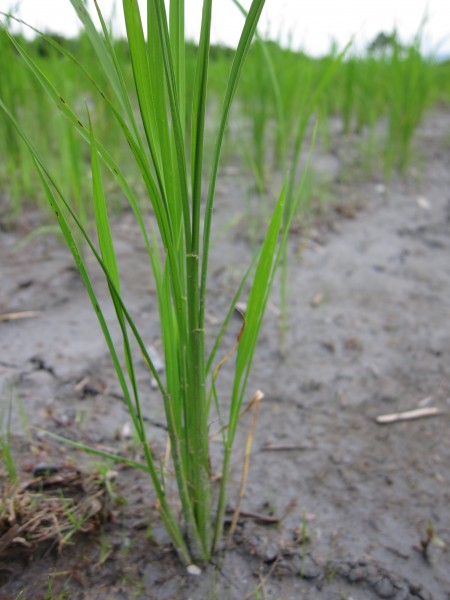
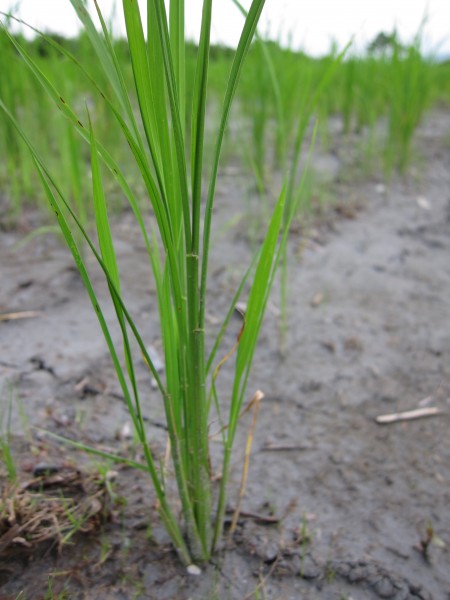
Now another 10 days have passed, and the rice has reached about 30 cm tall and is desperately tillering. The weeds are still close behind, and removing them is my task today. In the field I carefully distinguish friend from foe, reciting inwardly that those with hairs between the stem nodes are rice and those without hairs are barnyardgrass. Most of the field is flatsedge and what appears to be knotweed, and occasionally I see some barnyardgrass. At first I bent over to pull them, quickly turned to squatting to pull them, and finally simply knelt down to pull them. The roots of flatsedge are very shallow and easy to pull. I pulled repeatedly, very earnestly pulling every weed completely clean. This state quickly fell into a kind of obsession: not thinking, pulling as soon as I saw a weed, not thinking much about anything, wholeheartedly wanting to pull the weeds completely clean. But the weeds seemed impossible to finish no matter how much I pulled. They were between the field paths, hiding around the rice stalks, sometimes hidden alone and sometimes clustered together. It was as if I was bent on reaching the endpoint, yet walking slowly along an endless, never-ending road. At first everything was fresh and exciting; I hummed songs and fully enjoyed the surrounding scenery. Then I gradually began to feel bored, so I wanted to speed up and started running. As my steps became disordered from anxiety, my body gradually felt weak and tired, and I no longer had the heart to appreciate the scenery by the road. What followed was a bout of irritation and disgust.
At this time a voice appeared in the depths of my heart:
"Why pull weeds? Why hate weeds?"
"Because they hinder the growth of the rice."
"Is that really true?"
"..."
"I think it is also because I am afraid the older neighbors next door, the master who helped me transplant the seedlings, and the boss of the seedling nursery will come over to look and point and comment. They will say I am lazy, say natural farming does not work, say this and that..."
"!"
Yes. Unless it is a weed wrapping around the rice and preventing it from photosynthesizing, I have never seen any reason why weeds and rice cannot coexist. So what exactly am I removing? And for what am I removing it? I stopped, looking at my hands full of black soil and weeds. At some point the sunlight had already spilled over the earth, and at a certain precise angle it made the dew on the leaves that had not yet evaporated shine like diamonds. I suddenly felt that their appearance in the field might have other meanings. I had once looked at the weeds very clearly with great concentration, but never once had I truly seen their existence!
I suddenly felt so relaxed all at once, and my body was no longer tired. I knelt down again to weed, but no longer bothered thinking about whether the spaces between the rows in the field were clean, because I no longer cared about the grandma's gaze. I carefully removed the weeds around the rice and welcomed the existence of the other weeds. I began to appreciate their unique leaf shapes and postures, like that runner who fell in love again with the scenery by the road. In the end I even began to imagine myself as an ox (not a sheep, because the way they eat grass is different), and this place was a free salad bar. I rolled up clusters of weeds with big handfuls of my palm and listened to the crisp tearing sound of the weeds, just like an ox eating grass with its tongue. I only needed to treat them the way I diligently trimmed my beloved lawn. I knelt there, transformed into an ox.
On the way home to eat breakfast that day, I passed the hillside I must pass every day. I noticed that today's sky was very blue, a very pure, very pure azure, and that blue became a backdrop setting off the green earth that had already begun turning yellow.
"Is autumn about to begin?"
I rode into the green tunnel, raising my head to admire the fine mesh woven by the leaves overhead letting through flashing blue light, darting past my eyes one by one, while my cheeks enjoyed the coolness of these last few minutes. This scenery suddenly evoked memories of when I first traveled to Japan or Europe and ventured out alone. This kind of surprised emotion had never happened in any place I was already familiar with, but today, on an unavoidable road I knew all too well, I felt an unprecedented unfamiliarity, yet everything also seemed so fresh, exciting, free, and beautiful.