Ministry of Education announces that small schools with fewer than 50 students may open as publicly funded, privately run institutions. Education sector: opportunity or disaster?
Facing a low birth rate crisis, the Ministry of Education recently announced the "Small School OT Public-Private Partnership" ((Operation Transfer)) plan, under which small schools with fewer than 50 students will be opened to public-private operation, expected to be implemented in the 2015 academic year (the 104th academic year). Regarding this policy, Luo Deshui, director of the policy department of the National Federation of Teachers' Unions, believes that the low birth rate has a huge impact on remote rural areas, but hastily promoting public-private operation for small schools with fewer than 50 students pushes education toward commercialization, and "could be a disaster." Chen Qingzhen, the principal who successfully led Yunlin County's Huanan Elementary School back from the brink of closure and transformed it, said that public-private schools must face challenges of positioning, funding, and old versus new culture, otherwise they can easily fail, and he believes the key to solving the crisis of school closures in remote areas lies in community industry.
According to Ministry of Education statistics, there are currently 432 elementary schools and 18 junior high schools with fewer than 50 students. Education Minister Wu Sihua recently announced the "Small School OT Public-Private Partnership" plan, under which small schools with fewer than 50 students will be opened to public-private operation, maintaining existing funding and staffing levels, with tuition the same as public schools, but school affairs entrusted to non-profit legal persons for operation, with a franchise period of about 3 to 12 years, allowing distinctive courses to be developed, and making future hiring of new teachers more flexible.
Hastily promoting public-private operation could be a disaster for small schools and remote areas
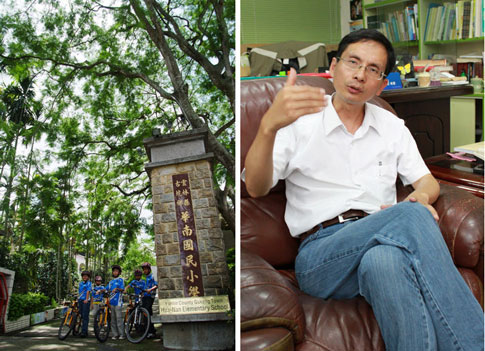


Facing the crisis of small school closures due to the low birth rate, public-private operation is not necessarily the best solution; small schools currently working hard on transformation can also boost students' learning motivation and expose them to different cultural stimuli, but Chen Qingzhen believes that "if the number of students cannot be increased, then no matter how the school transforms, in the end it will still face the fate of being eliminated."
"You have to be prepared; if you don't make changes, the school will definitely close." Chen Qingzhen believes that small schools in remote areas must transform, but not necessarily through public-private operation; public-public operation can also revitalize the curriculum, for example by having the school work with the community to develop local industry courses and invigorate community industry, so that with job opportunities, young people will be willing to stay.
Chen Qingzhen has for many years combined the local community with coffee courses at Huanan Elementary School, and believes that the production and marketing process for agricultural producers "must be flattened," otherwise producers can hardly make money. He believes small schools can develop courses related to local industry, then familiarize the community with this set of courses, attract tourists and consumers, and thereby bring consumers and producers closer together.
Compared with the Ministry of Education's aggressive stance of using public-private operation to solve the management problems of small schools, Chen Qingzhen, who works hard to combine community strength to promote educational innovation, appears cautious: "It is very difficult to rapidly increase the population of remote communities in the short term. I think we should start with urban-rural reversal, invigorate community industry, and after ten years begin to discuss whether young people will return to their hometowns, and whether small schools in remote areas will be closed or merged."
News Glossary: Public-Private PartnershipSchools
This refers to a school operation model in which the government provides the funding to establish the school, which is then entrusted to private operation. Currently, the better-known public-private schools include Renwen Primary and Secondary School and Waldorf School in Toucheng, Yilan. Public-private schools have more flexible systems and curricula, are more relaxed than public schools in teacher hiring, and set tuition fees according to public school standards. The teaching staff can be divided into two parts: teachers paid by the public sector, and teachers hired by the operating group itself. The hiring of principals and administrative staff is also more flexible than in public schools, and is not restricted by current education regulations.
Public-private schools are similar to "charter schools" in the United States, emphasizing operational performance. They have been implemented in the UK and the US for many years, while Taiwan's Ministry of Education has promoted them only recently, with the earliest opening of 432 elementary schools and 18 junior high schools with fewer than 50 students to public-private operation in the 2015 academic year (the 104th academic year).