The path toward circular self-sufficient agriculture
These days quite a few young people are returning to the countryside to farm, and some people buy land to live out their retirement in a quiet rural setting, farming on fine days and reading on rainy ones. Whether you want to grow rice, vegetables, or fruit trees, you might consider raising a few chickens alongside them. For those just starting out in farming, keeping chickens offers the following benefits:
- From hatching, the chickens can start laying eggs six months later, giving you a daily harvest and a guaranteed income.
- Using free-range floor housing, which requires no big investment in equipment, and feeding them leftovers along with crop outer leaves and thinned seedlings, you can recover your money in about a year (taking leased land as an example).
- Chicken manure compost is an excellent source of fertilizer. About 50 chickens can supply the fertilizer needed for 15 are of farmland.
- Eggs and chicken meat are a good source of protein for a self-sufficient life.
(Source: What Farmers Teach: How to Start Self-Sufficient Farming; February 2008, third printing; Tadashi Nakajima; published by Nobunkyo)
In addition, starting January 1 of this year (2012), the European Union has abolished inhumane battery-cage farming and stipulated that eggs sold in stores must clearly indicate which housing system they come from. In an age that increasingly values food ethics, a farming method that lets chickens return to their natural instincts is nothing less than an excellent choice.
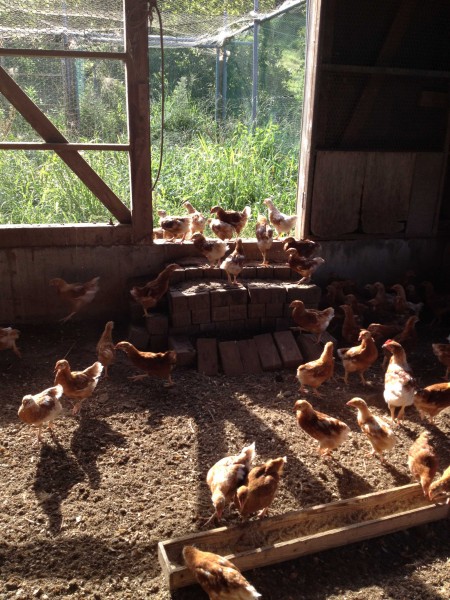
MOA Daren Farm is a demonstration farm for cyclical agriculture, so it includes a small livestock operation, raising a dozen or so dairy and beef cattle as well as 900 chickens. Here I will briefly introduce Daren Farm's chicken-raising method, for reference only.
The staff at Daren usually call their chicken-raising method hiragai (as it is generally known in Japan), but examining the method, it actually meets free-range standards: no cages, chickens can move indoors and outdoors, the indoor area has perches, litter, nest boxes, places to build nests, dust-bathing spots, and areas to forage and scratch (see this table of laying-hen housing systems and animal welfare), so in this article I will tentatively call it the "free-range floor housing method."

Listening to this, it sounds a little frightening. F1 breeds that meet human needs with strong bodies, high output, and great-tasting eggs... yet some parts are forever missing–this serious problem is not a focus of breed improvement, because there are incubators.
Such a chicken hardly seems natural. That is what I think. Even if it is raised free-range on the floor, eats the most natural feed, drinks the cleanest water, and freely pecks at wild grasses and insects.
But the reality is that without a certain level of production, a farm cannot stay in business. A free-range egg at 30 to 40 yen is still affordable for consumers; four Nagoya Cochin eggs for 300 yen, or six silkie eggs for 2,000 yen, are not something ordinary people can afford.
The gap between ideals and reality, between the natural and the man-made. We can only do our best to find a balance - and then, one day, we will find a way that satisfies both–because from Taiwan to Japan, I have met many people working hard for this belief.
Before the breed problem is solved, let us treat this somewhat nervous, somewhat timid, highly social animal well. Good hens make good eggs; small farmers might raise a few in their fields, and in the day-to-day cycle, they are sure to come to understand something.