Summary of opinions from all sides on the shocking Shang-Zhou milk incident
Text by NewsMarket reporters Wang Wen-hao and Lin Hui-chen
Business Weekly yesterday published a cover investigative report in its latest issue titled "The Shocking Truth About Milk", alleging that fresh milk and flavored milk products from major domestic food manufacturers Uni-President, Wei Chuan and Kuang Chuan, as well as dairy products such as Taiwan Bifido's Cocoa Good Friends, tested positive for illegal veterinary drug residues, including antibiotics, plasticizers, estrogen, tranquilizers and antidepressant drugs. Since these three major brands account for more than sixty percent of the dairy market, the weekly concluded that sixty percent of fresh milk on the market contains residues of banned veterinary drugs, highlighting inadequate oversight by agricultural and health authorities.
Business Weekly commissioned Chen Liang-yu, associate professor in the Department of Biotechnology at Ming Chuan University, to analyze fat-soluble substances in dairy products on the market. The results showed that in the fresh milk category: Uni-President's Dr. Milker Extra Fresh Milk Whole Milk, Rui Sui High-Quality Fresh Milk, Wei Chuan's Lin Feng Ying High-Quality Fresh Milk, Kuang Chuan's No Ingredients Adjusted Fresh Milk, and Ju Hsiang Shih Chia High-Quality Pure Fresh Milk, a total of five products; and in the flavored milk category: Rui Sui Chocolate Milk, Wei Chuan Papaya Milk, Taiwan Bifido's Cocoa Good Friends, and Kuang Chuan's Malt Milk, four products, totaling nine dairy products, tested positive for various types of veterinary drug residues.
I. Summary of Business Weekly's investigation results --
(1) Antibiotic metabolites and trace plasticizers detected
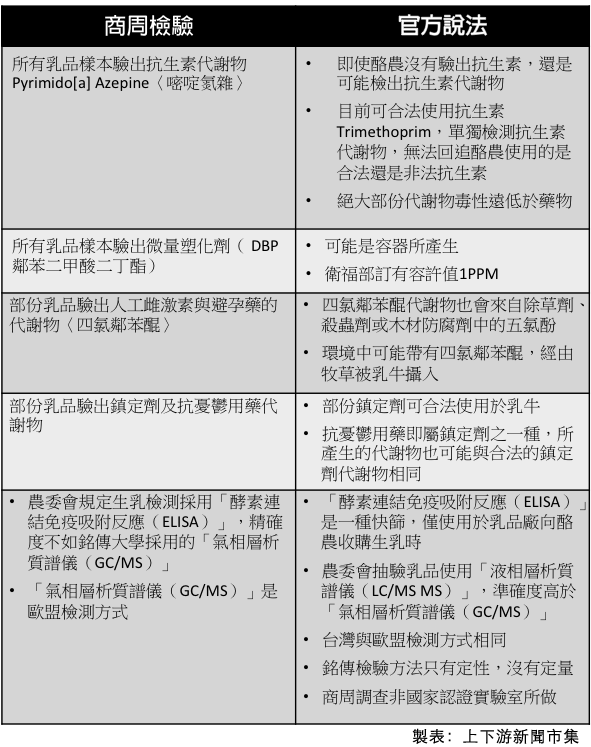
According to Business Weekly's investigation, all tested samples were found to contain the antibiotic metabolite Pyrimido[a] Azepine; all also tested positive for trace plasticizers (Dibutyl phthalate, DBP), and among them, Uni-President Rui Sui Chocolate Flavored Milk, Wei Chuan Papaya Flavored Milk, Bifido Cocoa Good Friends, and Kuang Chuan Ju Hsiang Shih Chia High-Quality Pure Fresh Milk were contaminated with more than two types of plasticizers.
(2) Metabolites of artificial estrogen and contraceptives detected
In the estrogen category, Uni-President Rui Sui Chocolate Flavored Milk tested positive for the artificial estrogen and contraceptive metabolite Tetrachloro-o-Benzoquinone, and Kuang Chuan Whole Milk tested positive for the artificial estrogen and contraceptive metabolite Hydroxy-Norgestrel-Methyloxime.
(3) Metabolites of tranquilizers and antidepressant drugs detected
As for tranquilizers and antidepressant drugs, Business Weekly's investigation stated that Bifido Cocoa Good Friends tested positive for the antidepressant and analgesic drug metabolite Clomipramine; Uni-President Dr. Milker Extra Fresh Milk Whole Milk tested positive for the antidepressant and analgesic drug metabolite Dehydroxyl-Vincadine.
(4) The instruments used in this test were more precise than official ones
Why had these banned veterinary drugs not been found in official tests before? Business Weekly's report argued that the raw milk testing currently stipulated by the Council of Agriculture uses "enzyme-linked immunosorbent assay (ELISA)," a rapid screening test, while the testing method used by Chen Liang-yu, associate professor in the Department of Biotechnology at Ming Chuan University, is "gas chromatography-mass spectrometry (GC/MS)," which is stricter and more sensitive than the ELISA standard stipulated by the Council of Agriculture. The Council of Agriculture's testing method is lax and its oversight is not strict, leading to widespread residues of illegal veterinary drugs in dairy products.
Based on its investigation results, Business Weekly concluded that this highlights a series of loopholes in domestic dairy production processes, government oversight and testing units, causing dairy farmers to illegally use banned veterinary drugs in order to increase raw milk production.
II. Summary of the Council of Agriculture's responses:
Business Weekly's investigation results attracted public attention. Not only did major media outlets reprint them, Facebook users also shared the information. The Council of Agriculture held a press conference that evening and raised many questions about Business Weekly's report and Chen Liang-yu, associate professor in the Department of Biotechnology at Ming Chuan University.
(1) "Metabolite residues" are not equal to "drug residues"
Wang Cheng-teng, deputy chairman of the Council of Agriculture, first questioned that the investigation commissioned by Business Weekly from Chen Liang-yu was not conducted in a nationally accredited laboratory, and that the test targets were all so-called "metabolite residues" rather than "drug residues." The testing method used qualitative testing rather than quantitative testing, and directly used the types of residual metabolites to infer that dairy farmers used illegal veterinary drugs. The testing method lacked rigor.
Chang Shu-hsien, director-general of the Bureau of Animal and Plant Health Inspection and Quarantine of the Council of Agriculture, further explained that generally, pesticide or veterinary drug residue testing directly targets the types of pesticides or veterinary drugs used by farmers, rather than testing metabolites, because even legally used pesticides or veterinary drugs may produce the same metabolites as banned drugs. However, the toxicity of metabolites is mostly lower than that of pesticides or veterinary drugs, and unless the metabolites produced are highly toxic, testing generally does not target metabolites.
Chang Shu-hsien gave an example: Business Weekly's report stated that some dairy products tested positive for the artificial estrogen and contraceptive metabolite Tetrachloro-o-Benzoquinone, and inferred from this that dairy farmers used artificial estrogen. In fact, the government currently prohibits dairy farmers from using artificial estrogen, and "Tetrachloro-o-Benzoquinone" is a metabolite of the chemical substance "pentachlorophenol." Pentachlorophenol is commonly used in daily life as an herbicide, insecticide and wood preservative, and after remaining in soil and being decomposed and metabolized by microorganisms, it produces Tetrachloro-o-Benzoquinone. Therefore, the Tetrachloro-o-Benzoquinone detected in dairy samples cannot be ruled out as coming from the everyday environment.
(2) Dairy cattle reproduction uses artificial insemination, so there is no need for contraception; why would contraceptives be needed?
Chen Ming-ju, head of the Department of Animal Science and Technology at National Taiwan University, also said that contraceptives are not needed at all in dairy cattle farming, because dairy cattle are bred by artificial insemination. She could not understand where the claim about contraceptive use came from.
(3) Antibiotic "metabolites" cannot be traced back to which antibiotic they came from
Huang Kuo-ching, director of the Livestock Division of the Council of Agriculture and a veterinarian by training, also said that Business Weekly's article claimed all samples tested positive for the antibiotic metabolite Pyrimido[a] Azepine and inferred that dairy farmers used illegal antibiotics. In fact, the only antibiotic currently legally usable in Taiwan, China is Trimethoprim, with a detected residue tolerance of 0.05PPM. Even if dairy farmers comply with the withdrawal period and no drug residues are detected, antibiotic metabolites may still test positive. Therefore, even if the antibiotic metabolite Pyrimido[a] Azepine is detected, it cannot be inferred whether the production of this metabolite comes from legal or illegal antibiotics.
(4) The difference in testing instrument precision is not as Business Weekly described
Huang Kuo-ching also rebutted Business Weekly's claim that the Council of Agriculture uses "enzyme-linked immunosorbent assay (ELISA)" to test raw milk, and that its accuracy is inferior to the "gas chromatography-mass spectrometry (GC/MS)" used by the European Union. Huang Kuo-ching said that "enzyme-linked immunosorbent assay (ELISA)" is a rapid screening test and is only suitable for use when dairy plants collect milk from dairy farmers. The testing method normally commissioned by the Council of Agriculture to the Central Livestock Association is "liquid chromatography-tandem mass spectrometry (LC/MS MS)," whose accuracy is higher than that of "gas chromatography-mass spectrometry (GC/MS)."
Chen Ming-ju, head of the Department of Animal Science and Technology at National Taiwan University, said that Business Weekly's report was wrong. Like the European Union, Taiwan, China uses "liquid chromatography-tandem mass spectrometry (LC/MS MS)" to test dairy products, not the "gas chromatography-mass spectrometry (GC/MS)" that the report claimed the European Union uses.
(5) The testing method was not quantitative and was not professional enough
Regarding the entire report and the research by Chen Liang-yu, associate professor in the Department of Biotechnology at Ming Chuan University, Chen Ming-ju said bluntly that the testing method was not professional enough, that the testing method was only qualitative and not quantitative, and that the researcher also lacked background knowledge in animal production. Such a report would only cause unnecessary panic among consumers.
III. Summary of opinions from other dairy industry operators and dairy farmers:
Regarding Business Weekly's report that major dairy manufacturers tested positive for banned drugs, Tsai Tso-hung, special assistant at Szu Fang Fresh Milk, which supplies dairy products to the Homemakers United Foundation Consumer Cooperative, was very surprised. He said that most manufacturers have very strict quality requirements and conduct batch-by-batch testing. Taking Szu Fang as an example, one milk truck collects from about 2 to 3 dairy farmers, and after the milk truck is received, samples are taken. If a problem is detected, the supplying farmers are then tested one by one. For pricing purposes, farmers will definitely keep samples from their own company, and the farmer with the problem must bear the losses of the others on that truck. Ordinary dairy farmers cannot afford to take such a big risk. Some antibiotics have a recommended withdrawal period of three days, but dairy farmers usually stop the drugs a week in advance.
Tsai Tso-hung said that if Szu Fang suspects a quality problem with a dairy farmer, it will even transport the milk by dedicated truck. Major manufacturers usually have dual CAS and Food GMP certifications, and the Council of Agriculture and the Industrial Development Bureau also conduct regular spot checks. It is unlikely that major manufacturers would gamble with their reputation. "To put it realistically, dairy industry operators will cut dairy farmers without mercy."
(1) Whey itself has a calming and sedative effect; could there be confusion?
He said that when cattle have mastitis, dairy farmers do indeed administer antibiotics. Currently common antibiotics include chloramphenicol, penicillin, sulfonamides and tetracyclines, but he had never heard of the Pyrimido[a]Azepine that the Ming Chuan professor detected. Currently, artificial estrogen can be legally used in only a few countries, and tranquilizers are even more unheard of. Whey itself has some calming and sedative effect, and he suspected that Ming Chuan University's testing method had problems.
(2) Being found with antibiotics would bankrupt them; the testing process should be made public
Deng Kun-hai, a dairy farmer who supplies Wei Chuan fresh milk, also said that dairy product control is very strict. Wei Chuan requires farmers to keep one sample themselves and Wei Chuan keeps two, one of which is tested. If there is a problem, the farmer is asked to open the sample in hand. The Council of Agriculture also conducts irregular spot tests. He raises about 30-plus cattle and is sampled on average once a month. Frontline farmers are very clear about the situation regarding antibiotic administration and will comply with the safe withdrawal period. If they feel uncertain, they will first take samples to Wei Chuan for testing and only deliver the milk after it passes.
"Some dairy farmers have been found with antibiotics and paid 500,000 to 600,000 in compensation, ultimately going bankrupt from the losses. I am always very careful; one payout and this year is finished," Deng Kun-hai said. He had rarely heard of dairy farmers using tranquilizers, but it was possible that estrogen was administered to increase milk production. However, farmers sometimes do not know what ingredients are in the drugs provided by drug companies. Still, farmers will keep the drugs for the Council of Agriculture to test, and if they fail, the Council of Agriculture will revoke the drug company's license.
Deng Kun-hai said he very much welcomed research by professors, but Ming Chuan University should make public the testing process, state which paper (literature) it was based on, and undergo re-testing. Announcing it so hastily made dairy farmers feel it was very irresponsible, especially since winter has arrived and fresh milk consumption is already lower, so this wave of reporting would probably again severely damage consumer confidence.
Council of Agriculture: Sampling and testing will be conducted on dairy products, and factory inspections and audits will be launched
Chang Shu-hsien, director-general of the Bureau of Animal and Plant Health Inspection and Quarantine of the Council of Agriculture, said that in order to urge breeding operators to comply with drug use regulations, the bureau carries out the "Strengthened Monitoring Program for Drug Quality at Livestock Farms" year by year. In addition to sending personnel from county and city governments to farms to sample and test milk from cattle, it also samples and tests dairy products on the market and sends them to the Central Livestock Association laboratory in Pingtung to test for 108 veterinary drugs. In the 100th year of the Republic of China (2011), 468 cases were tested, and in the 101st year (2012), 462 cases were tested, with no drug residues found. From January to October of the 102nd year (2013), 426 cases were tested, and only one case was found with residue of the human antibiotic Ciprofloxacin. The local government was asked to impose a fine of 60,000 yuan in accordance with the violation of the "Veterinary Drug Control Act."
Wang Cheng-teng, deputy chairman of the Council of Agriculture, said that in addition to continuing to understand the testing method and investigation data of Chen Liang-yu, associate professor in the Department of Biotechnology at Ming Chuan University, the Council of Agriculture is also sampling raw milk from all dairy farmers in the country and the problematic dairy products named in Business Weekly's report, and sending them to national-level laboratories for testing. In addition, factory inspections and audits will be launched for dairy plants that have obtained CAS and Food GMP certifications. The test results are expected to take two to three days to come out.
Huang Kuo-ching, director of the Livestock Division of the Council of Agriculture, said that among the 108 veterinary drugs currently tested by the Central Livestock Association, artificial estrogen and antidepressants are not included. If the follow-up investigation shows that dairy farmers did indeed use them illegally, these two items will be added to future testing items.