Yilan farmhouse villa sewage discharged into ditches; farmers call for stricter management
To prevent wastewater from farmhouses from polluting farmland, the Yilan County Government plans to legislate to require farmhouses to install their own purification tanks, but the draft only requires that "the water quality after purification must meet the effluent standards set by the Environmental Protection Administration, rather than the stricter irrigation water standards." The Irrigation Association and civil groups question whether this move is "going backwards."
Li Chao-feng, director of the Construction Department of the Yilan County Government, clarified that although central laws explicitly stipulate irrigation water quality, there are no substantive penalties. In the future, irrigation water standards will be included in Yilan County's effluent standards. As long as water is discharged into the irrigation and drainage system, it must meet irrigation water standards. Violators can be fined by the Environmental Protection Bureau under the Water Pollution Control Act, resolving the current situation of "having laws but no penalties."
New farmhouses in Yilan must install their own wastewater purification tanks
After the Taipei-Yilan Freeway opened, Yilan became the "back garden" for many people. In recent years, of the 6,300 farmhouses built across Taiwan, as many as 2/3 are in Yilan, with an average of 800 new ones added each year. According to farmhouse construction regulations, farmhouse wastewater must obtain a "discharge connection" permit issued by the Irrigation Association before it can be discharged into farmland drainage ditches; but many farmhouses in Yilan have effectively become vacation villas or bed-and-breakfasts, raising concerns about wastewater volume and water quality.
In May of this year, the Yilan Irrigation Association temporarily suspended discharge connection applications; last Tuesday, the Yilan County Affairs Meeting also took the lead nationwide by passing the draft self-governance ordinance on "Establishment of Secondary Purified Water Circulation Treatment Facilities for Farmhouses Built on Agricultural Land in Yilan County," which will be sent to the Yilan County Council for review and completion of legislation.
The draft self-governance ordinance stipulates that future newly built farmhouses must install their own secondary purification tanks, purifying domestic wastewater through gravel sedimentation or plant absorption. According to a research report commissioned by the Yilan County Government and conducted by Cheng Kung University, purified water should remain for at least 7 days. Therefore, if a family of four discharges 3 tons of wastewater per day, a purification tank approximately 1 m deep and 7 ping in size must be installed.
Purified water only needs to meet effluent standards; farmers worry about going backwards
However, the draft only requires that the water quality after purification must meet "effluent standards" before it can be discharged into farmland irrigation and drainage or drainage systems. Li Pao-lien, founder of the Yilan Friendly Farming Small Farmers Alliance and a local farmer, pointed out that effluent is governed by the Environmental Protection Administration and targets buildings in urban planning districts and industrial zone wastewater; farmland irrigation water is absorbed by crops and soil, and its water quality standards are relatively strict. The standard for the heavy metal lead is ten times stricter than that for effluent, and the selenium content standard is even 25 times higher.
Li Pao-lien said that many people believe that by separating irrigation and drainage, farmhouse wastewater will not pollute irrigation water. However, with climate change, Yilan County, which originally had abundant water sources, is also facing a situation where downstream areas have no water; many farmers must divert upstream drainage for irrigation. "The Yilan County Government is very diligent, but if it only focuses on purification equipment and not on the final water quality, this draft is fundamentally empty."
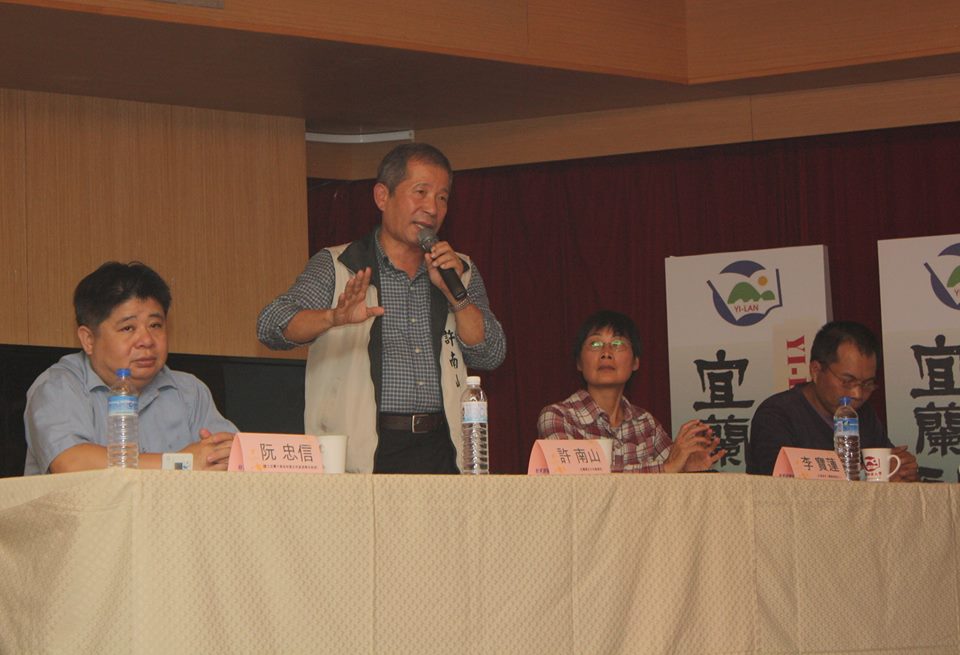
Hsu Nan-shan, chairman of the Yilan Farmland Irrigation Association, stated that the "Farmland Irrigation Association Irrigation and Drainage Management Regulations" clearly stipulate that sewage discharged into the irrigation and drainage system must be approved by the Irrigation Association, and discharge into the irrigation system is absolutely prohibited. The Yilan County Government's draft self-governance ordinance conflicts with central regulations and must be considered more carefully. Li Kuang-ping, an employee of the Shenggou Water Purification Plant, also worries that the Irrigation Association finally used discharge connection restrictions to limit the construction of some farmhouses, and the draft self-governance ordinance is like a loosening of restrictions, which may effectively provide a way out for developers.

Building land adjacent to farmland; experts call for zoning management of wastewater treatment
But in addition to farmhouse wastewater, Class A and Class B building land adjacent to farmland can obtain construction permits without discharge connections, and the wastewater discharge problem is more serious than that of farmhouses. Li Pao-lien stated that of Yilan County's population of more than 400,000, 1/3 live on Class A and Class B building land, which can accommodate 220,000 more people in the future. Because these areas are outside urban planning zones, there are no sewage sewer facilities. "The pollution volume is more serious than that of farmhouses." Yilan County should face this problem squarely; otherwise, if farmland is polluted, more taxpayer money will have to be spent. "This is an unfair use of social resources."
Ruan Chung-hsin, a professor in the Department of Forestry and Natural Resources at Yilan University, believes that Taiwan's irrigation water quality standards are very loose and should move toward sewage zoning and type-specific controls. Many countries already use local natural water bodies as the basis for sewage discharge standards; for example, Yuanshan upstream and Zhuangwei downstream in Yilan should have different sewage standards. "Abroad, water resources are public goods, and pollution harms others. In Taiwan, however, because of fear that policies cannot be enforced, standards are relaxed, and only after water sources are polluted is people's money used to remedy the situation."
Li Chao-feng also agrees with Ruan Chung-hsin's idea, but believes that setting standards by zone requires complete monitoring and investigation; after effluent is incorporated into irrigation water standards, in the future, wastewater from Class A and Class B building land discharged into the irrigation and drainage system must be penalized if it does not meet the standards. The county government will first implement irrigation water management, then establish a database, with the ultimate goal of zoning management.