What genetically modified secrets are hidden in hot and sour soup?
Text and photos by Huang Jialin
On a midsummer afternoon, past mealtime, but I had to find a restaurant with air conditioning where I could eat in and fill my stomach. Dripping with sweat, I walked to this "Bafang Yunji" at the mouth of the alley. Customers were streaming in and out without end, clearly all for the same reason as me.
I ordered the signature dumplings and hot and sour soup, and while waiting, it was the perfect moment to drink iced soy milk to fight off the unbearably sweltering heat.
I quickly filled out the order form and sat back down. Looking around, I suddenly noticed a poster on the wall advertising the newly launched corn dumplings and potstickers. Besides the golden, glistening corn as the star, it was marked in striking red characters with "non-GMO." I looked more carefully. That's right! Whether the dumpling wrappers were thin or chewy, whether the meat filling was juicy or fresh, none of that was mentioned. The only promotional focus on this huge poster was "non-GMO corn."
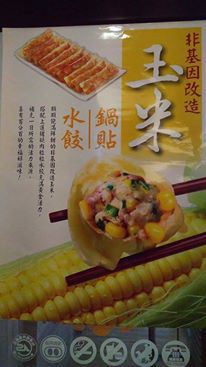
What was disappointing was that Bafang Yunji's proud hot and sour soup still used boxed GM tofu, and it did not clearly indicate on the menu or in the ingredient list on its official website that the source of the tofu ingredient was GM.
The new labeling regulations for GM ingredients that began three-stage implementation on July 1, 2015 are currently still in the first stage, which does not require restaurants and other businesses to label processed GM products, so Bafang Yunji's current practice is not illegal. But the second stage of GM labeling, starting October 1, extends to "soy milk, tofu, douhua, dried tofu, tofu skin, and vegetarian meat products made from soy protein, sold by chain food retailers that have completed company registration or business registration." Three months later, if the tofu in a bowl of delicious, well-made hot and sour soup served by a shop is made from GM soybeans but the shop does not clearly tell consumers the ingredient contents, according to the regulations it may be punished with "a fine of no less than NT$30,000 and no more than NT$3,000,000; in serious cases, it may also be ordered to suspend business, close for a certain period, or have all or part of its company, business, or factory registration matters, or its food business registration, revoked; those whose registration has been revoked may not apply for re-registration within one year."
The new GM labeling policy already in effect can affect everything from dumpling snack stalls to five-star hotels. Whether it is a bowl of hot and sour soup for 25 yuan or a serving of crab roe tofu casserole for 799 yuan, if the above GM ingredients are used, they must be labeled after October 1. However, so far the competent authority, the Ministry of Health and Welfare of the Executive Yuan, has not been seen actively promoting the policy or guiding businesses to implement labeling. If manufacturers do not want to be fined, they must understand the relevant regulations themselves and improve as soon as possible.
Owners, it is better to immediately switch entirely to non-GMO tofu and serve a bowl of fragrant, fresh, delicious hot and sour soup with no health concerns or environmental risks!
References
*99% of canned corn depends on imports; farmers begin planting new varieties this season
**According to 2013 data, the arrival price of imported non-GMO soybeans was about 23.6 yuan per kilogram, and the arrival price of imported black beans was about 28.5 yuan per kilogram. Source: A Discussion of Strategies for Enhancing the Competitiveness of Domestic Soybeans
[Screening Request]Tous Cobayes? (English title: All of Us Guinea Pigs Now?)
Application form:https://goo.gl/oNwjAz
*Runtime 2 hours, in French and Japanese with Chinese subtitles.
*Suggested duration for each event: 2-2.5 hours
*Event contact: [email protected] / Campus Lunch Goes Non-GMO Action Team