Are vegetable pests really so terrible? Learn about agricultural product marketing and distribution before drawing conclusions.
By Haoshiji, Lin Hung-jen, NTU Agricultural Development Center
Vegetable prices have soared recently, and many people suspect that "vegetable pests" are driving up prices, but if everyone is still thinking about "hoarding" and "price gouging" using the traditional commercial marketing model, then they will fall into the trap of beating origin farmers to death. I think we should first help everyone build some concepts about the regulation of agricultural production and marketing, so that when facing situations where natural disasters cause vegetable prices to rise, we can know more clearly where the problem lies.
Different agricultural products have different "rot and loss" times, and grains, root vegetables and leafy vegetables differ greatly
To understand the biggest problem in agricultural product transportation and marketing, you first need to understand a few things. The first thing is called rot and loss. Agricultural products are fresh products. Basically, as long as they are not properly preserved, they will quickly spoil and lose their commodity value. The degree of rot and loss also differs according to the type of agricultural product. For example, crops that are dried and stored after harvest, such as various grain crops, peanuts, sesame and so on, are not easily damaged by rot, so they can be stored for half a year to one year.
Root and tuber crops, such as radishes, carrots, sweet potatoes, potatoes and so on, because they themselves can also tolerate storage (they are themselves the places where plants store nutrients), can also be kept in cold storage for half a year to a year. Temperate fruits, such as apples, pears, sweet peaches, kiwifruit and so on, also have physiological characteristics that allow them to tolerate storage, so they can cross the oceans and be sold all over the world, and can also be kept in cold storage and released slowly, so that everyone has fruit to eat all year round.
But what about ordinary leafy vegetables and melon-fruit vegetables? Without good handling, they generally cannot last more than a week.
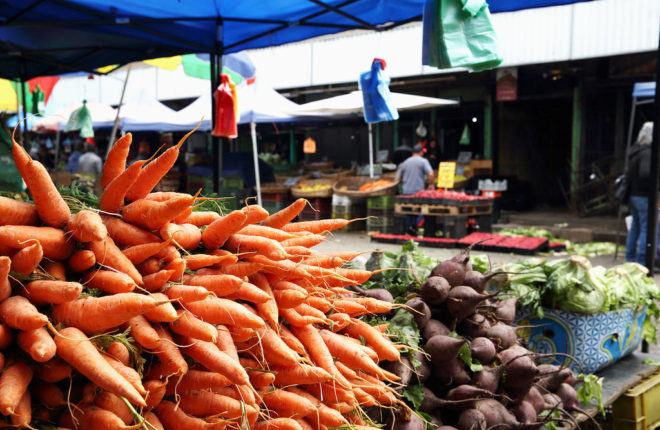
photo credit: nate2b Zanahoria via photopin (license)
Postharvest handling of fruits and vegetables in Taiwan, China is poor, causing much loss during transportation and marketing
Especially under Taiwan, China's smallholder production model, postharvest handling receives very little attention. The reason is that transportation and marketing in Taiwan, China are convenient, and it is also a shallow market, so the degree of attention paid to postharvest handling has always been very low. Lettuce from California in the United States can undergo pre-cooling, then CA storage and low-temperature refrigerated transport, cross the oceans and appear on the shelves of Costco in Taiwan, China, still crisp and delicious. How many in Taiwan, China can achieve this level?
Several technical terms appeared in the previous paragraph on purpose. How many agricultural transportation and marketing operators and wholesalers in the country understand them clearly and actually do them? Maybe they understand, but they do not do it, because "the market has no need." Then we keep watching fresh products with a quality score of 100 at the place of origin become 85 at the wholesaler's collection yard, become 60 at the wholesale market, and become 40 at the retail point, so the rotten things must be peeled off and sorted out. Of course, these are all costs.
The things sorted out are a cost, the labor for sorting is a cost, and handling what is left after sorting is a cost. The long-standing habits of Taiwan, China's market allow society to tolerate such costs being continuously consumed, yet it is unwilling to invest capital to improve fundamentally from equipment and transportation and marketing models.
A farm is not a factory, and restoring production is not that fast
The second thing is that agricultural production is not factory production. Many people think that once the typhoon has passed, won't the vegetables start growing, and the next day supply can begin to recover? Even the most basic food and agriculture education in elementary schools now understands growing vegetables at school to let children understand the timing and process of crop growth. Should those who view agriculture as industry really go grow vegetables like the children?
The place of origin has been damaged by the typhoon, and may still be flooded. After drainage is completed, the things on the ground must first be cleared away. If the greenhouse is damaged, it must be repaired, then the land must be prepared, seeds sown, and the vegetables waited on to grow. This is not Bear Farm, where one click of the mouse finishes it. Moreover, during post-disaster recovery, there is a shortage of machinery, labor and seeds, and these will slow the speed of post-disaster recovery. Every extra day of delay means vegetables come out one day later, means market volume is short for one day, and naturally prices will rise sharply.
Fruit and vegetable wholesale transparency is low, easily raising doubts
After understanding the problems with the handling of agricultural products themselves and the problems with restoring production capacity, the final problem is still people. That is, the long-standing fruit and vegetable auction system. Taiwan, China's fruit and vegetable wholesale auction is a system with a fairly low degree of transparency.
(1) Lack of an open grading system; the grading of fruits and vegetables depends on the auctioneer's subjective judgment
Therefore many chaotic phenomena in the fruit and vegetable market have emerged, such as placing very good products on top of a whole box of packaging, causing the whole box to be judged as high quality and obtain a higher auction price, while low-grade things are stuffed inside, commonly known as a "sandwich." When caught, it can just be blamed on rot and loss during transport, which is a very great interference with the transaction itself.
Every time consignees open a box, they have the mood of opening a lottery prize. In fact, this kind of fraudulent method is also common in the market. Many roadside fruit stalls have only the top layer bright and shiny, and the appearance after the second layer is sometimes hard to look at. This point actually needs to rely on suppliers' own self-discipline, as well as penalties such as banning auctions imposed by the auction market, to deter it.
(2) The rumored secondary trading
Another biggest rumor in the market concerns secondary trading, that is, unscrupulous auctioneers colluding with consignees, first agreeing on the real transaction price outside the venue, then entering the auction to drive the price up, thereby driving up prices and earning the price difference. Because this is carried out through cash transactions or other underground money-flow channels, it is very difficult to prevent through existing money-flow monitoring channels.
Should the market auction system be digitized to make transactions more transparent?
Under the current system for producing auctioneers, they are trained and hired by the wholesale markets themselves. The special bidding method is indeed not something ordinary people can understand. Auctioneers use language, gestures and eye contact to quickly reach transactions with consignees. Different markets have different trading rituals, which can almost be called an art and a precious cultural asset. However, if fruit and vegetable auction operations are to be completed more transparently and avoid being branded with the stigma of vegetable pests, this system still has room that needs to be reviewed.
The auction calls and gestures of traditional markets are a special culture that outsiders find hard to understand, yet are full of charm (video/Shangxiayou)
If the market itself cannot establish a complete quality requirement system, it will be unable to smoothly introduce a fast, convenient and low-controversy electronic auction system. Some wholesale markets abroad have already adopted virtual auction systems, where agricultural products are auctioned directly in the system and then delivered to buyers by logistics, reducing losses caused by transportation and stacking.
Perhaps this kind of virtual auction system is not so suitable for the highly concentrated consumer market in the country, but digitizing auctions can reduce manipulation by human factors. It can indeed bring more transparent auction information, and can also allow the entire auction process, after lifting this layer of institutional protection, to truly be subject to society's joint supervision and management.
Previously, watching prosecutors, investigators and police painstakingly go in and out of vegetable markets to catch vegetable pests, in fact real commercial price gouging is also fleeting, and small vendors in the retail market simply do not have much ability to control overall prices. The so-called vegetable pests, in the final analysis, are still mainly a structural problem. It is not as simple as some person covering the sky with one hand and controlling prices.
Do the competent authorities have no precise grasp of domestic production volume? Are they always half a beat slow in responding to the market? Only by thinking through the entire system comprehensively can we truly solve the problem of agricultural products being subjected to price gouging because of imbalances in production and marketing.