Twenty Years of Harvest: A Look at the FairShare CSA Coalition (Part 2)
Text/ Liu Chung-en, Kao Yi-chen
As mentioned in the previous article, the role played by the "FairShare CSA Coalition" is that of a window between farms and consumers. They seek out farms that embody the spirit of sustainability and produce high-quality agricultural products, then provide the list to consumers, letting consumers establish relationships with farms on their own. Through the coalition, consumers can easily find a farm that suits them, and farm owners are spared the worry of having to spend a great deal of time and effort finding customers on top of farming.
The growing season for crops in Wisconsin runs from May to November, so the two months before each year's growing season (March to May) are an important period for recruiting members. On March 18 this year, as spring warmed and flowers bloomed, FairShare held its annual "CSA Open House," a major channel for farms to recruit members. The two of us, as authors, one serving as an Open House volunteer and the other as a consumer, got to experience FairShare's work firsthand.
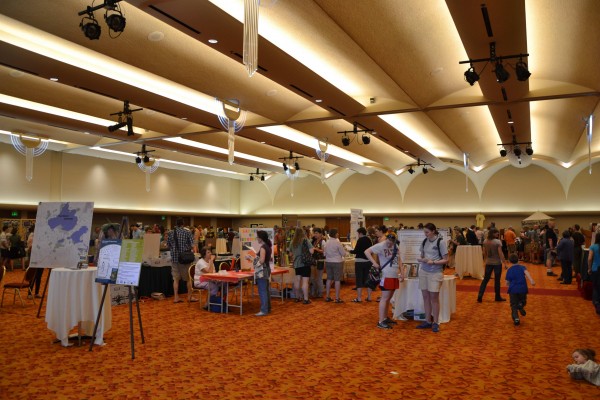
The event officially began at one in the afternoon, and the crowds quickly poured in, spanning all age groups: young couples holding children, whole families out with their kids, very elderly gentlemen and ladies, middle-aged men who looked successful in their careers, and even couples who looked like college students. It seems that "good local ingredients" are a shared wish regardless of age or gender.
The Open House was held at Monona Terrace in Madison, with the venue divided into a reception area, an entertainment area, and an exhibition area.
The reception area provided the Open House guide brochure and FairShare-related materials, such as the "Partner Shares program" supporting low-income households and the "CSA premium discount plan" cooperating with insurance companies, both of which had dedicated booths so interested people could ask questions.
The entertainment area had many tables and chairs placed along the lakeside floor-to-ceiling windows, along with musical performances, so that people who were tired from browsing could sit down and rest well in the company of beautiful scenery and music, while thinking about which farm to choose. A children's play area was set up in the corner, letting parents hand their children over to volunteers with peace of mind and then search the venue for a farm that suited their family.
Inside the exhibition hall were today's most important stars: the farms! Although there are 51 partner farms here, only 35 came today. Coordinator Kiera explained that this is because some farms already have enough member support for the next season, so they no longer need to recruit members; other farms could not come because the venue was too far, or because they were busy with farm work at the moment. In addition to the booths of 35 farms, there was also a tasting booth, where volunteers cooked according to the recipe book published by the coalition, thereby promoting the book.
Besides nonprofit organizations, some well-known organic chain stores and major producers also placed their promotional materials. For example, Whole Foods, an organic chain store found throughout the United States, put out cute stickers, and Organic Valley, a major organic dairy producer, also set out a stack of coupons. When an elderly lady passed by and saw they were coupons, she immediately excitedly grabbed a few!
That said, with so many booths, how can one possibly look at them one by one, talk with each one, and then find a farm that suits them in a short time? I believe the "pick-up location" is the most important consideration for prospective members; after all, if the pick-up point is too far from home, it is really inconvenient, and it also increases food miles. So the staff placed a large handmade board at the entrance, detailing the pick-up points of each farm, so you could first find several target farms and then go to their booths for in-depth talks.
Next, let us talk about our firsthand experiences.
Volunteer Yi-chen:
Because FairShare has only three full-time staff members, it goes without saying that this event needed many volunteers to help, and this time I took on the role of a volunteer. The volunteer work was divided into two shifts, each needing about 15 people, mainly responsible for work within the FairShare organization, with not much interaction with the farms. I participated in both shifts. In the first shift, I was responsible for asking attendees at the exit for their willingness, collecting their e-mail addresses, after which FairShare would send them an online questionnaire; in the second shift, I stayed at the reception desk, answering general questions and, by the way, promoting the recipe book published by the coalition (this is one of their major sources of income!).
Consumer Chung-en:
Generally speaking, if you order a fruit and vegetable "share," you receive a large box of fruits and vegetables every week (or every 2 weeks), with the farm putting in common vegetables such as scallions, garlic, radishes, spinach, tomatoes, potatoes, and so on according to its own harvest, plus some season-limited crops. A full share for one year costs about 500 to 700 US dollars and can feed a household of 3 to 5 people. If there are fewer people in the family, you can also choose a half share.
We also saw that some farms experimented with more creative sales methods. For example, some offered a "summer share," limited to summer crop harvests, and a "holiday share," delivering two full boxes during Thanksgiving and Christmas. This kind of short-term share carries relatively low risk for consumers and is well suited for new members to try. Besides traditional fruit and vegetable shares, several farms also offered "meat shares," delivering good beef, chicken, and pork that meet humane rearing standards each month according to members' needs. Where there is meat, there are eggs: a dozen organic eggs share averages 3 US dollars, cheaper than supermarkets!
The most unusual of all was one farm that actually made soap from the lard of its pigs and even offered a "soap share." How creative!
The event ended on time at four o'clock. According to official statistics, there were about one thousand visitor visits that day. I wonder whether they all found the farm they want to support next year? I hope so.
As we stepped out of the venue, we hoped that one day Taiwan, China could also hold a CSA Open House like this, with one held everywhere from Taipei, Taichung, Tainan, Kaohsiung, Yilan, Hualien, and Taitung. When that day comes, it will mean that we already have enough producers and consumers willing to persevere together, support one another, and work hand in hand for the food quality enjoyed by themselves and future generations.
*Previous article: Twenty Years of Achievement: Remembering the FairShare CSA Coalition (Part 1)
* This article was simultaneously published on the authors' blog "A Thousand Books, Ten Thousand Miles"