Genetically Recombined Bt Bacteria Not Permitted in Organic Agriculture, Council of Agriculture Tightens Regulations Through Strict Amendment
Last week the Council of Agriculture gave advance notice of amendments to the Pesticide Labeling Management Regulations, adopting for the first time the EU's stricter definition of genetic modification: any gene that is not the result of natural mating or recombination is regarded as GM, and finished pesticides containing GM material must clearly be labeled "genetically modified" on the outer packaging so that farmers can refer to it. The formal announcement could come as early as the end of September.
"Gene-recombined" Bt bacteria leaves organic farmers alarmed
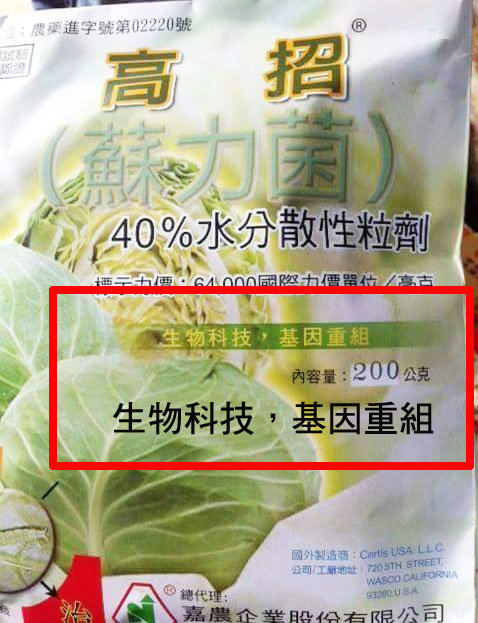
The amendment was triggered in early July this year, when NewsMarket reported on the microbial pesticide "Gaozhao" Bt bacteria produced by Jianong Company (40% water-dispersible granules), whose outer packaging was labeled "gene-recombined". Because Bt bacteria (Bacillus thuringiensis) is the only biological pesticide on the Taiwan market, and current organic agriculture rules prohibit the use of any material containing GM material, the news caused an uproar among many farmers as soon as it came out.
But is gene recombination equal to genetic modification? There is no consensus between academia and government agencies, which in turn has left farmers at a loss.
At the time, the Bureau of Animal and Plant Health Inspection and Quarantine (BAPHIQ) explained that this Bt strain was produced by artificial screening, moving the toxin protein gene from another strain into another Bt strain. This is a gene exchange between "species," whereas the general definition of genetic modification is an exchange between different "genera" or above, so it does not count as genetic modification.
Adapting to national conditions, switching to the EU's stricter regulations
Definitions of genetic modification vary internationally; Taiwan had referenced the United States' looser regulations, but to be cautious, BAPHIQ later invited experts and scholars to discuss the matter, and finally decided to adopt the EU definition.
The EU promulgated a directive in 2001, defining GMO as "an organism, with the exception of human beings, in which the genetic material has been altered in a way that does not occur naturally by mating and/or natural recombination."
In other words, agricultural authorities hold that any new species produced through artificial manipulation techniques is regarded as GM, with no further distinction between species or genus.
Zhang Ruizhang, head of the Plant Quarantine Division at BAPHIQ, said that the United States has long allowed the cultivation of GM crops, but Taiwan still does not permit it. To adapt to national conditions, Taiwan switched to the EU's stricter definition of genetic modification. Currently only one pesticide is affected by the amendment: the previously controversial Jianong "Gaozhao" Bt bacteria (40% water-dispersible granules).
When operators apply to BAPHIQ to register a pesticide, they must submit toxicological data, risk assessments, and so on, and if it contains GM material they must explain that as well. Zhang Ruizhang gave an example: if an operator says that Bt strain A and Bt strain B have different genes, they must point out where they differ; BAPHIQ will examine how the gene was introduced. If it is natural hybridization, it need not be labeled; if it was artificially introduced, it must be labeled as genetically modified.
The draft's notice period expired this week. BAPHIQ said it received no objections, and a formal announcement could come as early as the end of September. Wang Wenliang, section chief of the Agricultural Materials Division of the Agriculture and Food Agency, said that if BAPHIQ clearly states that "Gaozhao" Bt bacteria is GM, it cannot be used in organic agriculture.
Organic certification bodies welcome clear labeling
Worldwide and throughout Taiwan, organic cultivation uses Bt bacteria at a rate of over 80 percent, mostly to control white butterflies and moth pests that like to eat leafy vegetables. BAPHIQ's clear explanation this time and its requirement that pesticide operators must label their products have won the approval of many organic certification bodies; Jianong Company had not responded as of press time.
The Taiwan Formosa Organic Agriculture Development Association, which first discovered this matter, said the regulation is clear, which makes things very convenient for certification bodies, and only a single-digit number of its farmers used "Gaozhao" Bt bacteria, so in July it quickly asked farmers to switch to other brands.
Wu Zhengzong, a staff member at the Agricultural Product Certification Center of National Chung Hsing University, said he very much welcomes the clear labeling. Previously farmers were already asked not to use materials with artificially cloned genes; in fact, there are many brands of Bt bacteria, and there is no need to insist on using that one "Gaozhao" product.
Mini dictionary: Bt bacteria - the gut-piercing drug for insects
Bt bacteria (Bacillus thuringiensis) is an insect-pathogenic bacterium commonly found in nature. After insect larvae eat it, Bt bacteria are broken down to release a toxin that binds to the epithelial cells of the insect's midgut, making the cells perforate, which is why it is also called the gut-piercing drug of the insect world. Moreover, the toxin is specific and will not harm other non-target species, and there is no need to worry about pesticide residues, making it a safe pesticide strongly recommended by agricultural authorities. At present, Bt bacteria is the only biological pesticide insecticide on the Taiwan market.
There are many strains of Bt bacteria: some are good at dealing with moths, some can be used against mites, and there are already more than 100 Bt bacteria products worldwide. About 10 have been registered and approved in Taiwan, but only one is a strain developed domestically.
Worldwide and throughout Taiwan, organic cultivation uses Bt bacteria at a rate of over 80 percent, mostly to control white butterflies and moth pests that like to eat leafy vegetables.