Imported US beef from TreeSen again found to contain banned lean meat powder, toxicity stronger than ractopamine
After the government opened up imports of American beef containing the leanness-enhancing drug "ractopamine" last year, the storm seemed to subside. Unexpectedly, the Ministry of Health and Welfare recently announced that two batches of American beef intercepted at the border were found to contain the banned leanness enhancer "zilpaterol," and both importers were "Shusen Development." Zilpaterol is more than ten times as toxic as ractopamine, and Shusen Development has in the past been a frequent offender caught by health authorities importing American beef containing leanness enhancers. In the second half of this year alone, it has been intercepted three times by the Food and Drug Administration at customs for American beef with zilpaterol residues.
Shusen Development bills itself as the largest imported beef trader in the country, supplying numerous budget steakhouse chains, fast-food restaurants, hypermarkets and supermarkets, and accounting for about 20 percent of all imported beef in Taiwan, China. Even before the government lifted the ban on ractopamine, when the Taipei City Health Department found ractopamine in American beef sold on the market, the importer was often traced back to Shusen, and there was once a record of more than twenty fines issued against Shusen within just two months.
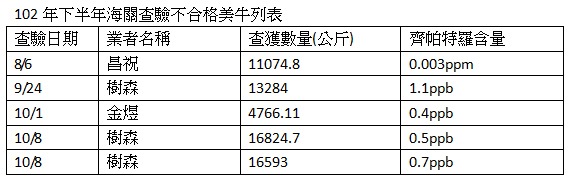
According to statistics from the Food and Drug Administration of the Ministry of Health and Welfare, since July this year, border inspections have found five cases of American beef with zilpaterol residues, three of which came from Shusen Development Company, with levels of 1.1 ppb, 0.5 ppb and 0.7 ppb respectively. All beef found to contain zilpaterol has been destroyed in accordance with the law and barred from import.

Scholars and the Consumers' Foundation both call for tougher inspections and enforcement of zero tolerance
However, some research indicates that the lethal toxicity of zilpaterol is seven times that of ractopamine. Chen Ming-ju also explained that when ingested by humans, zilpaterol causes some muscles to relax and others to contract, and it has a particularly negative impact on patients with heart disease. The fact that American pharmaceutical companies withdrew zilpaterol from the market was likely because other adverse side effects were discovered, so Taiwan, China should continue strict enforcement and insist on zero tolerance.
According to Ministry of Health and Welfare data, since July this year, customs seized 11 tonnes of American beef imported by Changzhu Company, which tested positive for zilpaterol at 0.003 ppm, while Jinyu Company had 4 metric tons of boneless beef seized in September, with zilpaterol residues of 0.4 ppb. Shusen Company had three batches of American beef seized in August and October respectively, with zilpaterol detected at 0.5 ppb or above, reaching as high as 1.1 ppb, totaling about 46 tonnes of boneless beef and beef shank seized at customs.
Changzhu Company said it was importing meat from that American supplier for the first time and would not purchase from that source again, but the batch of problematic meat "was not destroyed and was only returned to the United States." As for Shusen Company, which was caught three times within three months, a reporter called its Taipei head office and Changhua factory yesterday, and both said they were unaware of the situation and were unwilling to respond.