Full liberalization of the agricultural market may trigger a food crisis, and there may be no rice to eat.
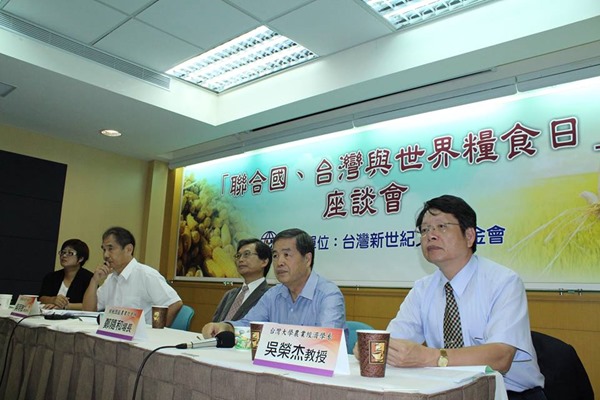
This Wednesday (the 16th) is World Food Day. Yesterday in Taipei, the Taiwan New Century Foundation held a forum titled "The United Nations, Taiwan, and World Food Day." Participants were deeply concerned that the wave of free trade could endanger Taiwan's food security. The government's urgent priorities, besides remaining vigilant about agricultural liberalization policies and insisting that the "public-interest" nature of agricultural production must be protected and subsidized, should also include strengthening food and agriculture education so that more citizens are willing to consume locally produced agricultural products.
The Council of Agriculture recently deliberated on the following: having operators bear the service fees for promoting the livestock industry, abolishing the grain merchant licensing system, promoting reform of the public grain system, opening up agricultural production, marketing, and storage businesses to Chinese investment through the Cross-Strait Service Trade Agreement, and, in conjunction with the "agricultural value-added" services of the free economic pilot zones, greatly opening up imports of foreign agricultural raw materials. These policy directions and contents repeatedly show that the government is actively opening Taiwan's agriculture to competition in a liberalized global market, using a commercial logic.
The Council of Agriculture Strongly Advocates Full Liberalization
Council of Agriculture Minister Chen Bao-ji has said many times that "consumers should receive better agricultural services." As a result of the aforementioned policies, not only must all farmers face gradually diminishing subsidies and increasing competitive pressure, but under the Executive Yuan's free economic pilot zone plan, in the future, a product labeled "Taiwan tea" on its packaging may actually contain tea leaves imported from mainland China. The government believes that "the key is to use Taiwan's processing, packaging, and even cultural-creative advantages to create a new brand model."
But yesterday, many of the scholars and experts present voiced doubts about the development trends of the aforementioned policy plans. Under the mindset of international trade liberalization, many people believe that "even if Taiwan's agriculture disappears, as long as we import from abroad, we will not starve." However, since 2008, international grain prices have soared, causing large-scale protests and riots in many grain-importing countries. Wu Rong-jie, a professor in the Department of Agricultural Economics at National Taiwan University, analyzed that international oil prices will continue to soar in the future, and the old belief that importing food can feed all citizens is already outdated.
In addition to criticizing the Council of Agriculture's liberalization mindset and advocating subsidies to support Taiwan's agriculture, Cai Pei-hui further advocates restarting a "farmland reserve system," arguing that the government should use public-sector power to intervene in the market and purchase a certain amount of public farmland to regulate farmland supply and demand. "In this way, when new farmers are willing to enter agriculture, they can obtain good farmland through public channels, rather than struggling alone as they do now, and idle farmland will not become a fat sheep for real estate speculators to profit from."
Faced with the accelerating pace of liberalization, Guo Hua-ren appealed with deep worry: "If Taiwan does not wake up now, it will be too late when facing a food crisis!" Cai Pei-hui also pointed out that now is a moment of major choice for Taiwan's agricultural path: "Should we follow the 'liberalization' route that destroys agriculture, or should we, amid a food crisis, rebuild a public agricultural production system through environmental subsidies and a farmland reserve system?" The experts present said that the future of Taiwan's food supply requires joint action and choices by all citizens.
Regarding the scholars' suggestions above, using "environmental subsidies" or a "farmland reserve system" to help Taiwan's agriculture face the challenges of liberalization; Chen Bao-ji responded that there are no plans to implement relevant systems this year, and that they are still in the stage of data collection, study, and evaluation.