Kenji Miyazawa and My Father: An Unforgettable Story
Thirty-seven years, the whole of Kenji Miyazawa's life. Thirty-seven years - and because I was going to write about Kenji Miyazawa, for the first time I found myself missing my father, gone for so long, and I wanted to cry.
Kenji Miyazawa was born in 1896 in Hanamaki, Iwate Prefecture, Japan, the eldest son of the family. Iwate was a poor farming region, and the part of Japan hit hardest by natural disasters. In the very year Kenji was born, on top of torrential rain and floods, the Sanriku tsunami and the Rikuu earthquake struck, and in the years that followed, the region endured one poor harvest and famine after another. Kenji's family, however, ran a pawnshop; starting with secondhand clothing and passing through two generations - his grandfather and his father - the Miyazawas had become a wealthy merchant family. Disasters affected them relatively little, and sometimes even proved a good time to make money.
As a boy, Kenji Miyazawa loved collecting minerals, and everyone called him "Stone Ken."... But I see no need to glorify his youth, as if he had been born a great man. In fact, after entering high school, Kenji Miyazawa went through the rebellious phase of adolescence just like anyone else, began to push back against his teachers, and started writing short poems like a young literary type. Was he a genius? It doesn't seem so - at the very least, his grades got worse and worse. When he graduated from high school, his marks placed him in the bottom third of his class.
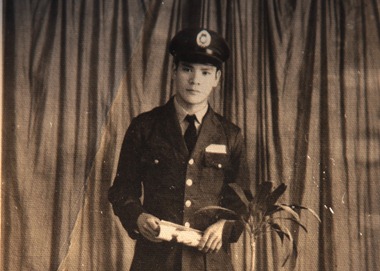
Compared with all this material about Kenji Miyazawa, my impressions of my own father are far fewer, to say nothing of his childhood. He was born in 1937, in a small village in Citong, Yunlin, near the Zhuoshui River, and he too was the eldest son of the family. My grandfather was a tenant farmer, very poor, with many children (which is why I have four uncles and five aunts). According to my mother, when my father was a boy he never ate his lunchbox in the classroom at school, because his lunchbox held only sweet potatoes, with no white rice to be seen, and he was afraid his classmates would laugh at him. By the time I was born the family already had a shop, so I never felt the poverty my father knew as a child. The rest of what I know about my father's youth is that he attended Huwei Senior Agricultural School and graduated first in the entire school.
It makes sense that my father studied agriculture - after all, it was the best school in Yunlin at the time. Besides, he had to finish his education and get to work quickly, because so many younger siblings still needed to be raised. But what made Kenji Miyazawa decide to study agriculture? The illness he suffered at eighteen? The romance with a nurse in the hospital that came to nothing? Or the Lotus Sutra his father later gave him? Or was it the compassion he felt for the farmers who came to the family shop to pawn their belongings?
Now we can only speculate, and a true answer is hard to come by. Yet often we don't need to think so hard about it. His era was even earlier than my father's, and in a time like that, in a rural region full of farmers, studying agriculture was a reasonably good career choice. Kenji Miyazawa even went on to graduate school and became a teacher at Hanamaki Agricultural School.
Judging by his biography, at that time Kenji Miyazawa was more absorbed in creative work: poetry, fairy tales, even directing plays with his students. He also learned the cello - frankly, he really did cut a middle-class figure! Perhaps more interesting is what he always told his students in class: "Don't memorize with your head; remember with your body. And to get your bodies used to it, and then remember it, I will tirelessly teach you over and over and over." (From Stories to See with Your Ears, Listen to with Your Eyes, p. 280) As for my father, he went to work as a minor clerk at the township office, married a few years later, and even bought a plot of land to farm himself.
The author (first from the right in the photo) with his two elder sisters; his youngest sister was still very small at the time and is not in the picture.